

Tow truck drivers rarely earn what a simple hourly calculation would suggest. A base rate sets the floor, but the size of the weekly check depends mostly on two things: how many calls dispatch sends your way and how many on-call hours you put in. A driver who runs twelve calls in a week and one who runs thirty can share the same base rate and still take home very different pay.
Many tow operators pay per completed job, or by an hourly rate tied to completed jobs, rather than a flat hourly wage. Some shops do pay straight hourly, and the comparison later in this article covers that model too. Either way, volume usually decides the week more than time on the clock.
On-call shifts add a second variable. Nights, weekends, and holidays create call opportunities that a daytime-only driver never sees, and some employers pay a standby stipend on top of the per-job rate.
This guide is for drivers comparing offers, fleet managers setting pay scales, and auto repair shops that depend on reliable towing partners. For the broader wage picture behind these numbers, see this breakdown of how much tow truck drivers make.
How Dispatch Volume Shapes Your Weekly Check
Your weekly pay tracks the number of runs you finish. Dispatch volume, the total number of dispatched calls you complete in a pay period, is the biggest single lever on earnings. When you are paid per call, a quiet board costs you money and a steady stream of assignments builds it back up.
The Math Behind Each Call Type
Calls do not pay the same, and the mix you handle changes the total. Heavy-duty tows bring the highest ticket because they need bigger rigs, more skill, and longer recovery windows. Light-duty tows sit in the middle. Quick roadside jobs such as jump-starts and lockouts pay less per call, but they clear fast enough to stack up over a shift.
Average Per-Call Payout
The table below lists typical per-call payouts for the assignments a dispatcher sends out. Treat these as baseline figures; actual rates shift by region and contract.
| Call Type | Average Payout |
|---|---|
| Heavy-Duty Tow | $165 |
| Light-Duty Tow | $95 |
| Roadside Assistance | $75 |
| Jump-Start | $55 |
| Lockout | $50 |
Typical payout per call, by tow call type.
Ten lockouts and ten heavy-duty tows are both ten dispatched calls, but they are not the same week. Understanding how tow truck pricing and call rates are structured helps you read a pay stub and negotiate from a stronger position.
Why Dispatch Priority Decides Your Runs
Dispatch priority decides who gets the high-value work first. Drivers with reliable response times, clean safety records, and the right equipment for heavy-duty recovery tend to sit near the top of the rotation. Priority compounds: better standing means more high-paying runs, and those runs keep you at the front of the queue. Raising dispatch volume and protecting your standing is the most direct way to lift a weekly total.
Volume also shows up in the averages. Here is what typical weekly pay looks like as the call count rises:
| Weekly Dispatch Volume (calls/week) | Average Weekly Pay (USD) |
|---|---|
| 0-20 | 620 |
| 21-40 | 880 |
| 41-60 | 1,170 |
| 61-80 | 1,480 |
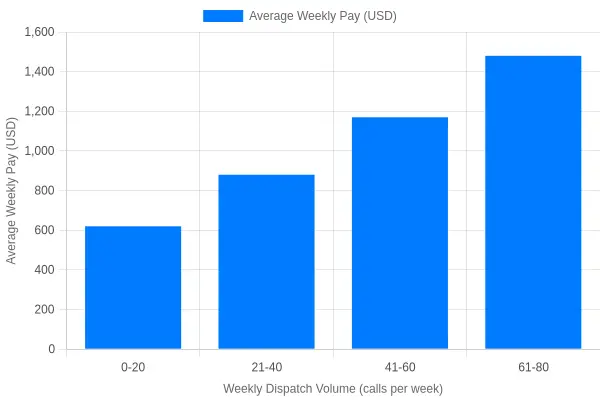
Average weekly tow truck driver pay rises steadily as weekly dispatch volume grows, climbing from roughly $620 at 0-20 calls to about $1,480 at 61-80 calls.
What On-Call Shifts Do to Your Weekly Check
An on-call shift is a scheduled block when a tow driver has to stay sober, rested, and within a short distance of the truck, ready to roll the moment dispatch calls. You may never hook a single car during that window, but you cannot take another job, run errands, or fully relax. That restriction is why on-call time lands on a paycheck differently from a normal shift.
How On-Call Pay Is Built
Most towing companies assemble on-call compensation from a few separate pieces:
| Pay Component | What It Covers | Typical Structure |
|---|---|---|
| Hourly standby pay | Time spent waiting, even with zero calls | Flat hourly rate, often below active-driving wage |
| Per-call premium | Each dispatched job you take | Flat bonus added on top of the tow fee |
| Shift differential | Unpopular hours worked | Percentage or dollar bump for nights, weekends, holidays |
What matters is the combination. A driver on a modest standby rate who catches four calls during a stormy weekend can out-earn a day-shift driver who ran back-to-back non-premium jobs.
When Call Volume Is Low
Standby pay protects the check when the board is quiet. On a slow overnight rotation you are paid for being available, and a dead night does not hurt the way a slow commissioned shift would. The trade-off is the ceiling. Companies that guarantee generous standby pay tend to cap or restrict call volume; shops that pay purely per call offer unlimited upside and no protection on a dead night. Neither model is better on its own. It comes down to how busy your market runs.
Why Nights, Weekends, and Holidays Pay More
Unpopular rotations carry shift differentials for a simple reason: they are harder to staff. Overnight, weekend, and holiday on-call blocks usually combine a higher standby rate with richer per-call premiums. A holiday rotation can be the most lucrative block on the schedule even if only a couple of calls come through.
On-call shifts pay for hours reserved, not just hours worked. Customer tips can also top up a light on-call week, which is why it helps to know the norms around tipping etiquette for tow truck drivers and whether you should tip a tow truck driver.
What Standby Pay Adds Up To
On-call shifts pay for availability as much as activity. Guaranteed standby pay smooths slow weeks and protects your baseline, while per-call premiums and shift differentials reward the chaos you actually handle. Track both the floor and the ceiling, and you can see why two drivers with the same tow count finish the week with very different checks.
Comparing Tow Truck Driver Pay Structures
Use the table below to compare how each compensation model works, who it suits, and how it tends to move a weekly paycheck, then dig into the full picture of how much tow truck drivers make.
| Pay Structure | How It Works | Best For | Typical Impact on Weekly Check |
|---|---|---|---|
| Hourly Wage | Drivers earn a fixed rate for every hour worked, no matter how many calls come in. | New drivers and slow markets where steady, predictable income matters most. | Keeps pay stable and easy to budget, but earnings rarely climb during busy weeks. |
| Commission per Call | Drivers are paid a set dollar amount for each tow or service call they complete. | High-volume dispatchers who want to reward hustle and individual output. | Swings sharply with dispatch volume, from thin slow weeks to record highs. |
| Percentage of Tow Revenue | Drivers take a cut, often 20-40%, of the total revenue each job brings in. | Experienced drivers handling long hauls and high-value heavy-duty tows. | Rewards premium jobs, so a few big tows can lift the entire week. |
| Base Salary Plus Commission | A guaranteed base pay is topped up with per-call or percentage bonuses. | Fleets balancing income security with genuine performance incentives. | Provides a reliable floor while still climbing on strong dispatch weeks. |
| On-Call Standby Pay | Drivers receive a lower flat rate for hours spent waiting on standby. | Night, weekend, and rotating-shift crews covering unpredictable demand. | Adds a small steady supplement that softens the sting of quiet on-call shifts. |
Combining Dispatch Volume and On-Call Shifts to Estimate Weekly Pay
Dispatch volume and on-call hours are the two biggest levers on a weekly check, and they pull in different directions. Volume is how many jobs you actually run; on-call hours are how long you stayed available in case the radio lit up. Broader towing economics explain why standby pay is often the tiebreaker between two drivers with similar workloads.
A driver with moderate call volume and heavy on-call hours can out-earn one with high volume and no standby pay, and the reverse happens just as easily. Standby shifts stack predictable pay on top of every hook, while pure-volume drivers are paid only when a call lands. One slow week can erase a volume advantage quickly.
How the Two Variables Interact
| Dispatch Volume | On-Call Hours | Typical Weekly Check Pattern |
|---|---|---|
| Low | Heavy | Steady, standby-driven |
| High | Light | Spiky, unpredictable |
| High | Heavy | Strongest overall |
| Low | Light | Weakest overall |
A Simple Step-by-Step Method
- Add up paid calls for the week.
- Multiply by your average revenue per call.
- Apply your commission or revenue share.
- Multiply on-call hours by your standby rate.
- Add base or guaranteed pay.
- Subtract fuel, fees, and deductions.
Expressed as a general formula:
Weekly Check = (Calls x Avg Revenue per Call x Your Share) + (On-Call Hours x Standby Rate) + Base Pay – Deductions
Run this each week to see which input moves your weekly check more, then negotiate shifts accordingly.
Weekly Pay Projection Across a Four-Week Cycle
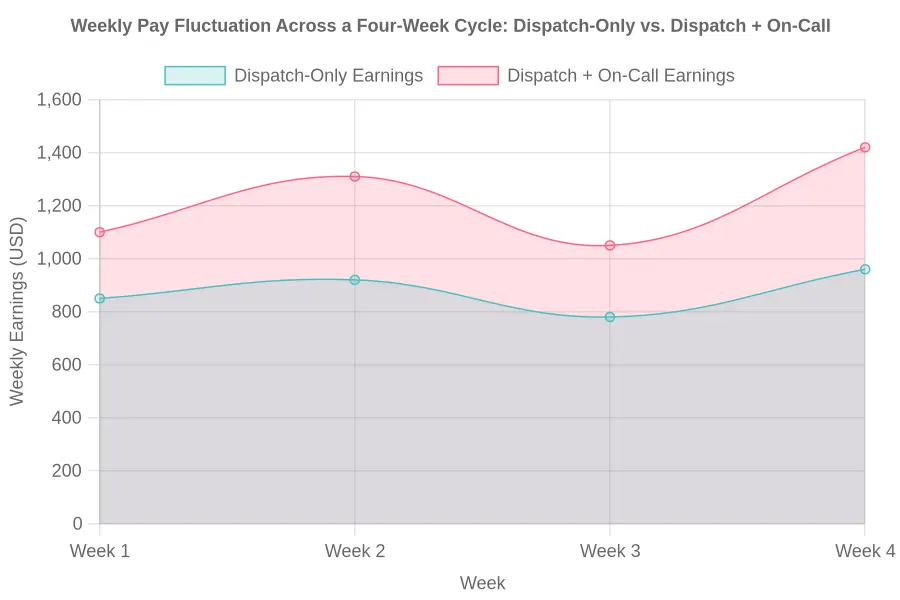
Projecting a driver’s weekly earnings over four weeks shows that adding on-call shifts lifts every week by roughly $220 to $460, widening the pay gap most in high-dispatch weeks.
Key Factors That Move a Tow Truck Driver’s Weekly Check
A weekly check rarely lands on the same number twice. Knowing what drives the swings is the first step to earning more predictably. Here is how much tow truck drivers make when the pieces line up.
- Dispatch volume is the single biggest lever, since every additional call you answer adds directly to your pay.
- On-call frequency decides how many after-hours, premium-rate jobs land on your schedule.
- Call type mix matters: a quick jump-start pays far less than a long-distance tow or a heavy-duty recovery.
- Regional demand sets the baseline, because densely populated metros generate more calls per square mile.
- Licensing and certifications open higher-paying work, from hazmat endorsements to specialized heavy-recovery credentials.
- Equipment decides which jobs you can accept, so a flatbed versus a rotator quietly changes your earning ceiling.
- Seasonal demand creates predictable spikes, with winter ice, summer road trips, and storm season all moving the needle.
Get several of these working in your favor and the weekly check stops feeling random.
The Dispatch-to-Pay Flow at a Glance
Every tow truck payday follows the same four steps: a call comes in, a driver accepts the job, the work gets completed, and the money lands in a check. That chain is the backbone of weekly earnings.
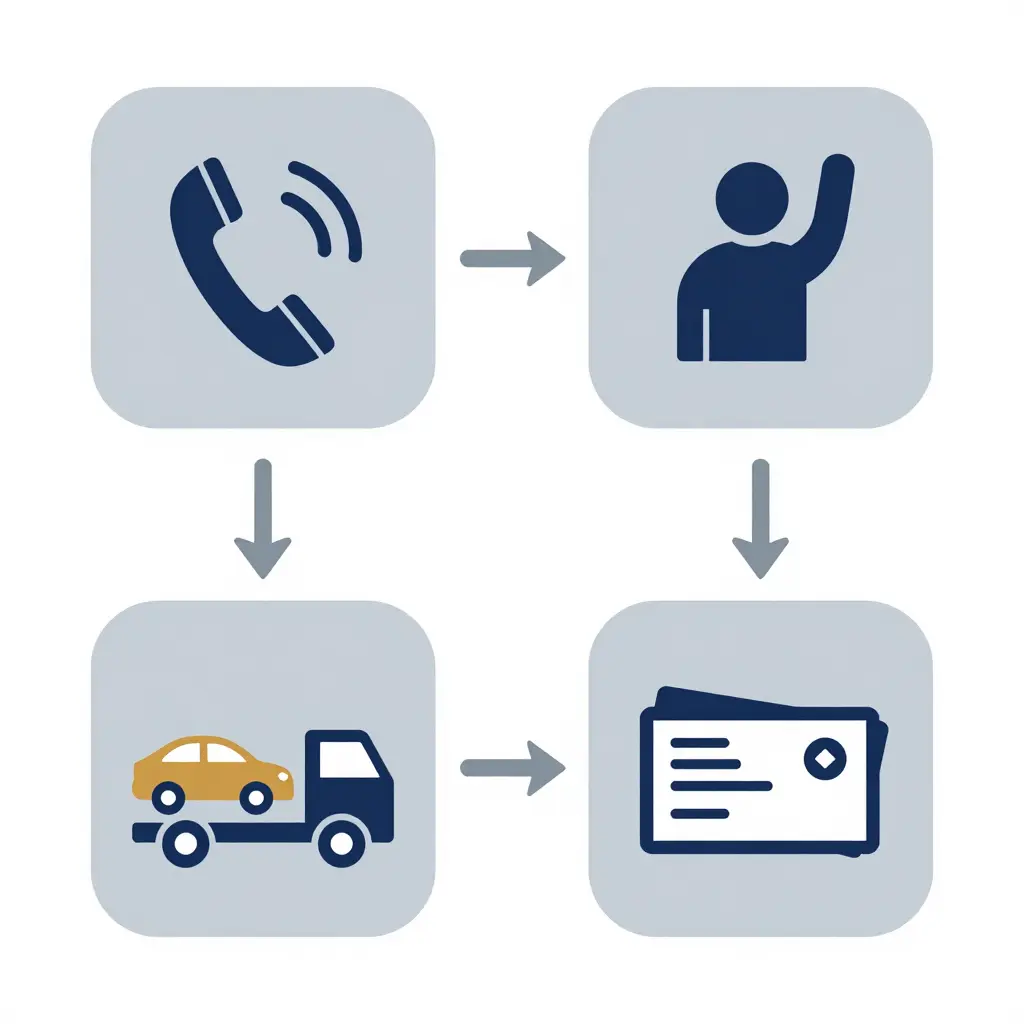
A simplified schematic of the dispatch-to-pay cycle, where each accepted job feeds directly into the payout that shows up on your weekly check.
Once the four stages are connected, it becomes obvious why dispatch volume and on-call shifts matter: more calls accepted means more completed jobs, and more completed jobs means a bigger check at the end of the week. Before optimizing your own flow, it helps to see how those numbers stack up against industry averages in this breakdown of how much tow truck drivers make.
Frequently Asked Questions About Tow Truck Driver Pay
Do on-call shifts pay even when no calls come in?
Often, yes, but usually at a reduced rate. Many employers pay on-call shifts at a standby rate below the full driving rate, sometimes as a flat stipend per shift, plus full pay once you respond to a call. If your shop offers zero standby pay, you are working for free during quiet hours, which is worth negotiating before you accept the role. Policies vary widely between independent operators and large fleets, so confirm how on-call time is compensated in writing.
How much does dispatch volume change a weekly check?
For drivers paid per call, dispatch volume is usually the biggest swing factor. A driver handling 8 to 10 calls a week may earn far less than one handling 30 or more, since each tow carries its own base fee, mileage, and sometimes a service charge. A slow week with high on-call time and few dispatches can shrink a check dramatically, while a busy week with several long-distance or after-hours calls can nearly double it. That is why it pays to track your own call counts against your pay rather than trusting a single “average” number.
Is commission or hourly pay better for tow truck drivers?
Neither model wins everywhere. It depends on your market, the type of tows you run, and how steady the work is. Commission pays off in high-volume or heavy-duty markets where calls are frequent and profitable, but it leaves you exposed during slow stretches. Hourly pay provides predictable tow truck driver pay and stability, especially for newer drivers who are still building skills and speed. Many operations blend the two, offering an hourly base plus a commission or per-call bonus to balance risk and reward. For a deeper look at typical earnings across experience levels and regions, see this breakdown of how much tow truck drivers make.
Do heavy-duty tows raise weekly pay?
Generally, yes. Heavy-duty tows carry higher rates, need specialized equipment, and often require longer on-scene time that is billed accordingly. A single heavy-duty recovery can pay several times what a light-duty jump or lockout brings in. Those calls also come with added complexity, certification requirements, and liability, so the higher pay reflects the greater skill and risk involved. Drivers trained and licensed for heavy-duty work tend to command both higher rates and more consistent demand.
How do fleet managers structure on-call rotation pay?
Most rotate on-call duties on a fixed schedule, such as one week on and two to three weeks off, so the burden is shared fairly across the team. During a rotation, drivers usually receive a standby stipend for holding availability plus their normal rate when they roll on a call. Some fleets pay a flat guaranteed minimum for the entire on-call period regardless of call volume, which protects drivers during dead hours. Clear written policies on standby rates, response windows, and rotation fairness head off most disputes and keep morale steady.
Are tow truck drivers paid for the time between calls?
It depends on the employer and on whether you are classified as hourly or commission. Many drivers receive a lower standby rate, or nothing at all, for idle time between calls. Time clocked in at the yard for maintenance, cleaning, or vehicle checks is normally paid at the standard rate. Idle time spent away from the shop while still available is where policies differ most, so ask up front. Knowing the distinction makes a pay stub easier to read week to week.
The Bottom Line on Dispatch Volume and On-Call Shifts
A driver’s weekly check rises with both higher dispatch volume and on-call coverage, and the two reinforce each other. More calls mean more paid work; on-call availability opens the after-hours and emergency jobs that daytime-only drivers never see. A driver who handles steady volume and also steps up for on-call shifts gets both effects, because the extra availability feeds directly into a larger share of high-demand jobs.
Throughout this guide, one point held: dispatch volume, not seniority alone, drives the busiest and best-paid schedules, so drivers who build reliable relationships with dispatchers tend to earn more. On-call coverage rewards flexibility, often with premium rates or incentives that lift base earnings. Together, these factors shape both tow truck driver pay and the size of each weekly check more than any single variable.
For those who want the full picture, this breakdown of how much tow truck drivers make puts the numbers in context. Drivers can use it to negotiate stronger schedules, fleet managers can use it to design fairer on-call rotations, and auto repair shops can use it to plan dispatch partnerships that keep vehicles and revenue moving.