
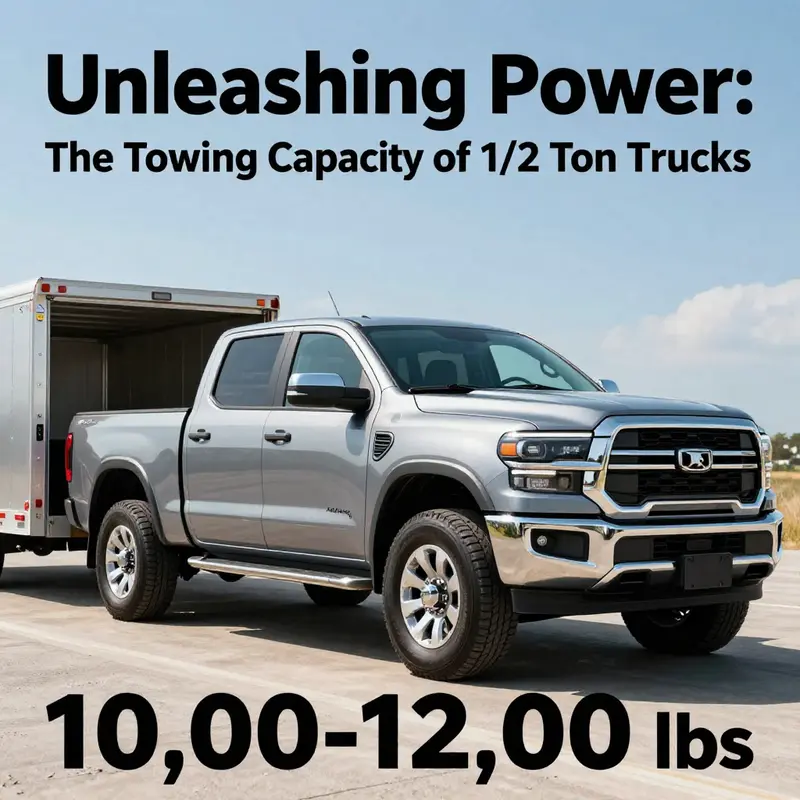
Understanding the towing capacity of a 1/2 ton truck is crucial for various users, from everyday drivers and commuters to property managers and dealership staff. With a towing capacity typically between 10,000 to 12,000 pounds, these trucks offer impressive versatility for hauling trailers, boats, or equipment. However, several factors influence this capacity, including truck specifications and payload. This comprehensive guide will explore the typical towing capacities, examine the elements that affect these ratings, analyze high-end models, outline the safety implications if capacities are exceeded, and review manufacturer specifications to help you make informed decisions.
null
null
Reading the Limits: How the Real Towing Power of a Half-Ton Truck Emerges from Its Factors
Towing capacity is not a single fixed line; it is a system rating that emerges from the truck, the trailer, the load, and the way you drive. The published figure is a ceiling under controlled conditions, and real-world results depend on a constellation of factors.
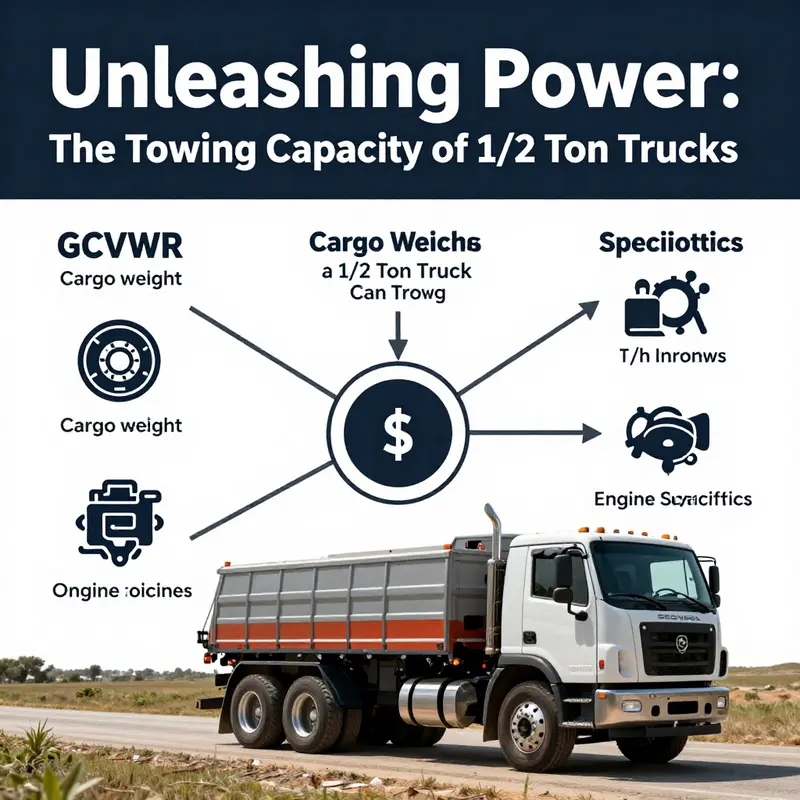
At the heart is GCWR—the gross combined weight rating—which caps the total weight of the truck, payload, and trailer. It, along with GVWR and payload, defines the safe envelope. You must consider the weight inside the cab and bed, not just what sits behind the hitch, because a heavy interior load reduces headroom for a trailer.
Power and driveability matter: torque is what gets you moving and climbing, not just horsepower. A towing-focused automatic with proper gearing and cooling helps keep the engine in its sweet spot. The axle ratio also matters: higher numerical ratios boost pulling power off the line but raise engine speed at highway speeds, trading economy for capability.
Drivetrain and terrain influence handling and control but do not magically increase the limit. RWD, AWD, or 4WD change traction and stability; upgraded suspension, brakes, and trailer-sway controls improve safety but cannot compensate for overload or poor load distribution.
Tongue weight— the share of trailer weight on the hitch—should be around 10 to 15 percent. Too light invites sway; too heavy stresses the hitch and front suspension. A weight-distribution hitch can help steer some tongue load to the truck axles but must be properly configured.
Aftermarket and factory tow packages can widen the safe envelope, but only when integrated correctly with the truck’s design. Inaccurate or mismatched upgrades can cause overheating, handling quirks, or unpredictable behavior.
Environmental conditions—altitude, heat, wind, and road grade—also trim the real capacity. The same trailer can feel heavier on a hot day or at elevation, or on a gusty crosswind.
The practical takeaway is simple: treat the published towing figure as a ceiling for your exact build. Start with the manufacturer’s numbers, weigh the rig (truck plus occupants plus trailer), and verify the total stays within safe margins. If in doubt, consult the owner’s manual or a qualified technician.
Breaking the Half-Ton Barrier: How Much Can a Modern 1/2-Ton Tow?
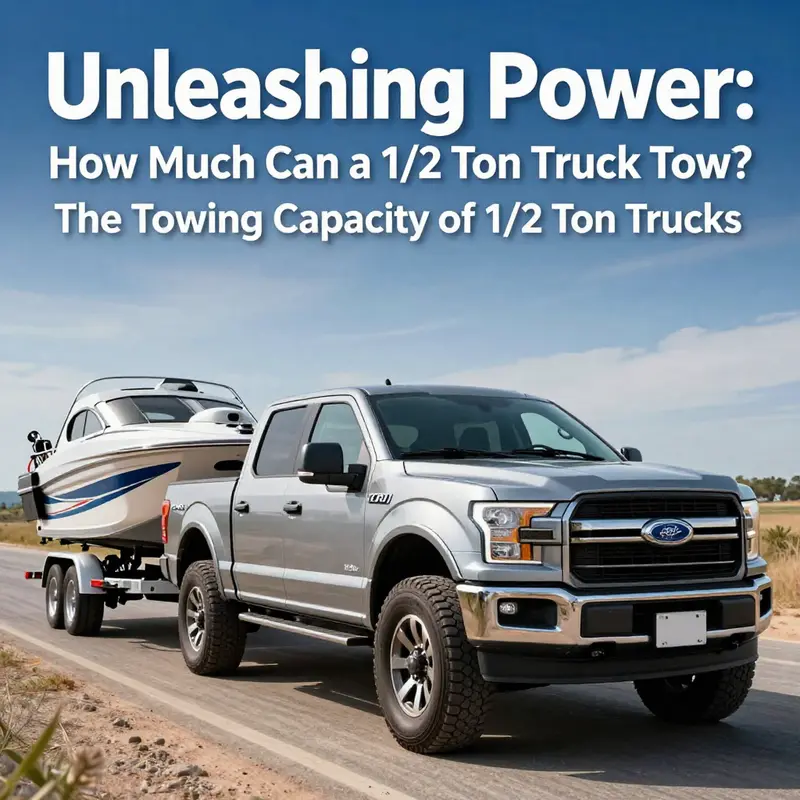
The term half-ton is a relic of payload ratings from decades past, but today’s half-ton pickups have matured into serious workhorses. They carry more payload, ride better, and tow more than their ancestors, thanks to stronger frames, more robust suspensions, and advanced powertrains. Yet the value of a rating is not a guarantee; it represents how much a specific configuration can pull under controlled conditions. For someone planning a weekend haul of a trailer or a heavy equipment trailer, the figure you see on a window sticker is a ceiling, not a target to chase in the real world. The overall message is that high-end half-ton models are capable of substantial towing, but the exact number is a function of setup, configuration, and how you use the vehicle.
When you look at towing numbers, the first thing to understand is the difference between the gross vehicle weight rating, the payload, and the gross combined weight rating. The GCVWR signals the maximum allowable weight of the truck plus the trailer and its load. The truck has a curb weight and a payload rating—the maximum payload it can carry, including passengers and cargo inside the cab and bed. The actual towing capacity is calculated by subtracting the weight of the truck itself and its loaded payload from the GCVWR. In practice, that means two identical trucks with different loads can present very different towing capabilities. A lightly loaded crew cab with a smaller bed can reach toward the higher end of the range, while a truck packed with people, gear, and a heavy hitch will expend much of the available headroom before you ever drop a trailer tongue onto the hitch.
Among the broad landscape of these vehicles, high-end configurations stand out for their ability to move heavier trailers with greater confidence. The most capable iterations in this segment can push toward the upper teens in pounds, though achieving that threshold requires the right combination of engine output, transmission behavior, axle gearing, and a factory towing package tuned for serious pulling. In simple terms, a modern half-ton equipped for maximum tow tends to combine a strong torque delivery with a stable, reinforced drivetrain and a hitch system designed to distribute weight across the rear axle and trailer. The practical implication is clear: if you want to tow at the top end of the spectrum, you must also pair the truck with a trailer that matches the truck’s capabilities and a braking system that can handle the load, especially on hills or long descents.
In real-world practice, the typical towing range for most well-equipped half-ton pickups sits around ten thousand to twelve thousand pounds. That range reflects a prudent balance between capability, safety, and the frequencies customers actually tow around daily. It allows for common items like large utility trailers, mid-size campers, and sizable car or equipment trailers. But within that broader band, the premium or high-end trims that feature upgraded powerplants and advanced towing packages can exceed the mid-point, reaching into the fourteen-thousand-to-sixteen-thousand-pound territory when the configuration is optimal. Think of these as the apex of half-ton capability, contingent on a precise set of choices: a strong engine or hybrid-assisted powertrain designed to deliver high torque at low and mid-range RPMs, a robust transmission with appropriate gearing and cooling, a chassis that resists trailer sway, and an axle ratio that complements the engine’s torque curve for towing efficiency rather than merely top speed.
To illustrate the point, imagine a large, high-output powertrain paired with a stout transmission and a properly matched towing package. In such a setup, the published maximum could reach around fourteen thousand pounds or more, provided the trailer has a weight distribution designed to transfer weight to the rear axle smoothly and not overwhelm the vehicle’s payload. In another scenario, where the same large trailer is loaded heavily and the truck carries extra passengers or heavy gear, the usable tow capacity can slump by several thousand pounds. The opposite is also true: reducing payload, choosing a configuration with a higher axle ratio tailored for towing, and using a stable hitch can help approach the upper limits. These factors underscore why the exact number a consumer sees on a spec sheet often differs from the real-world number they notice when hooking up a trailer, checking tongue weight, and testing braking performance on hills and curves.
Because the truest limit comes from the manufacturer’s official specification, it is essential to interpret the rating within the context of the specific vehicle configuration. The “maximum towing capacity” pertains to the best-case scenario—not to routine operations where the truck is fully loaded with passengers, cargo, and fuel, and the trailer has a heavy load. It is also worth noting that a high-end half-ton’s towing prowess does not negate the importance of proper towing technique. The trailer hitch, weight distribution system, and trailer brakes are not optional accessories; they are integral to maintaining control, reducing sway, and preserving braking performance as you descend grades or navigate windy stretches. The very idea of towing safely hinges on matching the trailer to the vehicle, ensuring the trailer’s mass is within the distribution capabilities of the hitch setup, and maintaining correct tire pressure and brake function.
For readers seeking a pragmatic sense of the landscape, consider that the maximum figures cited in the high-end category generally sit in a band from roughly fourteen thousand to around sixteen thousand pounds, but only when all the components align: the engine’s torque output, the transmission’s ability to sustain effort, the axle ratio, and the presence of the factory towing package. The same family of vehicles will present a different face if you choose a shorter cab or longer bed, or if you opt for a different wheel and tire package that alters the vehicle’s rolling mass and aerodynamic profile. In short, the number you notice on a dealer sticker is a ceiling for a perfectly paired setup, not a guarantee under every load condition.
If you are planning a specific haul, the best next step is to estimate actual payload and compare it to the trailer’s weight and attributes. Start with the truck’s curb weight and the measured payload capacity—these values reflect the weight that remains for passengers, cargo, and the hitch before the GCVWR ceiling becomes a constraint. Then consider the trailer’s gross weight and tongue weight. Tongue weight should be approximately ten to fifteen percent of the trailer’s gross weight for a well-balanced coupling. Too little tongue weight can cause trailer sway; too much can affect steering and braking. The interplay of these numbers guides whether your next load is within safe, comfortable reach or whether you should look at a heavier-duty platform or a lighter trailer. If you want a concrete reference point for your own vehicle without hunting through pages of manual measurements, you can explore practical resources that discuss how much your truck can tow, like this one: how much can my truck tow.
In all cases, adhere to the manufacturer’s stated ratings for your exact model year and trim. The same truck can display different towing capacities across years and configurations as new engine options, transmissions, and suspension tweaks enter production. The reason behind this is straightforward: to meet consumer demands for stronger capability while balancing weight, fuel economy, and safety features, engineers recalibrate power, cooling, and chassis stiffness. As a result, the high-end end of the spectrum tends to be defined not only by a raw number but by the quality of the supporting systems that make that number usable in the field. With careful selection of engine, drivetrain, and towing package, these trucks can deliver substantial pulling power without compromising ride comfort or handling under normal driving conditions.
The practical implication for a buyer is clear. If the aim is to move heavy loads regularly, you will benefit from focusing on configurations that explicitly support heavier tow ratings, and you will recognize that the limits are not merely about horsepower at the crank but about the harmony of the entire vehicle and the trailer. That means paying attention to axle ratios that favor torque delivery, choosing a transfer of weight that improves stability, and installing the right hitch and braking components. It also means acknowledging that some high-end versions will still be designed with off-road capability, interior luxury, and payload in mind, which can slightly temper straight-line tow performance. In other words, the most capable towing configuration is one that aligns with the intended use, takes into account the trailer’s weight and dynamics, and remains within the safety margins established by the manufacturer.
As we move through the discussion of how much a 1/2-ton truck can tow, it becomes evident that there is a spectrum rather than a single number. The half-ton label may be old-school, but the capability it implies has evolved into a practical, real-world proposition. A modern half-ton with the right equipment can really haul substantial loads, but the exact ceiling is dependent on a careful combination of power, chassis design, and proper trailer coupling. The bottom line is that the most accurate answer to the question of how much a 1/2 ton truck can tow lies in the details of the particular configuration you select and the way you plan to use it. And that is a conversation that almost always begins with a careful read of the official specifications and a candid assessment of how you will load the vehicle before you hitch up.
External reference: https://www.ford.com
null
null
Beyond the Label: Reading the Real Towing Power of a 1/2-Ton Pickup
Ask most people how much a 1/2-ton pickup can tow, and they expect a single magic number. The truth is more nuanced. Towing power is a spectrum shaped by the truck’s frame, engine torque, transmission, drivetrain, and the often-optional towing gear that accompanies modern pickups. The same model line can feel dramatically different depending on how it’s equipped. In practice, a properly configured half-ton can haul significant loads, but the actual limit is not a fixed ceiling nailed to the bumper. It’s a rating that considers the whole vehicle system—how much weight you’re pulling, how much payload you’re carrying, and how you manage the trailer’s behavior on the road.
To understand the math, it helps to start with the Gross Combined Vehicle Weight Rating, or GCVWR. This single figure, published by the manufacturer, represents the maximum allowed combined weight of the vehicle, the trailer, and all the payload in the truck. It is not merely the weight of the trailer or the weight of the truck in isolation. Instead, it’s a ceiling that binds every component: the curb weight of the truck, the weight of passengers and cargo in the cab, the weight of the hitch and any attached equipment, and the weight of the loaded trailer. If you fill the cab with people and gear, you’ve eaten into the towing capacity you can safely apply to the trailer. The practical takeaway is simple: towing numbers are real, but they are not universal. They shift as the truck’s own weight budget shifts.
Across the market, you’ll hear figures like 10,000 to 12,000 pounds as a typical towing range for modern half-tons with the right heavy-duty towing package. Those numbers reflect a baseline that assumes a relatively moderate payload, a balanced axle setup, and a trailer within reasonable length and braking capability. Some configurations push beyond 12,000 pounds, especially when the truck has a robust engine, a favorable axle ratio, and an integrated towing package that includes stronger cooling, a dedicated trailer brake controller, and transmission coolers. And then there are the outliers, the high-end setups where the same category can tip past 13,000 pounds. None of these figures should be assumed without checking the exact specification for the specific truck, cab configuration, bed length, and package. Without the precise package and configuration, those numbers aren’t guarantees; they’re targets to aim for with caution and preparation.
A useful, concrete illustration of how much a typical half-ton can pull shows the critical role of towing hardware. One widely cited scenario demonstrates a substantial uplift when a weight-distribution hitch is employed. With the correct hitch and setup, a capable half-ton may approach or even reach roughly 14,000 pounds. If the hitch isn’t used, or if the vehicle uses a lighter towing setup, the limit can drop dramatically—perhaps to around 5,000 pounds. That discrepancy isn’t a quirk; it’s a reminder that the towing package and hitch choice change the effective road-ready payload you can pull. The distinction between these two extremes underscores a central theme: the equipment you attach to the truck can either unlock a higher ceiling or constrain you to a far more modest pull.
Beyond the single example, other configurations in the same class deliver substantial capacity as well. In broadly described terms, some half-ton families with a strong engine and the right towing setup can manage on the order of 13,000 pounds or a bit more, while others settle in closer to 12,000 pounds with a different engine, axle ratio, or bed/cab combination. These figures reflect not only the raw engine torque but also the relationship between the powertrain and the vehicle’s structural limits. The engine’s torque curve matters, but so do the transmission’s ability to handle that torque, the cooling system’s capacity to sustain it on long pulls, and the chassis’ stability under heavy loads. In the same breath, the payload rating matters as well, for every pound of people or gear you carry in the cab reduces the amount you can legally tow. The interplay of these factors—torque, cooling, axle ratio, payload, and towing package—defines the practical towing power more than any single spec alone.
When planning to tow, drivers frequently forget that the trailer itself imposes constraints that ripple back to the tow vehicle. Trailer length, braking system, and sway control all affect the number you see on the sticker inside the glove box. A longer trailer requires more tongue weight management, and a trailer with robust brakes eases the burden on the tow vehicle’s braking system. If you’re pulling a long, heavy trailer without trailer brakes, you’re effectively increasing the load the tow vehicle must decelerate and control through curves and downgrades. Conversely, a shorter trailer with efficient brakes can feel lighter than its official rated weight because braking and stability margins are more forgiving. The bottom line remains the same: the safe towing number isn’t only about what the truck can pull; it’s about how well the entire towing system behaves under real-world conditions.
For readers who want to connect these principles to real-world planning, a practical step is to identify not just the top-line towing figure but the specific configuration that drives it. Cab style, bed length, axle ratio, and the presence or absence of a towing package all tilt the scales. A crew cab with a long bed and a rear-end gearing optimized for towing will present a higher practical capacity than a different arrangement with the same basic engine. Likewise, the inclusion of a trailer brake controller, upgraded cooling, and a four-wheel-drive drivetrain can alter the dynamic load path through the tow vehicle. Because the numbers hinge on the entire configuration, the best approach is to consult the owner’s manual or the manufacturer’s official specification for the exact model and setup you intend to use. Only then can you translate a published rating into a confident, safe, and lawful towing plan.
For those who want a broader, more practical sense of how these numbers play out on the road, there is a helpful resource that walks through the calculation and considerations behind a truck’s towing capability. It lays out a framework for evaluating your own vehicle’s potential, including the impact of payload, hitch type, and trailer load distribution. See how-much-can-my-truck-tow for a grounded discussion that connects the math to everyday towing decisions. This kind of resource helps translate textbook ratings into usable, field-ready guidance, avoiding the trap of chasing an artificial ceiling without understanding what it takes to reach it.
Of course, the most authoritative numbers come from the manufacturer, and they can vary with cab configuration, bed length, axle ratio, and the exact towing package selected. When in doubt, confirm the specification in the official documentation for your exact truck model and build. The safe towing range is not a fixed number that applies to every truck of the same general type; it is a precise specification tied to the vehicle’s actual build and equipment. Keeping that in mind protects both the vehicle and the people on the road. It also preserves the trailer’s safety, as improper towing can lead to sway, overheating, or loss of control that endangers occupants and others on the highway.
For readers who want to verify official figures from the manufacturers, consult the manufacturer’s towing capacity page for the particular model and configuration you intend to use. As a point of reference, the broader landscape of half-ton towing capacity includes the idea that a properly equipped model can reach into the 13,000–14,000-pound range in some setups, while other configurations might be safely limited to around 10,000–12,000 pounds. Always align your trailer choice, hitch setup, and cargo with the vehicle’s documented limits. And remember: exceeding those limits is not just a matter of risk to the drivetrain; it also compromises braking, steering response, and overall stability. The interplay of all these elements defines the practical towing power of a 1/2-ton pickup far more than a single touted figure.
For more general guidance on how to approach these numbers in practice, the official towing capacity page of the truck’s manufacturer is a reliable starting point. It provides model-specific data that accounts for the exact combination of cab style, bed length, engine, and towing package. As you prepare for a trailer pull, bring the numbers into harmony with your real-world plan: know the trailer’s weight, verify the hitch setup, assess the payload you’re carrying, and confirm that the combined weight remains within the published GCVWR. In this way, the iconic label of “half-ton” becomes a useful shorthand for a carefully engineered, safe, and capable towing system rather than a vague promise of power. For a thorough grounding in how to translate all of this into practical guidance, refer to the linked resource and keep the manufacturer’s specifications close at hand when you hit the road.
External resource: For the most official and model-specific numbers, consult the manufacturer’s towing capacity page here: https://www.ford.com/trucks/f-150/towing-capacity/
Final thoughts
In conclusion, understanding how much a 1/2 ton truck can tow is essential for maximizing its utility while ensuring safety. With typical capacities ranging from 10,000 to 12,000 pounds, and considerations like vehicle weight and specific configurations, owners and operators must be diligent in adhering to manufacturers’ specifications. This knowledge not only helps in making informed choices but also significantly impacts safety on the road. Properly equipped high-end models can achieve even greater limits, reflecting the advancements in truck technology. By staying informed, users can efficiently and safely harness the impressive capabilities of 1/2 ton trucks.