
Tow operations sit at a unique intersection of mobility, risk, and commercial responsibility. For Everyday Drivers, Residents & Commuters, and fleet owners alike, understanding how much tow truck insurance costs per month is essential to budgeting, compliance, and a safe operations baseline. Across the United States, average premiums typically land in the range of roughly $300 to $600 per month, but the actual number for any given operation depends on a blend of factors: the type and value of the tow equipment, the coverage levels chosen, the driver experience on the road, and the local risk environment. This article pulls the lens back to core cost ranges, then expands to how location, fleet size, and exposure change those numbers, followed by how premium components like liability limits and driver history shape the final quote, and finally how to obtain personalized quotes and negotiate policies that fit your needs. Each chapter builds on the central question: how much is tow truck insurance per month, and what practical steps can you take to manage and optimize that cost. Understanding these elements helps you align coverage with actual risk, avoid overpaying, and stay protected on every tow.
Tow Truck Insurance by the Month: Reading Core Cost Ranges, Hidden Drivers, and What That Means for Your Fleet
Tow truck operators approach insurance not as a single line item but as a map of risk that changes with every mile driven and every job attempted. The monthly premium, then, is less a fixed fee and more a reflection of how a business stacks up on a wide field of exposures. For anyone who runs or plans to run a towing operation, understanding where the cost comes from is essential. It is the difference between budgeting with confidence and staring at a number that seems to appear from nowhere. The average cost, across the United States, sits in a broad band because the policy is built from a chorus of variables. Base premiums might be in the hundreds per month, but they can climb quickly when the business touches high-risk environments or high-value equipment. The practical takeaway is simple: you pay for the risk you present, and that risk is rarely uniform from one operator to the next. A closer look at the factors reveals how a single operator in a quiet corner might pay a fraction of what a fleet in a dense urban market would face. For a closer look at the cost picture, see the discussion at tow-truck-costs-pricing.
The broad range that many readers encounter—often quoted as roughly two hundred to five hundred dollars per month in some sources, with others reporting three hundred to six hundred—highlights not a single universal price but a spectrum shaped by policy choices and risk realities. The base level of coverage typically includes liability, physical damage, towing and storage, non-owned auto liability, and garage keepers liability. Each of these coverages adds a layer of protection but also a line item on the premium bill. When insurers quote, they evaluate how much protection a business needs and how likely it is to require it. A policy that mirrors a modest operation with a clean driving history will be appreciably cheaper than a program built for a multi-vehicle fleet with a history of claims in a busy market. The numbers can be surprising, but they make sense once you map out the risk geography and the operational profile that sits behind them.
Vehicle type and size are among the most visible levers. Heavy-duty wreckers, with their larger engines, heavier frames, and higher towing capacities, pose greater exposure to both liability and physical damage claims. The premium responds in kind: more robust equipment comes with higher potential for extensive damage in an accident or a collision at a roadside scene, and that risk is priced accordingly. Conversely, lighter salvage or light-duty tow trucks tend to carry lower premiums, all else equal. The fleet mix matters, too. A single truck that operates mostly in rural stretches may incur far lower premiums than a fleet bouncing through urban corridors, where traffic density, average speeds, and the potential for multi-vehicle incidents rise. The location of operations is not just a matter of driving routes; it informs the insurer about the local claims landscape, the legal environment, and the typical severity of losses in that area. Urban centers often carry higher premiums because the frequency and cost of claims tend to be greater, even when the risk profile of a single driver looks strong on paper. For operators who plan to diversify routes or expand into new regions, the price tag follows the map they draw.
Driver experience and driving history are equally potent determinants. A driver with a clean record and a long track record in towing operations is seen as a lower risk, and that translates into a lower monthly rate. In contrast, an operator or contractor with recent violations, accidents, or disciplinary issues faced by drivers will trigger higher premiums. Insurers assess not only the driver’s past but the company’s overall safety culture. Do they run regular training sessions? Do they fit the trucks with safety features and telematics that can demonstrate cautious operation? All of these factors swing the premium. A few incidents in the recent past do not automatically shutter an opportunity to insure a tow operation, but they will push up costs and require mitigations that prove to the insurer that risk is being controlled. The value of a robust driver training program and a well-documented safety history cannot be overstated in premium calculations.
Coverage levels and deductibles are the most deliberate ways to shape the monthly price. Higher liability limits or the addition of comprehensive coverage beyond basic protections will raise the cost. If a policy includes higher caps on bodily injury or property damage, the insurer prices that extended protection into the premium. Conversely, choosing a higher deductible can lower the monthly charge. The deductible acts as a first-line filter for smaller incidents, and when a business can reasonably shoulder that outlay, insurers reward the risk reduction with a lower premium. Operators should weigh deductible levels against cash flow and risk tolerance. A lower deductible increases the monthly premium but reduces the out-of-pocket cost during a claim, while a higher deductible reduces the premium but raises the financial consequence if something goes wrong. The right balance depends on the company’s liquidity, risk appetite, and likelihood of frequent small claims versus rare large losses.
Business operations and equipment beyond the truck itself shape another critical portion of the price tag. The scope of a tow operation—whether it provides roadside assistance, recovery services, or operates a salvage facility—changes the risk profile. A business that stores vehicles on-site, handles heavy equipment, or transports higher-value assets may require additional coverages like garage keepers liability or tools and equipment coverage. The value of the specialized equipment carried on board also influences premiums. High-value gear and tools become expensive if damaged or stolen and thus push premiums upward. The insurer’s math accounts for both the probability and the cost of replacement, so fleets with sophisticated gear, multiple units, or specialized service offerings should anticipate higher monthly payments.
A claims history that follows a business from one policy to the next is one of the strongest indicators insurers use to project future costs. Frequent or large claims signal higher risk, and the premium adjusts accordingly. The impact is not merely punitive; it reflects the insurer’s expectation of ongoing risk. At the same time, a clean slate with minimal claims and proactive loss prevention measures can yield meaningful price relief over time. This is where risk management investments pay off. Operators who implement formal incident reporting, routine maintenance, driver coaching, and accident response protocols create a track record that helps justify lower rates as the business grows. The price for insurance, in other words, often mirrors the quality of the risk management program as much as the raw number on the policy screen.
For those contemplating a new entry into towing or expanding a current operation, the practical approach is to translate these factors into a single, coherent budget line. Start with the base costs that reflect the vehicle mix and operating environment. Then layer in the protection level you truly need, mindful of the deductible you can tolerate and the cash flow you can sustain. Don’t underestimate the role of business operations: if you are expanding to include more units or more services, expect a corresponding rebalancing of premiums. The process of obtaining quotes is not a one-and-done event; it is a dialogue about risk, strategy, and resiliency. Insurers will want to know how you manage risks day to day, what training you provide, and how you monitor the performance of your fleet. Preparing a clear risk profile, backed by data, can help secure more favorable terms and provide the foundation for a more predictable month-to-month expense.
The arc of cost is not a fixed slope but a landscape that shifts with policy design and operational choices. As you weigh higher protections against cost savings, consider how much protection you truly need for the scenarios you actually encounter. A roadside emergency, a multi-vehicle incident on a city street, or a loss from theft of equipment at a remote location each carries a different weight in the premium calculation. A thoughtful approach to coverage can keep monthly costs aligned with realistic risk and ensure the business has the protective layer it requires without overpaying for protections it will rarely use.
As you plan and quote, remember that the numbers you see aren’t just about the policy. They are also about the risk posture you project to customers, lenders, and partners. A well-insured operation, with solid driver training and proactive safety practices, communicates stability. That stability can, in turn, unlock access to better terms, faster claims handling, and a smoother path to growth. For readers seeking a deeper dive into the structural aspects of the rate components, the National Association of Mutual Insurance Companies offers a comprehensive guide that outlines the key exposures and the way insurers think about them. This external resource can illuminate how a policy translates to practical protection and cost in real-world scenarios. https://www.namic.org/insurance-education/tow-truck-insurance-guide/
In sum, tow truck insurance costs per month sit at the intersection of vehicle attributes, location dynamics, driver history, policy design, and organizational discipline. The range you see reflects a spectrum of risk and risk management maturity rather than a single universal price. When you engage with insurers, come with a clear map of your fleet, a documented safety program, and a plan for how you would respond to incidents. Be ready to discuss deductibles, coverage limits, and the financial safeguards you have in place to handle claims. The more you can demonstrate control over risk, the more you will be able to shape the monthly price in your favor. For many operators, this thoughtful calibration yields a margin of financial predictability that can be as valuable as the protection itself.
To close, the essential insight is that tow truck insurance is not a static line item. It is a dynamic reflection of how a business manages risk across people, trucks, jobs, and environments. By understanding the core cost drivers and actively managing them, operators can align monthly premiums with their actual exposure and build a resilient operation that can weather the inevitable bumps in the road.
Chapter 2: The true range of tow truck insurance monthly costs—variability by location, fleet size, and risk exposure
Tow truck insurance is not a single number you can pin down with a single calculator. It behaves like a spectrum, bending with the landscape of where you operate, how many trucks you run, and the kind of risks your crew faces every shift. As a result, the monthly premium for tow truck insurance can swing widely. A careful read of the recent industry data shows a core pattern: premiums cluster around a midrange, but the edges can be surprisingly sharp. That is not a flaw in the market; it is a reflection of the way risk compounds when you move from a lone operator in a quiet county to a multi-truck fleet in a dense metro area, or when your work straddles roadside assistance, heavy-duty recoveries, and remote or hazardous scenes. Understanding why these differences arise is essential for anyone trying to forecast costs, plan budgets, or design a program that protects both people and equipment without draining cash flow.
Location plays a starring role in the insurance equation. The everyday reality is that the risk exposure attached to a tow operation shifts with the traffic mix, crime rates, and how quickly body shop mechanics and parts are available to repair damaged gear. In major urban centers—cities with tangled traffic, high incident rates, and frequent vandalism—the monthly premiums for tow truck operations tend to run higher. Numbers observed in practice show ranges where premiums can land from roughly four hundred to eight hundred dollars per month, and in some cases higher, depending on the exact neighborhood, the type of towing service provided, and the age or value of the equipment. In contrast, operators in rural or low-risk states report lower ranges, with many operators paying closer to two hundred to four hundred dollars a month. The logic is straightforward: the more eyes on the road, the more time a vehicle spends in heavy traffic or on busy highways, the greater the exposure to incidents, theft, and costly property damage. The degree of state regulation also matters. States that mandate higher liability limits or require more comprehensive coverage for specialty work effectively lift baseline costs for many operators. Even the same truck and the same driver can cost more to insure simply because state law requires more robust protection. The overall takeaway is not that urban operators pay a premium for the same work; it is that the risk environment around that work elevates the price of risk transfer.
Beyond geography, fleet size enters the scene as a powerful dampener or amplifier of costs. A single operator running a lone tow truck faces a different calculus than a shop with five or ten vehicles. Larger fleets benefit from economies of scale—the cost per vehicle for insurance can go down when the policy covers multiple units under a single umbrella. The total premium, however, climbs in absolute dollars as more units join the fleet, so the combined outlay can still be substantial even if the per-vehicle price declines. This is especially true in high-risk zones or when the fleet includes a mix of heavy-duty wreckers, light-duty roadside assist units, and specialized recovery vehicles. The interplay between fleet size and risk is why some operators see a per-vehicle premium that seems modest at first glance, only to realize the yearly cost balloons as the number of active units grows. When fleets expand, insurers increasingly focus on how the operation is managed—driver training programs, maintenance schedules, and dispatch practices—because those elements significantly influence the overall risk picture.
Insurance costs also respond to how risk itself is managed on the ground. The very factors an operator can influence—driver experience, vehicle upkeep, safety protocols, and the overall quality of dispatch and incident reporting—translate directly into premium adjustments. The risk exposure factors cover a broad landscape: driver behavior and qualifications, the condition of the tow fleet, and the environments in which work happens. Experienced drivers with clean records reduce the likelihood of accidents and injuries, and well-maintained vehicles reduce the chance of breakdowns that force costly roadside interventions. Operational environments—highway scenes, construction zones, night operations, or adverse weather—each bring different levels of hazard, speed, and complexity. Heavy-duty towing or recovery work from challenging terrains can strain equipment and increase the potential for incidents, all of which drive up premiums. Liability exposure remains a constant headline risk; when a tow operation involves third-party property damage or personal injury, the costs can escalate quickly, even if the tow itself was not the principal cause of the incident. Theft and vandalism of equipment also factor in, particularly for parked units in remote or poorly lit areas. Regulatory compliance, licensing, and proper underwriting practices all play their part, and a claims history marked by multiple losses or subrogation challenges can push premiums higher for years. In such a system, the most effective moves to control costs often involve a mix of better driver screening, ongoing safety training, consistent maintenance, stronger incident reporting, and a robust risk management program that demonstrates a proactive approach to reducing exposure.
A more granular view of the premium bands helps illuminate why the cost picture looks the way it does in practice. For a typical solo operator with a single truck, basic liability and physical damage coverage is commonly priced in a band around four hundred to six hundred dollars per month. This band reflects coverage that protects against third-party liability and the costs of damage to the tow truck itself, with modest deductibles and standard limits. When operators add more protection—such as coverage for bobtail operation when not actively towing or non-owned auto liability, alongside garage liability for shop premises—the monthly cost rises into the range of seven hundred fifty to eleven hundred dollars. These numbers are not universal, but they illustrate how incremental additions to coverage quickly multiply the monthly outlay. For fleets, the pricing structure commonly shifts toward per-truck pricing that can range from six hundred to nine hundred dollars per truck per month, with volume discounts applying in some circumstances. For particularly high-risk operators—those with alarming claims histories, high mileage in risky zones, or specialized work that demands extra safety measures—the monthly premium can climb to one thousand two hundred dollars or more per truck, and in the worst cases into the two-thousand-dollar territory. Those figures reflect not only the higher liability and physical damage coverage required for riskier operations but also the premium adjustments that accompany increased likelihood of subrogation and the cost of specialized equipment or hazardous material handling.
Because pricing is so sensitive to the exact combination of location, fleet structure, and risk controls, the most reliable approach to budgeting remains obtaining multiple quotes and evaluating them side by side. A prudent plan is to seek quotes from insurers who specialize in commercial auto insurance for towing operations and to compare not only prices but the scope of coverage, deductibles, liability limits, and any value-added protections such as garage operations coverage, non-owned vehicle protection, and coverage during non-tow periods. When comparing quotes, it is crucial to look beyond the monthly premium. The true cost of ownership includes the deductible you would pay in a claim, the limits that apply to protection against large losses, and whether the policy provides coverage for equipment stored at a shop or during non-tow duties. In the push and pull of budget planning, operators often find it beneficial to weigh the value of safer equipment and stronger safety programs against incremental premium savings from switching carriers or reducing coverage. This is where risk mitigation becomes a cost-control tool. Investing in driver training, preventive maintenance, restocking safety supplies, and implementing rigorous dispatch and incident reporting protocols can yield meaningful premium reductions over time, as insurers recognize the reduced exposure and improved reliability of the fleet.
For an instant sense of how these dynamics translate into real-world pricing, consider a few illustrative ranges observed in practice. A single tow truck with basic liability and physical damage coverage may cost roughly four hundred to six hundred dollars per month. If the operator needs broader coverage that includes bobtail and non-owned auto liability, the monthly premium commonly rises to seven hundred fifty to eleven hundred dollars. When a small fleet of five trucks is in play, the collective premium per truck per month often falls into the six hundred to nine hundred-dollar neighborhood, assuming a legacy of safety training and a reasonable claims history. Large fleets, with a mix of heavy-duty and roadside assistance units, can command even more favorable per-vehicle pricing, but the total monthly outlay rises with the number of active units. Conversely, operators who face significant risk indicators—poor driving records, high-mileage operations in dense urban corridors, or work in hazardous environments—may see per-truck monthly premiums that exceed a thousand dollars, with total fleet costs climbing quickly. The practical message is clear: the price of risk transferred through insurance scales with how much risk you carry and how effectively you demonstrate your plan to manage and mitigate that risk.
To ground these considerations in a practical decision point, remember that even with clear regional trends, the actual premium you pay is a function of your specific business profile. The best way to approach pricing is to build a four-part picture: where you operate, how many trucks you run, how your operation manages risk, and how coverage is structured. A realistic quote will weigh the geographic exposure, the nature of the towing tasks performed, the age and value of the tow equipment, and the drivers’ experience and training records. It is also worth noting that the existence of a formal risk management framework can operate like a discount lever in the hands of insurers. Demonstrating routine safety checks, maintenance schedules, driver coaching, and incident reporting can translate into tangible premium relief over time, reducing the daily and monthly burden on cash flow.
In discussing these dynamics, it is helpful to provide a frame of reference that emphasizes the practical choices a business must make when budgeting for insurance. If you are an independent operator, your path may center on selecting a base level of liability and physical damage coverage with reasonable deductibles while ensuring you can still cover the occasional repair or replacement without derailing monthly finances. If you run a small fleet, you will likely pursue tiered coverage options that balance the protection you need with the efficiency of a shared policy, while also focusing on driver screening and maintenance programs to nudge premiums downward. For larger fleets, the calculus shifts toward optimizing coverage across multiple units, leveraging fleet-wide risk management, and seeking carriers who can tailor terms to the complexity of operations—heavy-duty recoveries, complex scenes, and a broad geographic footprint. Throughout, a steady emphasis on safety, training, and disciplined maintenance remains your most reliable strategy for shaping both the rate of claims and the premium you ultimately pay.
For readers seeking further context that ties these trends to regionally specific expectations, the broader literature on commercial auto pricing emphasizes the same pattern: location and operating profile create the most significant variations, while the scale of the fleet and the quality of risk management practices can produce meaningful differences in the final monthly outlay. When markets shift—whether due to evolving accident trends, changes in regulatory requirements, or new safety standards—the premium bands can move accordingly. The practical takeaway for operators is to approach insurance as an active cost-management discipline, not a static line item. Regularly revisiting coverage, reviewing safety performance, and coordinating with a broker who understands towing operations can yield ongoing value. It helps to keep in mind that the goal is not simply to minimize the premium but to secure protection that aligns with the actual risk exposure you carry, thereby reducing the chance of a costly false economy when a claim occurs.
For those who want to anchor these ideas with an external benchmark, broader regulatory and market data from official channels offers independent guidance on state-by-state trends and regional pricing dynamics. See the authoritative resources on regional pricing and underwriting practices to inform your planning and negotiations with insurers over time: https://www.naic.org. Additionally, a practical, user-friendly estimate of current market rates can be found through general industry analyses and broker platforms that specialize in commercial auto coverage for towing operations, which provide real-time or near-real-time premium estimates as you adjust coverage levels and risk controls. When you combine these external benchmarks with a careful internal audit of your fleet, equipment, and driver performance, you build a robust picture of where your monthly insurance spend should land and how to steer it toward sustainable, protected growth.
As you map your budgeting strategy, keep in mind the value of referring back to simple, grounded figures for quick planning. A conservative perspective on a single truck in a lower-risk area might place monthly costs in the neighborhood of three hundred to six hundred dollars depending on the exact coverage mix and deductibles. A more comprehensive program covering multiple trucks, non-owned vehicle exposure, and garage liability could push the monthly outlay toward the upper end of the spectrum, with the potential to exceed one thousand dollars per truck in higher-risk markets. For operators who want to connect these numbers to reality, there is a straightforward route: request quotes from multiple insurers who focus on commercial auto insurance for towing operations, compare not just price but the scope of coverage, and use the data to shape a risk-informed, financially sensible strategy. And for those seeking a grounding reference in practical terms, a quick exploration of a simple, illustrative example—such as the cost framework for a single-tow operation, a modest fleet, or a high-mileage, high-risk scenario—can illuminate the path toward a balanced program that protects both people and assets while keeping monthly premiums aligned with actual risk exposure. If you want a quick, real-world sanity check on truck costs themselves, you can explore a concise explainer here: How much is a tow truck?.
In closing, the monthly cost of tow truck insurance hinges on a constellation of factors centered on where you work, how many units you manage, and how proactively you manage risk. The ranges discussed here—roughly two hundred to four hundred dollars for the lowest exposure in rural settings, up to eight hundred dollars or more in dense urban environments for basic coverage, and higher figures for broader or riskier coverage—provide a practical frame for budgeting and planning. The presence and quality of safety programs, driver qualifications, vehicle maintenance, and operational discipline can meaningfully influence where a given business lands within that spectrum. For operators seeking to anchor this understanding with regulatory and market context, turning to official data sources and industry benchmarks will help ensure that pricing decisions stay aligned with the evolving risk landscape. And, as always, a tailored quote from a specialist insurer, one that takes into account the specifics of your fleet, your jurisdiction, and your risk management practices, remains the most reliable way to transform these general ranges into an actionable financial plan.
Reading the Monthly Toll: Interpreting Tow Truck Insurance Premiums Through Liability, Coverage, and Driver History
The question of what tow truck insurance costs per month is less a fixed price and more a spectrum shaped by risk, coverage choices, and the practical realities of operating in a world where every tow can pivot on a single moment. When you ask how much a tow truck insurance policy costs in a given month, you’re really asking how the insurer translates risk into a premium, and how your specific operation—its trucks, drivers, routes, and safety practices—will push that translation up or down the scale. The commonly cited range—roughly $300 to $600 per month for an individual operator in many parts of the United States—gives a basic sense of the ballpark. Yet that band masks a wide spread of realities. A lone operator working in a quiet rural corridor with a clean driving record may sit near the lower edge of that band, while a small to mid-size fleet serving dense urban corridors with fluctuating demand and more high-risk on-hook and loading scenarios could easily move into higher ranges. And fleets with multiple trucks, higher utilization, or less experienced drivers can push monthly costs well beyond the midpoint. The premiums are not random numbers; they are the product of a structured underwriting view that peels back layer after layer of exposure, loss history, and operational choice to arrive at a price that reflects anticipated risk and the insurer’s desired margin for uncertainty.
To understand the premium, start with what drives liability exposure and the coverage envelope around it. Liability coverage limits are the backbone of any commercial auto policy because they define the potential payout in a claim. Tow operations carry a heightened perception of risk due to road exposure, high-traffic environments, and the likelihood of property damage or bodily injury when a vehicle manipulates heavy gear on busy streets or near customers’ sites. In practice, many operators select liability limits in the realm of one to two million dollars, a choice that aligns with typical fleet risk profiles, state requirements, and the economic realities of potential claims. As limits rise, the premium tends to rise in lockstep because the insurer’s exposure—the maximum it could owe in a covered incident—grows. It’s a straightforward relationship: more protection equals more premium. Yet the math is nuanced, because higher limits can be paired with higher deductibles or paired with other adjustments that offset some of the cost. The crucial point for a buyer is to balance the likelihood and magnitude of a worst-case outcome against the cost of preventing or mitigating smaller, more frequent losses.
But liability limits are only part of the story. The total outlay in a month reflects the broader coverage you choose. Beyond liability, most tow operators consider comprehensive and collision (the physical damage coverages), as well as more specialized protections like on-hook/load coverage or garage-keepers coverage. Each of these adds a layer of protection for different risk scenarios: comprehensive protects against non-collision perils like fire or theft of the equipment; collision covers damage from road incidents; on-hook/load coverage guards the operator against damage while towing a vehicle; garage-keepers covers property damage to third-party vehicles kept in custody at the operator’s facility. The more expansive the coverages—and the more comprehensive the deductible structure—the higher the monthly premium. The trade-off is straightforward but meaningful: broader protection lowers the residual risk and your exposure in a claim, but it does so at a cost that becomes visible every month on the renewal notice.
The kind of equipment you run also matters. Tow trucks differ markedly in size, weight, and capability. A light-duty wrecker used for roadside calls operates in a different risk envelope than a heavy-duty, 5-ton to 8-ton wrecker that hoists the kind of heavy vehicles you might encounter on highway incidents or complex recoveries. Heavier, more capable equipment carries greater potential for damage if something goes wrong, whether during loading, transport, or offloading. That elevated risk translates into higher premiums, all else equal. Fleet operators often balance the equipment mix against their service model and insurance needs. If a fleet leans toward smaller, lower-risk units, the per-vehicle premium may be lower; if it runs a mixed or high-capacity fleet, the aggregate risk grows, and the pricing reflects that.
Driver history and the operator’s broader risk profile close the circle of factors. Clean driving records, few or no past claims, and demonstrable investment in safety training and risk management tend to produce more favorable premiums. Underwriters evaluate not just raw driving history but also the presence of formal safety programs, ongoing instructor-led training, and the use of telematics or incident response protocols. A fleet that documents robust driver onboarding, regular safety refreshers, and active risk-mitigation strategies sends a signal to insurers: this operation understands and controls risk, which can translate into lower premiums. Conversely, a history of accidents, traffic violations, or repeated claims elevates perceived risk and pushes rates higher. It’s the insurance equivalent of showing up to a job with good habits already in place: the risk is lower, so the price is lower.
Fleet size and scale of operations introduce another layer. A single truck with a modest daily workload will typically incur different exposure patterns than a fleet of several vehicles performing a high volume of tows in busy urban lanes. The coverage strategy for a larger fleet often moves toward a combined or fleet policy that spreads risk across multiple units. Fleet pricing can provide some economies of scale, but it also requires the insurer to model aggregate exposure—how many tows, how many drivers, how many incidents—across the entire operation. The result is a premium that is highly customized to the fleet’s utilization patterns, safety record, and loss history, rather than a simple per-vehicle figure. This customization is why two operators with similar-looking equipment can face markedly different monthly premiums when their utilization, driver quality, or loss histories diverge.
Geography and regulation add a final layer of texture. Insurance markets price risk with a geographic lens. Urban centers, high-traffic corridors, and states with stringent regulatory environments can produce different underwriting results than rural routes. Points of exposure—such as night operations, proximity to schools or hospitals, or areas prone to severe weather—factor into the premium. The cost of insurance is not abstract; it reflects the likelihood and severity of potential events in the operator’s operating footprint. The same fleet in two different regions might see a premium divergence that seems disproportionate at first glance, but it aligns with underlying risk dynamics and claim trends observed by underwriters across similar operations.
The calculus would not be complete without recognizing the role of deductibles and other pricing levers. Higher deductibles reduce the insurer’s potential payout on smaller claims, which tends to lower the premium. This is a common mechanism for operators who are confident in their risk-control environment and are willing to shoulder a bit more out-of-pocket when a claim occurs. Bundling policies—combining commercial auto with general liability, workers’ comp, or other lines—can yield discounts, as insurers appreciate consolidated risk management and a long-term relationship with a single carrier. Discounts may also come from safety investments, such as telematics, incident-response protocols, and proactive driver training programs. In practice, the premium you see is the result of a negotiation between these levers and the market’s current appetite for risk.
Putting this into a concrete interpretive framework helps a business owner translate a monthly premium into actionable budgeting. A practical starting point is to map your risk profile: document the driving histories of your operators, the track record of incidents, and the specific safety programs you have in place. This risk map then informs the dialogue with insurers about the appropriate liability limits and coverage levels. When you receive quotes, request a clear breakdown that shows per-vehicle costs versus fleet-wide pricing, and explore scenarios that illustrate how modest adjustments—raising deductibles, adjusting liability limits, or expanding or trimming coverages—shift the monthly total. This exercise is not merely a cost exercise; it is a risk-management exercise that makes the future cost of risk more predictable.
A critical, practical step is to examine how the structure of your fleet affects pricing. A small operator may find better value with an individual vehicle policy, particularly if the fleet is not heavily utilized. A larger operation, facing high utilization and diverse risk exposure, often benefits from a fleet policy that aggregates risk and rewards scale, but only if the underwriting model accurately captures the fleet’s safety metrics and loss history. This is where benchmarking becomes essential. Market data and trend reports from reputable industry sources help place your quotes in context, making it easier to identify whether a quote aligns with typical ranges for your region and operation. While you will not find a universal answer to the monthly cost, you can anchor your expectations and negotiate more effectively by understanding how liability limits, coverage breadth, deductibles, and driver safety programs interact.
To tie the thoughts together, think of monthly tow-truck insurance premiums as a synthesis of exposure: liability risk, asset value, and the operational discipline you bring to the job. Higher liability limits and broader coverages raise the price, but they also reduce the risk of a ruinous payout in a real incident. A disciplined fleet with strong safety programs and a track record of low claims can enjoy premium relief through favorable underwriting. Location, fleet size, and vehicle type shape the risk profile in ways that are often invisible at first glance but become evident under the underwriting lens. The monthly toll you pay is not just a number; it is a reflection of how you manage risk every day—on the road, at the shop, and in every tow you perform.
As you plan next steps, keep a few guiding principles in mind. First, start with your risk profile and desired protection level, then build your coverage around that profile. Second, be deliberate about deductibles and policy structure; small changes here can meaningfully alter monthly costs. Third, consider whether a fleet policy makes sense given your scale, and ensure you are comparing apples to apples when evaluating per-vehicle quotes versus fleet quotes. Fourth, don’t overlook the value of risk-management investments, from driver training to telematics and post-incident review processes; these are not just safety initiatives but potential levers for premium reduction over time. Finally, use credible benchmarks and industry insights to calibrate expectations and avoid surprises when renewal comes around.
For readers seeking to situate these considerations within a broader industry context, a useful external reference is a comprehensive overview of tow-truck insurance trends and risk assessment methodologies published by a leading insurance information resource. This source offers deeper dives into how risk exposures, pricing models, and coverage choices interact to shape premium outcomes. It complements the practical guidance here with a larger market perspective, helping operators understand why premiums fluctuate with market conditions and how to position themselves for more favorable terms over time. External resource: https://www.iii.org/article/tow-truck-insurance-what-you-need-to-know
If you’re evaluating or budgeting for tow-truck operations, gather multiple quotes that break out per-vehicle versus fleet rates, and request scenarios showing how changes in liability limits, coverage levels, deductibles, and driver safety investments would affect monthly premiums. Review safety and risk-management programs you can implement to potentially improve risk metrics and reduce premiums over time. Check current market data and authoritative analyses to understand prevailing ranges and underwriting practices for your region and operation. A practical, perennial reminder: insurance is a hedge against the unexpected, but it is also a lever you can pull to reduce risk across your entire operation when used with discipline and foresight. And while the numbers matter, the story you tell with your risk management practices—driver training, incident response, and continuous improvement—often matters just as much in shaping the premiums you will face year after year.
To explore a practical example of how these factors translate into numbers, imagine a small to mid-sized tow company operating a moderate fleet in a suburban market. The owner has a mix of light- and medium-duty wreckers, a clean driver roster with documented training, and a policy framework that includes telematics and a formal safety program. Liability limits sit at $1.5 million, comprehensive and collision are in play with deductible levels arranged to balance cost and protection, and there is some bundled coverage with general liability. The operator’s claims history is favorable, but not entirely blemish-free, and the fleet uses a fleet policy rather than per-vehicle policies. In this scenario, monthly premiums might land in the mid-range of the general band, with a margin that reflects the liability protection and the breadth of coverage chosen, moderated by the strength of the risk-controls in place. Swap in a few variables—higher limits, a higher-risk urban route, or a handful of prior incidents—and the premium could climb toward the higher end, illustrating how sensitive the total is to risk configuration.
The bottom line is that monthly tow-truck insurance costs hinge on a blend of explicit policy choices and implicit risk signals. By understanding the core drivers—liability limits, coverage breadth, vehicle type, driver history, fleet scale, geography, and risk-management practices—you can approach quotes with clarity and purpose. This clarity reduces the risk of over- or under-insuring your operation and helps ensure that the protection you purchase aligns with the real-world risks you face. And as you prepare to compare quotes, remember the value of a well-documented risk profile and a thoughtful, data-informed approach to selecting coverage. The price you pay each month is the cost of a safer operation—an investment that, when managed well, can pay dividends in lower claims, steadier service, and a more predictable financial future for your tow business. For more practical guidance and examples you can adapt to your own operation, see the detailed content on our tow-truck cost resources via the linked page above.
Tow Truck Insurance by the Month: Reading Quotes, Weighing Risk, and Negotiating Coverage
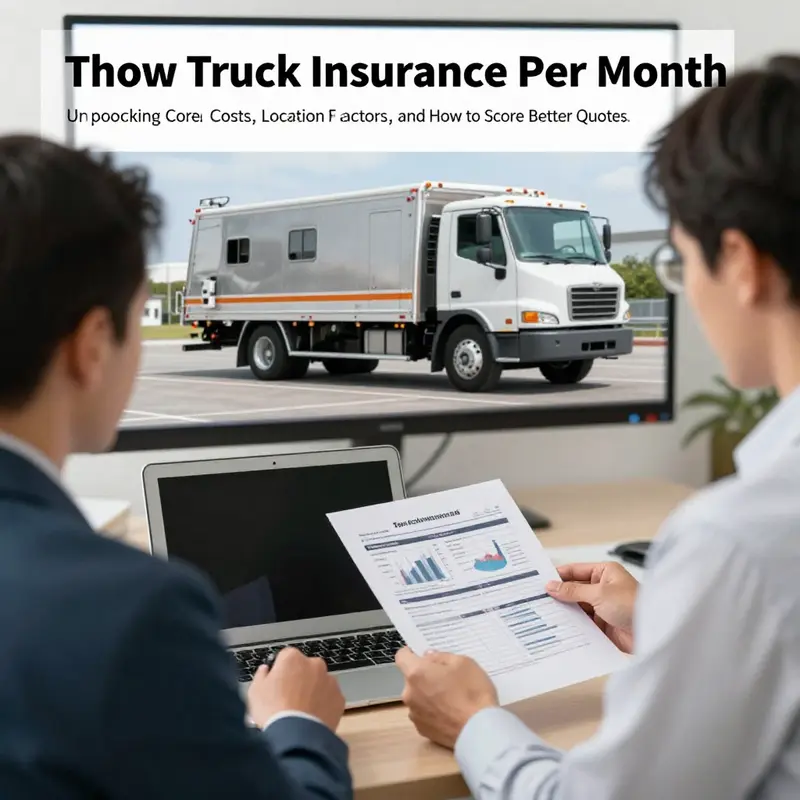
Insurance costs for tow trucks are rarely a single number you memorize. They arrive as a monthly figure shaped by risk, coverage choices, and operational reality. In many respects, the price of protection mirrors the work itself: a combination of exposure, vigilance, and the ability to demonstrate responsible management. In this chapter we’ll trace how monthly premiums form, what drives the gaps between quotes, and how a thoughtful buyer can negotiate policies that fit both risk and budget. The aim isn’t merely to find the lowest price; it’s to secure coverage that keeps a business resilient when the road throws its worst at you. And yes, it helps to know where the numbers come from and how to read them before you sign anything. As you plan, you’ll encounter a spectrum of monthly costs, from the tighter end of a few hundred dollars for a lone operator in a quiet market to the higher bands that fleets in busy urban centers with older drivers can face. The broader market paints a more nuanced picture: in many cases, the average premium for tow truck insurance in the United States sits in a range that becomes more expansive as the vehicle size grows and as risk exposure widens. A simple way to frame this is to recognize that a single, light-duty operator in a relatively low-risk area may approach a monthly expense closer to three hundred dollars, while a business that runs several trucks, spans multiple shifts, and operates in high-traffic corridors can see monthly premiums climbing toward or beyond six hundred dollars. These general markers reflect the interplay of location, vehicle type, and the coverage mix you select, rather than a one-size-fits-all price tag. For more granular context, consider the macro view that industry data sources offer, which often present a broader band of potential costs depending on the wheelbase of the equipment, the type of tow operation performed, and the specific risk profile of the business. The numbers aren’t random; they correspond to actual exposures on the road and in the yard, to the cost of repairing or replacing heavy equipment, and to the likelihood of claims under different policy constructs. The practical upshot is clear: any tow-truck operator evaluating monthly premiums should begin with a candid assessment of the operation’s scale, the typical towing scenarios faced, and the driver mix that powers daily activity. The more accurately the insurer can quantify exposure, the more precise the quote will be, and the more meaningful the negotiation can become. It is this ongoing calibration—between claimed need and realized risk—that underpins a sustainable premium. For a broader sense of how these numbers translate into your business, it helps to know that the costs can swing substantially based on the specifics of the operation. A small operator in a safer area with a clean driving record might observe costs hovering around the lower end of the spectrum, while a company managing multiple heavy-duty units, especially 5-ton to 8-ton winches used in road-wrecker assignments, tends toward higher premiums. The higher end reflects not only the value of the equipment but also the increased potential cost of accidents, on-road damage, and the complexity of liability arrangements. These dynamics aren’t mere abstractions. They shape the way a business should approach the process of acquiring insurance. Rather than passively accepting a quoted figure, you can engage in a disciplined comparison across providers, with an eye toward the specific risk profile of your fleet and the operational realities you face. When you look at the landscape of quotes, remember that the monthly premium is just one piece of the puzzle. The policy’s coverage limits, deductibles, exclusions, and added protections materially affect the true cost of risk transfer. Liability limits, physical damage coverages, underinsured/uninsured motorist protections, hired and non-owned auto coverage, and cargo or equipment in tow can swing the monthly price as much as the base rate itself. It’s also essential to consider the role of deductibles. A higher deductible reduces the monthly premium, but it increases out-of-pocket costs when a claim occurs. Conversely, a lower deductible raises the monthly cost but can make an open claim less painful financially. The balance you strike depends on cash flow, risk tolerance, and how regularly your operation encounters incidents that might trigger a claim. If you want a practical foothold in this terrain, it helps to imagine the cost structure as layered. The base premium reflects the insurer’s estimate of present and future risk. Add-ons—such as higher liability limits, equipment breakdown coverage for the tow truck itself, roadside assistance add-ons, or coverage for towing a third-party vehicle—multiply the cost in structured ways. The more layers you add, the closer you approach the full risk footprint your business carries. A simple way to approach this layering is to view it as a portfolio of protections rather than a single policy. The portfolio should align with the operational profile: the types of calls you handle, the regions you serve, and the hours you keep. For instance, if a fleet routinely handles urban deployments with tighter response windows, you may face greater exposure to accidents, theft, and on-the-job damage to equipment from frequent use in congested environments. If your operation includes winter weather or off-road recovery in rugged areas, the risk intensity rises again, pushing premiums toward the higher end. These realities show up not only in the numbers you see on a quote sheet but also in the way insurers assess your business. The single most effective way to anchor monthly costs in a favorable range is to bring precision to the information you provide during the quoting process. Online quote tools can be very helpful, but the accuracy of the inputs matters. You should be ready to supply details about vehicle weight and type, typical usage (pure commercial towing, roadside assistance, or mixed operations), geographic coverage area, and the driver roster. You’ll want a clear picture of the fleet size, the age and condition of the equipment, any special equipment attached to the trucks, and your company’s loss history. Insurers often weigh claims history heavily; a clean record can translate into meaningful savings. If you maintain strong driver-training programs, incident-prevention protocols, and regular maintenance schedules, you should highlight these during the quote process. These factors can contribute to lower premiums by demonstrating improved risk management. In fact, many insurers offer discounts or favorable terms to operators who implement formal safety training, observance of preventive maintenance, and documented incident-response procedures. Another lever you can pull is the structure of your policy’s terms. Some operators are tempted to pursue the shortest-term commitment possible to minimize exposure to long-tail liabilities. Yet, longer terms can sometimes secure lower rates through commitment to the insurer and a proven risk-management track record. If your budget allows, negotiating for a multi-year quote bundle can be advantageous. It’s also worth exploring whether the insurer can offer tiered pricing or per-vehicle discounts when you add more units to your fleet. In a typical market, financing options exist for premium payments, just as they do for other business expenses. Some providers offer payment plans that smooth out the cash flow impact of large upfront costs, turning a potentially volatile monthly expense into a more predictable line item on the P&L. While the numbers you see on quotes are crucial, the policy language is equally decisive. You may encounter terms that require close attention: exclusions that narrow coverage in certain risky scenarios, endorsements that broaden coverage in specific situations, and definitions of covered uses and garaging requirements. For example, some policies define “use” in ways that exclude certain after-hours or non-emergency operations, or they may limit coverage when a tow is performed outside a designated service area. These provisions can quietly alter the practical cost of risk protection. It is here that thoughtful negotiation becomes critical. When you’re evaluating quotes, approach the conversation as a risk-management partner rather than a purely price-focused client. Share your operational realities and intent, and request quotes that reflect those realities rather than generic baselines. Ask for clearer explanations of how premiums are calculated and for exact savings opportunities tied to risk-reduction actions you can implement. If you want an additional navigational compass, consider the simple, practical step of reviewing multiple insurers, including those that specialize in commercial auto and heavy-duty vehicle coverage. Multiple quotes will reveal which carriers understand the specific dynamics of towing work and which are applying a generic auto policy framework that may not map to your day-to-day risks. This is where the phrase “get personalized quotes” becomes more than marketing—it’s a live exercise in risk assessment, price transparency, and policy design. For those who want a broader view of the financial terrain, a general reference point exists in industry data that describes typical ranges, while acknowledging the considerable variation by vehicle size and usage. In the context of tow-truck operations, the cost bands can widen when you move from small, single-vehicle operations to fleets with heavier equipment and more complex risk profiles. A useful shorthand is to remember that light-duty, low-mileage operations can sit at the lower end of the spectrum, while heavy-duty, multi-vehicle fleets in high-traffic zones will generally experience higher premiums due to the amplified exposure and the more expensive repair and replacement costs that come with larger equipment. When you start planning your next steps, consider a twofold approach: gather quotes from several insurers that specialize in commercial auto or heavy-duty vehicle coverage, and use those quotes to inform a structured negotiation process. Create a baseline target for liability limits that reflects your exposure, identify optional coverages that align with your operational risks, and assemble a documented safety program to present as leverage for premium reductions. If you take these steps seriously, the monthly premium you eventually select can become a reflection of deliberate risk management rather than a number that simply lands on your desk. For further reading on related cost considerations, you can explore a broader discussion of tow-truck costs and pricing, which offers context on how price evolves with fleet size and service scope: tow-truck costs and pricing. This link helps connect the insurance conversation to the overall financial framework of running a towing operation, underscoring that insurance is part of a larger system of cost controls, planning, and resilience. In the end, the right monthly premium is the one that aligns with the business’s risk tolerance and cash-flow realities while providing clear protections against the real-world hazards of the road and the yard. A thoughtfully negotiated policy builds a shield that allows operators to respond to emergencies with confidence, knowing that coverage supports recovery rather than creating a burden at a moment of need. The numbers are important, but the strategy—how you prepare, what you ask for, and how you manage risk—may determine whether insurance becomes a stabilizing asset or a recurring pressure point. External data sources remind us that the landscape can differ from one market to another, and that thoughtful preparation matters. For those evaluating options today, a practical path is to collect several personalized quotes, compare the level of risk transfer each provides, and then align the final choice with a proactive risk-management plan that includes driver training, regular vehicle maintenance, and clear incident response procedures. This approach helps ensure that the monthly outlay for protection remains a constructive line item on the balance sheet, rather than a source of uncertainty that complicates daily operations. External resource: Insure.com’s analysis of commercial auto insurance costs offers broader perspectives on how premiums are shaped by liability exposures, claims history, and coverage levels. See https://www.insure.com/insurance/automobile/commercial-auto-insurance-costs/ for more on how costs can vary by risk profile and coverage choices, and use that broader context to calibrate your own quoting strategy.
Final thoughts
Understanding tow truck insurance per month starts with the fundamentals: core cost ranges, the local and fleet-specific context, and how coverage structure translates into real premiums. For many operators, a modular approach to coverage—balancing liability limits, physical damage, and optional protections—delivers solid protection without overpaying. The most impactful steps are proactive: maintain a clean driving record, invest in in-house driver training, implement robust vehicle maintenance programs, and seek quotes from providers who specialize in commercial auto insurance for towing. When you couple these practices with a clear comparison of quotes, you’ll be positioned to negotiate terms that match your actual risk profile while supporting a sustainable business model.