
Tow truck drivers power essential everyday mobility, emergencies, and commercial logistics. Their earnings reflect a mix of region, experience, and employer type, just as service demand shifts with traffic patterns and seasons. For everyday drivers, residents, commuters, truck owners, auto repair shops, dealerships, and property managers, understanding pay helps with budgeting, hiring decisions, and forecasting service costs. This overview connects regional wage landscapes with the factors that push pay up or down and then situates those insights within a broader international frame. The three chapters guide readers from where pay varies most (geography) to what actually drives the numbers (experience, company size, job type), and finally to evolving trends, bonuses, and cross-border comparisons. Each piece emphasizes how much a tow truck driver earns matters not just for the worker, but for neighborhoods that rely on reliable, timely roadside assistance, fleet planning, and service levels. By the end, readers will grasp not only the typical hourly ranges but also the conditions under which rates jump, the potential for bonuses, and how Canada, the US, and Australia compare in the global context. With practical takeaways, the article supports informed decisions—whether budgeting a roadside program, negotiating a contract with a service provider, or evaluating the economics of running a towing operation.
Chapter 1: Tow Truck Pay by Place — A Geographic Portrait of Regional Wages and What It Means for Drivers
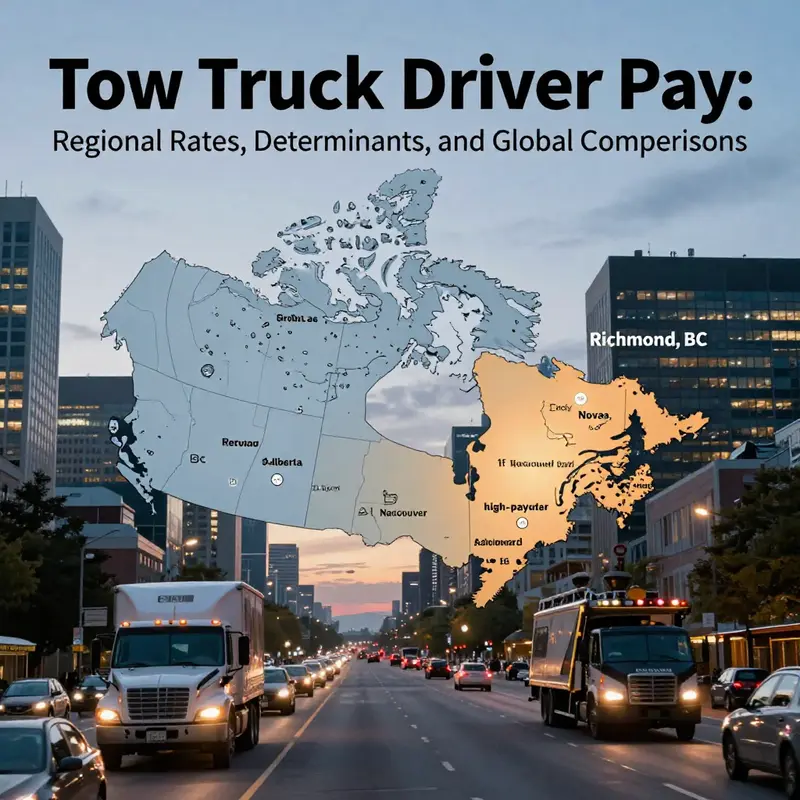
The sound track of a tow truck driver’s day is as variable as the map of the road itself. It blends the heat of a summer afternoon, the chill of a predawn shift, and the precise math of pay that changes with every mile, every call, and every line on the employment sheet. When you ask how much a tow truck driver makes, you’re really asking about a mosaic of earnings that shifts by region, by employer, by the kind of tow work being performed, and by the way a driver structures their work life. The most recent data available as of early 2026 tell a nuanced story. In Canada, the national snapshot suggests an hourly wage hovering around the mid-teens, while pockets in high-demand urban centers push wages higher. Across the country the average nudges toward just under $18 per hour, but this figure masks real variation at the local level. In British Columbia, for example, the average hourly wage sits just above the national benchmark at about $17.85. Yet, in a city like Richmond, BC, the numbers jump meaningfully—to roughly $24.06 per hour, a level that stands about 36 percent above the national average and signals how demand and capacity to absorb labor in busy markets can lift pay above the provincial norm. The rest of the province mirrors a broader pattern: the same figure of about $17.85 in places like Vancouver, Victoria, Surrey, and Delta, with occasional micro-markets where wages inch higher or lower depending on the employer mix, shift length, and the specific service offered. The provincial tale of pay in Alberta, by contrast, trends lower on average, around $16.01 per hour, an almost ten percent differential below the national average. The contrast here is not simply about the price of a coffee in the morning but about the distribution of work, the density of incidents, and the type of tow that is most common in a given region. Even within Alberta, however, there are standout cases where earnings race ahead of the baseline—specifically in specialized or large-company roles, with some drivers reporting $36 to $45 per hour in Fort McMurray, a zone characterized by remote locations, harsh weather, and the near-constant demand for heavy-duty towing and recovery. In Atlantic Canada, the spread is similarly nuanced. Dartmouth, Nova Scotia, sits at about $15.70 per hour, roughly 12 percent below the national average, while Halifax itself offers higher around $27.39 per hour, reflecting a coastal city with significant roadside activity and a demand curve shaped by seasonal traffic, commuter patterns, and a mix of municipal and private towing operations. Across the border to the United States, the overall picture shifts again. The national hourly wage average sits around $21.13, with annual earnings translating to roughly $46,231, according to the same data stream that tracks thousands of postings over multiple years. That annual figure sits about 18 percent below the broader national average for all occupations, a reminder that wages in this line of work are often weighed against the irregularity of calls, the intensity of physical effort, and the hazards that can accompany roadside assistance. In Australia, a wider context is available through NSW, where the industry pays out in a weekly framework, estimated at about $1,264 per week for a tow-truck driver in that jurisdiction. These numbers, while helpful as benchmarks, only begin to illuminate the daily reality of earning for tow-truck operators, because pay is not a single ledger line. It is a composite of base pay, call-out pay, on-call stipends, overtime, per-job or per-mile rates, tips in some regions, and occasionally bonuses tied to performance, safety records, or fleet utilization. And the job type matters just as much as the region. The broad categorization of work—whether a driver is operating a flatbed, a wheel-lift, a service vehicle operator, or a specialized recovery unit—can swing earnings by a substantial margin. The data hint at this by noting that high-demand or specialized assignments—like heavy-duty or remote-area recovery—enter the wage mix in ways that the standard roadside assist role does not. In Richmond, the concentration of incidents and the premium paid by local fleets to attract qualified operators create a wage floor that lifts the average above the provincial baseline. In Fort McMurray, the same premium is driven by isolation and the difficulty of scheduling work in a mining and oil-services ecosystem where delays can command a high per-hour rate. And in Halifax, the combination of urban density and seasonal flows of traffic and incidents translates into a higher-than-average base rate in the context of a more modest cost of living than in some giant urban centers on the mainland. These patterns reinforce an essential point for readers who want to understand “how much does a tow truck driver make.” Wages are not fixed by a single rate or a standard contract; they are a spectrum shaped by geography, demand density, operating models, and the specific duties of the job. A driver who works for a large fleet on a flatbed may see a different trajectory than a single-owner operator who handles a mix of light recoveries and roadside assistance across a metropolitan belt. The economics of ownership versus employment adds another layer. The owner-operator, who shoulders licensing, insurance, vehicle maintenance, fuel, and the performance costs of returning to a bay or port with a vehicle ready for the next call, has a different risk profile and potential upside. The company driver, on the other hand, benefits from predictable schedules, benefits packages, and fewer out-of-pocket costs per shift, but their upside is limited by wage scales and the structure of overtime, per-call bonuses, and union or non-union status in their region. That distinction matters because the same per-hour rate in two different employment arrangements can translate to divergent annual take-home numbers once benefits, taxes, insurance, and the variable cadence of calls are folded into the equation. A driver who moves from a lower-wage region to a market with higher demand will typically see a meaningful bump in earnings, but the cost of living in the high-wage city often accompanies that increase. The Richmond example illustrates this dynamic most clearly: an hourly rate of roughly $24.06 can look very attractive on a paycheck, yet the same region often carries a higher cost of living in housing, groceries, and transportation. For anyone evaluating a potential move or a shift in specialization, the takeaway is simple: region matters, but it is just one axis among several. The type of work—flatbed versus wheel-lift versus service vehicle versus heavy recovery—can swing earnings by double or more when paired with either an owner-operator status or a robust company structure with performance-based incentives. In practice, a driver aspiring to maximize earnings might pursue a path that begins with building solid experience in a metro area with a steady volume of calls and a diversity of incidents. After gaining proficiency with the routines of roadside rescue, wheel-lift operations, and on-scene safety management, a professional can explore specialized niches that command higher pay. Training, certification, and experience open doors to assignments such as heavy-duty towing, winching in complex conditions, or remote-area recovery—work that commands premium rates in Alberta’s oil regions or in the more hazardous urban corridors of major US markets. The data from Indeed, drawing on tens of thousands of postings over three years, reinforce a practical truth: pay in this field carries a strong signal of regional demand, but it does not rest on a single fixed base. The annual perspective—about $46,231 in the United States, for example—likely reflects a mix of full-time roles, part-time shifts, per-call compensation, and the variety of employers that deploy crews across urban cores and rural outposts. The hourly rate, at about $21.13, sits in a comfortable middle range for a mechanized, hands-on vocation that blends physical risk with the need for precise technical skill. Yet it is crucial to recognize that these figures are often a starting point rather than a final word. A driver who moves through multiple markets, accumulates a stable track record, and accrues additional credentials—such as heavy vehicle operation or hazardous environment training—can command higher base pay and better incentive structures. The contrast between urban density and rural spread matters as well. In major metros like New York, Los Angeles, and Chicago, the higher traffic volumes, more complex roadway systems, and the sheer number of breakdowns and collisions yield elevated compensation in many fleets. Rural regions, where incidents are less frequent but the calls can be more arduous due to distance and time, can present different compensation dynamics. The cost of living in a metropolitan center can offset a wage premium by a meaningful margin, turning the purchasing power of a given hourly wage into a different reality. For someone planning a career in tow-truck work, the choice of where to work becomes a strategic decision that weighs more than pay alone. It considers the reliability of shifts, the stability of a fleet’s maintenance program, the likelihood of overtime, the potential for per-call bonuses, and the prospects for advancement into supervisory or specialized roles. A driver with a drive to grow into leadership within a fleet, or one who wants to progressively assume larger and more technically demanding assignments, should look for regions and employers that offer clear pathways to certifications and advancement. In this context, the data from Indeed becomes a guide rather than a verdict. It helps map the high- and low-wage landscapes, but the personal calculus involves lifestyle, family needs, the tolerance for irregular hours, and the willingness to relocate for a sector that offers stronger growth opportunities. The way pay translates into lifestyle also hinges on additional earnings streams. Some fleets reward drivers with bonuses tied to safety records or on-time performance, while others layer in shift differentials that reward night or weekend work. There are also scenarios in which drivers can augment their base wages through tips, although tipping norms vary by region and by the precise nature of the tow service being offered. And there is the possibility of supplemental revenue from ancillary services—like tire changes, vehicle unlocks, or minor roadside repairs—that can be bundled into a single call. All these components interact with the fundamental numbers. A driver contemplating a move from a moderate-wage area to a higher-demand market should evaluate not just the hourly rate but the forecasted total compensation, the stability of call volumes, and the likely cost of living in the destination city. This is where sources like how much tow-truck drivers make can offer practical context for what a broader wage landscape looks like and what kinds of factors typically push earnings higher or lower over time. The question of “how much” thus expands beyond the surface figure into the daily realities that shape a driver’s income—from the mix of calls received to the design of the fleet’s incentive plan, to the geographic political economy that governs where demand concentrates. When someone asks how much a tow truck driver makes, the best answer begins with the awareness that the number is not just a sign on a door or a line on a payroll. It is a function of geography, of the kind of tow work that is in play, of whether the driver is operating as an owner-operator or as a company employee, and of the broader economic environment in which the business operates. The most informative way to approach the question is to assess one’s own priorities: stability versus flexibility, base pay versus potential upside, the value of benefits, and the willingness to undertake specialized training to access higher-paying niches. This approach can help a driver align with a market that not only pays well but also fits their professional goals and life circumstances. For those who want to dive deeper into the numbers and see how a given region stacks up against the broader landscape, the Indeed data set offers a comprehensive, if general, frame for state- and metro-area comparisons. It provides a sense of how urban concentration tends to push wages upward and how cost of living factors into the real value of a wage offer. As you explore these patterns, remember that the figures are snapshots that reflect broad trends rather than precise paychecks. Individual contracts, company policies, and the specifics of an assignment can shift the math in meaningful ways. If you are an aspiring tow-truck driver or a current professional weighing a move, this geographic overview serves as a practical map. It invites you to consider not only where the pay is highest but where you can best leverage your skills, certifications, and professional network to secure a role that offers both fair compensation and sustainable career growth. The landscape is diverse enough to reward persistence and strategic planning, and it rewards those who invest in the specialized capabilities that differentiate a driver in a crowded market—from advanced winching and recovery to the mastery of customer service under pressure. And while the numbers form an essential guide, the real value lies in translating them into a career path that aligns with your ambitions, your aptitude for hands-on problem solving, and your willingness to navigate the changing currents of demand across regions. For readers who want to broaden their understanding beyond the regional layers, it is useful to consult a range of sources that provide more granular, state- or metro-area insights. The data from Indeed, while informative, is complemented by other salary surveys and labor-market databases that can offer more specific views of wage distribution by city or metro. With that in view, the geographic panorama of tow-truck wages becomes not only a ledger of numbers but a living guide to planning a career that travels with you—up the ladder of responsibility, into specialized work, and across the country’s most dynamic labor markets. External reference for further context: Indeed – Tow Truck Driver Salaries in the United States (linked but not quoted verbatim here): https://www.indeed.com/career/tow-truck-driver/salaries
Chapter 2: The Paying Road—Decoding How Much Tow Truck Drivers Make Across Regions, Experience, and Job Type
Wages for tow truck drivers do not travel in a straight line along a single national curve. They bend with geography, they rise with experience, and they shift with the kind of work a driver takes on. In Canada, the latest data available as of early 2026 show that the average hourly wage for a tow truck driver hovers around the mid-teens to low twenties, but the picture is far from uniform. Across the country the range is wide, shaped by local demand, living costs, and the particular duties a driver assumes. A national snapshot places the approximate hourly figure in the mid-teens to the high teens in many regions, with provincial pockets where the numbers climb into the mid-twenties or higher. The variation matters because it is not merely a question of what a driver earns per hour, but how those earnings compound with overtime, on-call shifts, weekend premiums, and the kinds of jobs that fill a week on the road.
Within this framework, British Columbia shows a slightly elevated average compared with the national figure, with an overall hourly wage around the mid-to-high $17 range. It is a reminder that even in a single province, there can be meaningful gaps from city to city, especially where traffic density and the reliability of towing services create tight labor markets. In major BC centers, the baseline wage tracks the provincial average, but there are outliers that pull the numbers up. Richmond, for instance, stands out as one of the higher-paying locales in Canada, where the average hourly rate exceeds $24. This rate is roughly 36 percent above the national average and reflects a confluence of strong demand for reliable tow services, higher costs of living, and a market that rewards quick, safe responses to roadside emergencies.
Yet the story is more nuanced when you step beyond the metro hubs. In cities like Vancouver, Victoria, Surrey, and Delta, the numbers align with the provincial average, underscoring that the Richmond surge is not a universal law but a regional phenomenon driven by unique local dynamics. Alberta paints a different spectrum. The province sits a bit below the national Canadian average, with an overall hourly wage near $16.01, about 10 percent lower than the national median. That statistic, however, does not capture the brightest edges of the market. In large centers such as Fort McMurray, the work environment can command premium compensation in the range of $36–$45 per hour for specialized or high-demand roles. These positions often involve heavy-duty towing, emergency response, or specialized fleet work in challenging operating conditions, where risk and skill are elevated, and where the employer’s ability to deploy fast, reliable service justifies the higher pay.
Nova Scotia reveals another facet of the wage mosaic. In Dartmouth, the average hovers around $15.70 per hour, a figure that sits below the national average and reflects a different mix of demand, competition, and the regional economy. Nearby Halifax, however, offers significantly higher pay, with wages around $27.39 per hour. This contrast within a relatively small geographic area illustrates how local market forces, including the density of fleets, the severity and frequency of weather-related incidents, and the appetite for 24/7 service, can reshape earnings for drivers who stay in the same general region.
Across the border, the United States presents a different baseline. The national hourly wage there sits higher, near $21.13 per hour, illustrating a broader pay envelope when compared to Canada. The international differences underscore a broader theme: the economics of tow truck work is tightly coupled to regional demand, cost of living, and the structure of the local towing industry. In a broader sense, the Canadian data point to a central truth for workers considering this line of work: the path to higher earnings is less about chasing a single national average and more about targeting the right regional demand, the right kind of job, and the right employer with the capacity to reward skill and reliability.
To map this more precisely, it helps to understand what drives the pay scale in a given location. Location matters because it shapes the demand for towing services. Urban corridors with heavy traffic, more frequent breakdowns, and greater accident activity naturally require more tow truck operators. High-density areas also tend to have more competing fleets, which can push wages upward as companies vie for reliable, highly skilled drivers. Conversely, more rural regions with fewer incidents and smaller fleets may offer steadier, if slightly lower, baseline wages. The existence of dedicated emergency and accident-response towing, along with the legal and regulatory environment surrounding roadside assistance, also has a tangible impact on compensation. In places where fleets are legally mandated to provide rapid response during peak driving hours or winter weather events, drivers see more opportunities for on-call shifts, overtime, and shift differentials that bolster earnings beyond the base hourly rate.
Another important determinant is the type of job being performed. Although many tow drivers handle standard vehicle towing, a substantial premium attaches to specialized work—heavy-duty towing for larger commercial vehicles, winching in high-traffic highway settings, or roadside recovery at accident scenes. In Alberta, the provincial baseline may be modest at first glance, yet the spectrum widens quickly for specialized roles. A listing for a Tow Truck Driver with Class 3 credentials, typical in heavy-duty operations, shows pay in the range of $40–$45 per hour. This reflects a higher level of responsibility and technical skill, including the ability to operate larger trucks, handle complex recovery scenarios, and manage risk in potentially hazardous environments. When combined with on-call requirements and emergency deployments, these roles can attract a meaningful premium that dwarfs the entry-level rate.
Experience is perhaps the most consistent driver of earnings. For new entrants, wages tend to hover near regional averages, which themselves fluctuate with local demand. As a driver accumulates time on the road, the opportunity to command higher pay grows. In high-demand markets like Alberta’s larger centers or the Richmond area of BC, a veteran driver who has built a track record of reliability, fast-response times, and safe operation can see substantial advancement. The trajectory from entry-level to specialist or supervisory roles often translates into a step change in earnings, particularly when skilled labor shortages intersect with the seasonal and emergency demands that characterize towing work. In practical terms, experience translates into better dispatch assignments, the ability to handle more complex or hazardous recoveries, and potentially access to premium shifts that pay above the standard hourly rate.
The scale and reputation of the employing company also shape earnings, though perhaps less intuitively than geography or job type. Larger, established fleets with an entire operations backbone—training programs, safety protocols, modern equipment, and robust dispatch systems—are more likely to offer higher base pay and more predictable hours. They tend to invest in continuous training, which translates into greater reliability and better performance during high-stakes incidents. These firms can also negotiate higher billing rates with clients due to their track record, which can support stronger driver compensation. In contrast, smaller independents may offer more flexible schedules or the potential for overtime, but the base pay often remains closer to the local average. Nevertheless, there are exceptions. Smaller outfits that specialize in high-risk or time-sensitive work can offer premium wages to attract and retain the right talent willing to operate in challenging conditions or in remote locations. The practical takeaway is that a driver’s earnings are the product of a dynamic interplay between market demand, the technical demands of their role, and the quality of the employer’s training, systems, and safety culture.
To connect these threads with concrete numbers, the data landscape paints a consistent picture: workers in higher-demand or higher-cost regions tend to command above-average wages. Richmond’s elevated rate, for example, reflects a regional premium that aligns with higher living costs and a dense, consistent flow of roadside incidents needing prompt service. Halifax’s higher-than-average pay in a city with substantial maritime and urban activity likewise demonstrates how a concentrated demand cluster can outperform provincial baselines. Alberta’s story is more nuanced: while the provincial average might lag the national figure, the outliers in Fort McMurray and similar hubs show that the right combination of heavy-duty work, remote locations, and the willingness of employers to pay for on-site readiness can create a distinct value proposition for experienced drivers. In areas with a heavy emphasis on emergency response and hazardous conditions, salaries can carry additional stipends or shift differentials that, while not always visible in the base hourly rate, contribute meaningfully to total compensation.
With this broader perspective in mind, drivers evaluating their career path should think beyond the nominal hourly rate. A longer-term view considers how to build the specific skills that unlock higher-paying opportunities. Certifications that support heavy-duty operation, safety compliance, and emergency response can unlock jobs that command $40 per hour or more, especially in regions where demand for skilled rescue and recovery works remains high during severe weather. The possibility of overtime and on-call premiums, particularly in peak driving seasons or during winter storms, further reshapes total earnings. For those prioritizing a stable and predictable income, a large, well-established fleet with regular shift patterns may offer more reliable weekly pay, while those seeking higher ceilings may gravitate toward roles involving rapid response or remote terrain, where premium rates are possible but risk is higher and job conditions more demanding.
It is useful to connect these observations with a practical frame for planning. For instance, a driver considering relocation to Richmond, BC, might anticipate a higher baseline opportunity than in many other Canadian markets, but should also factor in the cost of living and the local competition among fleets. A driver eyeing Alberta’s heavy-duty lanes could pursue Class 3 or other specialized endorsements to unlock earnings in the $40–$45 per hour range, with the understanding that such roles require not only driving skill but also a proven safety record and the ability to operate in demanding environments. The same logic applies when comparing Dartmouth and Halifax; while the latter may offer superior pay in some roles due to concentrated demand and higher service expectations, the former might present a more modest baseline with opportunities to grow into higher-paying assignments through experience and the pursuit of specialized work.
The numbers also underscore a broader point about how the field is evolving. As fleets modernize and the urban rush intensifies, the demand for reliable, skilled drivers who can operate at scale and across a range of incident types continues to grow. This dynamic suggests that the earning potential for tow truck drivers remains sensitive to training, certifications, and the deliberate selection of job types. For aspiring drivers and career switchers alike, the route to meaningful earnings involves a combination of geographic targeting, skill development, and engagement with employers who value reliability and safety as much as speed and efficiency.
If you are exploring this path, you can see a concise, career-focused summary of these dynamics through a resource that distills the pay conversation into actionable insights. How Much Do Tow Truck Drivers Make offers a practical look at how experience, company scale, and job type intersect to shape earnings. This page anchors the core idea that the pay landscape is not a single value but a spectrum of possibilities that drivers can navigate by building the right skills and choosing the right markets. While the data points from various sources provide a snapshot, the real-world experience of drivers in different regions confirms that strategic moves—whether through specialization, certification, or targeting high-demand areas—can meaningfully raise weekly take-home pay.
For a broader external reference that illustrates how employers present compensation to prospective drivers and how job listings reflect the realities of the market, consult the following external resource. https://www.indeed.com/cmp/Calgary-Heavy-Towing-Inc/jobs/Tow-Truck-Driver-8b7f9e5d3a8e4c4a?jobId=8b7f9e5d3a8e4c4a. This listing captures how real-world postings describe duties, expectations, and compensation in a market known for its mix of heavy-duty and emergency work. It is a useful comparator to the regional data discussed above, highlighting how dynamic the job market can be when demand for rapid, professional response collides with the realities of service delivery in unpredictable conditions.
The wage landscape for tow truck drivers, then, is a mosaic rather than a single figure. The numbers from Canada reveal a country where location, experience, and the nature of the job blend to produce a broad range of earnings. The high end appears in specialized, high-demand markets and roles that demand heavy-duty capabilities and rapid response. The mid-range reflects standard towing responsibilities that many drivers perform each day, while the lower end points to markets where demand is softer, or where the region’s overall wage structure keeps base pay closer to the regional average. Importantly, the variations within provinces and cities reinforce a practical reality for workers: your pay is not just about your skill on the ramp, but about where you choose to work, which job types you embrace, and how you cultivate the experiences and credentials that elevate you into higher-paying roles over time. The journey from entry-level to specialized specialist is not instantaneous; it requires deliberate skill-building, exposure to diverse incident scenarios, and a willingness to pursue opportunities that may demand on-call availability, travel, and a readiness to operate under conditions that test safety and efficiency in equal measure.
Tow Truck Pay Unpacked: Regional Variations, Bonuses, and What Drives Earnings in 2026
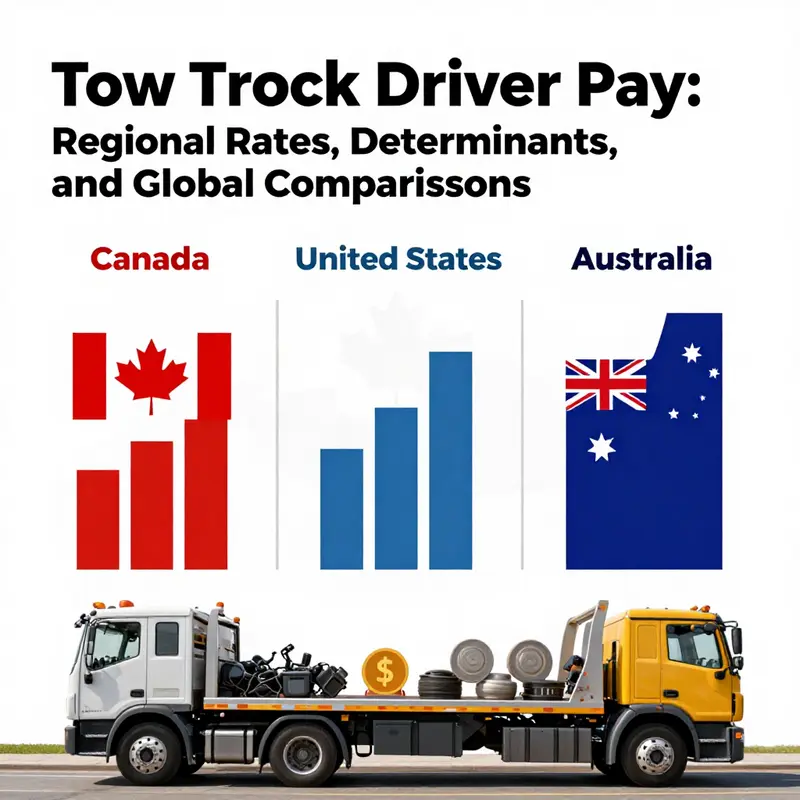
Wages in the towing industry do not follow a single line or a simple curve. They rise and dip with the same forces that shape many skilled trades: local demand, urban density, the type of towing work, and the after-hours reality that keeps certain markets unusually competitive. The numbers from early 2026 tell a story of a base pay that looks modest on a national level in some countries, yet can become surprisingly generous in specific hubs or specialized niches. What someone earns behind the wheel of a tow truck is not only a function of hours worked, but also the market’s appetite for rapid response, the vehicle class being moved, and the incentives a company uses to attract experienced drivers. Read together, the data from Canada, the United States, and Australia sketches a map of where pay tends to cluster and where it remains lean, and then annotates the spaces in between with the realities of bonuses, overtime, and signing incentives that often alter the final take-home amount in meaningful ways.
In Canada, the baseline picture starts with a national average wage that sits around the mid-teens per hour. Specifically, the national hourly wage for tow truck drivers is reported at about $17.75. This snapshot, based on hundreds of salary reports updated toward the end of 2025, is not a universal floor or ceiling; it is a reference point that reveals both the breadth of compensation and the compression of pay in some regions. The national figure may appear modest, but it hides pockets of strong demand and higher pay that show up in major markets. To illustrate, the province of British Columbia reports a slightly higher average—approximately $17.85 per hour—yet the same dataset highlights dramatic contrasts within the province. Richmond, British Columbia, stands out as a high-wage outlier, where the average hovers around $24.06 per hour. That gap—roughly 36 percent above the national average—reflects a combination of dense traffic, quick-call demand, and a concentration of towing services in a city with a sophisticated logistics network. Other large BC centers such as Vancouver, Victoria, Surrey, and Delta sit closer to the provincial average, underscoring how a few high-need pockets can skew a broader regional picture.
Alberta presents a more nuanced tale. The province’s average sits a bit below the national Canada mark, around $16.01 per hour, about 10 percent under the national average. Yet Alberta’s landscape is peppered with high-paying exceptions that illustrate the industry’s variability. In Edmonton, for example, selected positions can reach about $36 per hour, and in Fort McMurray the range is even higher, between $40 and $45 per hour, reflecting the region’s resource-driven demand and the premium for critical-response labor. Calgary also features opportunities that can approach $39 per hour, which reinforces the principle that within a single province, pay can swing sharply from the baseline to the elevated end depending on employer, vehicle class, shift structure, and local labor market tightness. In practical terms, the Alberta example shows how a worker who can position themselves with the right employer and the right schedule can climb into a markedly higher earnings tier—even if the provincial average reads modest on paper.
Nova Scotia adds another layer to the mosaic. In Dartmouth, the average is about $15.70 per hour, which is roughly 12 percent below the national benchmark. But proximity matters: Halifax, just a short drive away, offers higher pay, with rates around $27.39 per hour reported in the region. Other nearby communities demonstrate the same pattern—the base average drifts downward in some areas while close markets not far away command significantly higher rates. This regional scenery illustrates the kind of dispersion you find across a single country: a national average can obscure a landscape where a driver might discover a steady, well-compensated niche in a nearby city, especially where demand for rapid, local-tow services remains consistently high.
Taking a broader view of Canada, the highest-paying cities in late 2025 point to urban centers with heavy traffic, dense dispatch networks, and frequent, time-critical towing needs. Thunder Bay, Ottawa, Richmond (BC), Edmonton, and Winnipeg emerge as top earners by hourly rate, each breaking into the mid-to-high twenties per hour in many cases. For example, Thunder Bay sits around $26.53 per hour, Ottawa averages about $25.19, and Richmond sits near $24.06. Edmonton’s numbers around $24.05 reflect its status as a large city with robust dispatch activity, while Winnipeg caps the list at about $23.11. These city-level figures reinforce a practical truth: pay tends to be highest where the pace is fastest, the volume of calls is high, and the infrastructure to support quick, on-demand towing is fully developed. All told, the Canadian map shows a core pattern: a stable base with significant uplifts in specific markets that command premium rates for specialized, urgent, or heavy-duty work.
The real-world picture also includes the question of what constitutes total compensation beyond the base hourly rate. Data from Indeed and other salary aggregators reveal that for tow truck drivers across Canada, the annual earnings can span a wide range. In some cases, annual salaries can climb into the $60,000 to $77,000 band, though other related occupations offering similar skill sets may report a broader spread. These figures emphasize the impact of factors beyond the hourly wage—such as overtime opportunities, weekend and night shifts, call-out frequency, compensation structures that include commissions or flat-rate bonuses, and the presence of福利 (benefits) or retirement plans. Third-party salary data, while insightful, should be read with caution; it captures self-reported figures that can reflect a variety of employment arrangements and contract types, some of which are temporary, seasonal, or tied to a larger fleet’s operating model. The key takeaway across Canada is that base hourly pay forms a floor in many markets, but that floor can be pushed upward by location, shift pattern, vehicle class, and the willingness of a company to offer added incentives.
To place the Canadian picture in a broader frame, the United States presents a higher national baseline. The U.S. average hourly wage for tow truck drivers sits around $21.13 per hour, according to a compilation of regional statistics and occupational surveys. The U.S. data often features a wider spread, with some areas reporting substantially higher pay due to tight labor markets, elevated cost of living, or specialized responsibilities like heavy-duty or flatbed towing that require advanced skills or additional certifications. Annual earnings in the United States typically range from roughly $39,865 to $97,001, reflecting substantial regional variation and the same mix of base pay plus shift differentials, overtime, and bonuses seen in Canada. Indeed’s data sometimes highlight an even broader annual window, with figures reported in the band of $60,608 to $77,699, depending on location, job type, and the exact mix of hours. The cross-border contrast—Canada’s base rate in the high teens to mid-twenties in some markets versus the U.S. mid-to-high twenties in many metros—illustrates how currency, local demand, and labor policy shape this line of work.
Beyond North America, the global context adds a helpful perspective for anyone weighing where to work in towing. In Australia, for instance, the NSW context shows a weekly pay around AU$1,264, which translates to about AU$31.60 per hour when broken down into standard hours, and it points toward higher hourly figures for major cities and specialized roles. The Australian pattern reinforces a familiar theme: even when base hourly wages appear to fall within a relatively narrow band, real earnings can be higher when you account for overtime, on-call arrangements, and the premium paid for night shifts or longer, more demanding routes. The NSW scenario aligns with a broader conclusion common to all three countries: pay improves where demand is intense, urgent-response capacity is critical, and the fleet structure rewards those who can move fast and stay on the road when others cannot.
What, then, should a prospective tow-truck driver expect when evaluating job offers today? First, recognize that base pay is only part of the total compensation equation. A driver entering a market with a modest national average may still secure a financially healthy income by choosing to work in a high-demand city, or by specializing in a category of towing that carries higher rates—such as flatbed work, heavy-duty recovery, or municipal contracts that require round-the-clock availability. Second, expect meaningful regional variation. Markets like Richmond, Thunder Bay, Ottawa, and Edmonton illustrate how local demand and dispatch density can push wages upward, even when the surrounding region sits closer to a base baseline. Third, factor in bonuses and incentives. Sign-on bonuses, night-shift stipends, overtime, performance bonuses, and welfare benefits can alter the equation enough to push a worker well into higher earning bands over the course of a year. In short, the number you see on a job listing is often just the tip of the iceberg; the full compensation package—measured by hours worked, overtime opportunities, and after-hours pay—determines the real earning potential.
For readers who want to anchor these observations to concrete data, it is useful to explore a consolidated view that brings together the most representative Canadian, American, and Australian figures. The aim is not to enforce a single narrative of earnings but to map the terrain where to work if the goal is maximum pay, while also considering other factors such as stability, benefits, and work-life balance. If you are weighing your next move, consider how much of your income will come from the base hourly rate, how many overtime hours you expect to log, and how often you will be on call during weekends or overnight shifts. In markets with heavy traffic and frequent incidents, the odds rise that you can supplement a modest base with a healthy level of overtime pay and bonuses that significantly lift take-home pay. Conversely, in quieter markets, the same base rate may require a longer horizon to achieve the same annual earnings, particularly if overtime opportunities are limited or if seasonal demand creates fewer year-round shifts.
The practical implications extend beyond personal finances. Higher pay often accompanies more robust training, better equipment, improved dispatch systems, and a greater emphasis on safety and customer service. These factors contribute to a more sustainable career path for tow-truck drivers who build expertise in heavy-duty or specialized recovery work. They also shape the professional ecosystem around towing, including maintenance costs for fleets, insurance considerations, and the negotiation dynamics between drivers and employers when it comes to signing bonuses or shift premiums. For someone considering a career in towing, the message is clear: to maximize earnings, align with markets and employers that value rapid response, specialized skill sets, and a willingness to work the hours that others avoid.
Internal link for deeper context. A consolidated view of earnings trends and regional variations can be found here: tow-truck driver earnings. This resource gathers a snapshot of how base wages, bonuses, and regional demand interact to shape the annual income landscape. While the numbers above provide a structured reference, the daily reality of pay is highly contingent on location, employer, and the specific duties a driver takes on. For ongoing accuracy, prospective drivers should consult current local postings and industry salary surveys that reflect the most recent market conditions.
As you weigh opportunities, keep in mind the external dimension of pay that plays into the overall return on a towing job: the interplay between cost of living, insurance costs, vehicle maintenance, and the need for specialized training. A higher hourly rate in a city with steep living costs may be offset by higher expenses, while a lower rate in a more affordable area might yield a comparable or even superior standard of living. This nuanced calculus is not unique to towing; it is true across many service trades that pivot on dispatch-driven schedules and after-hours demand. Yet for tow-truck drivers, the metrics of success are sometimes more sharply defined by time-and-distance dynamics—the quicker you can reach a scene, the more opportunities you have to earn through base pay plus overtime, call-outs, and bonus structures. In that sense, the job’s financial highlights rest on a blend of speed, reliability, and the capacity to operate across different vehicle types and road conditions, often in conjunction with municipal or fleet-driven contracts that shape both workload and reward.
If you are a reader seeking actionable guidance, the road map is straightforward. Start by researching regional pay baselines in the markets you are considering, paying particular attention to the range between the floor and the ceiling—base hourly wage versus the potential uplift from overtime and bonuses. Then evaluate the fleet type and job focus of prospective employers. A company that emphasizes heavy-duty or flatbed towing, close to commercial districts or industrial hubs, is more likely to offer higher hourly rates and robust incentive structures than a small-town operation with a limited call volume. Finally, assess the stability and growth opportunities that might accompany a higher initial pay rate. In markets with strong growth, experienced drivers can often transition into higher-paid roles with more complex tasks or supervisory responsibilities, creating a longer arc of earnings growth beyond the first year on the job.
In sum, the pay for tow truck drivers in 2026 reflects a multifaceted marketplace. Base wages vary meaningfully by country and region, with Canada showing modest averages and high pockets in places like Richmond and Thunder Bay, the U.S. displaying a higher baseline in many metro areas, and Australia illustrating a premium in significant urban centers. But the real story is the dynamic not captured by a single number: the compensation that drivers accumulate through overtime, sign-on bonuses, shift differentials, and the strategic choice of where and when to work. For workers who can align skills with demand—whether that means heavy-duty recovery, flatbed operations, or municipal contract work—the earning potential can rise well above the simplest hourly rate. And for employers, the challenge remains how to attract and retain drivers who bring speed, reliability, and safety to the roadside while offering a fair and competitive total compensation package. The numbers cited here are a guide, not a guarantee, and they point toward a broader conclusion: tow-truck driving, like many skilled trades, rewards expertise, market orientation, and the ability to thrive in a demanding on-call environment.
External resource: https://www.bls.gov/oes/current/oes533010.htm
Final thoughts
Across regions and roles, tow truck driver pay reflects geography, experience, and job nuance. Regional leaders can command notably higher hourly rates, while growth stems from experience, larger fleets, and specialized service types. For buyers and managers—auto shops, dealers, property managers, and fleet operators—understanding these dynamics supports smarter budgeting, contract negotiations, and service level planning. The international snapshot shows Canada, the US, and Australia each price roadside reliability through distinct wage landscapes, underscoring the value of local market intelligence when assembling towing partnerships or evaluating in-house fleet needs.