
Tow truck driving sits at the crossroads of service reliability and regional demand. Earnings are not the same from coast to coast or city to city; location, market density, and the way companies pay workers all shape the real income of a tow operator. This article unpacks three core angles that drive what a tow truck driver can realistically earn: how geography and market conditions push pay up or down; how compensation structures—from hourly wages to monthly salaries and bonuses—affect take-home pay; and where the industry is heading in terms of career progression, demand trends, and long-term earning potential. The target audience includes Everyday Drivers, Residents & Commuters, Truck Owners, Auto Repair Shops & Dealerships, and Property Managers who rely on dependable towing services and want a clear picture of the economics behind it. By tying practical wage data to employer behavior and market trends, readers can benchmark earnings, negotiate pay, and plan for future opportunities with confidence.
Geography, Demand, and Dollars: How Market Forces Shape Tow Truck Pay Across Canada
Wages for tow truck operators don’t drift upward in a straight line. They rise and fall with a map of demand, a city’s cost of living, the density of service providers, and the times when the clock is most expensive to taxpayers and insurers alike. Reading the pay differences across Canada is less a story about a single career path and more a tour through regional economies, urban volumes, and the ebb and flow of emergencies that keep fleets running around the clock. The core insight is simple and robust: geography matters as much as skill, and market conditions do most of the heavy lifting when it comes to what a driver can reasonably expect to earn. When you assemble the available data, a picture emerges of disparity that is both convincing and practically actionable for anyone weighing how to build a career in this field.
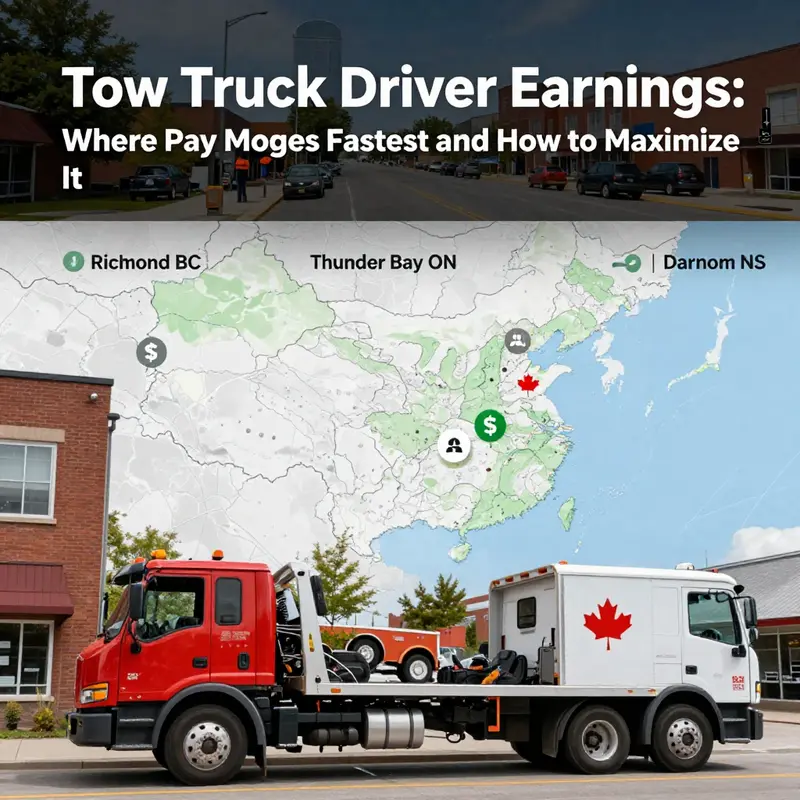
Across the country, the national average for tow truck drivers sits around the mid-teens to upper-teens per hour, a reflection of the early- and mid-career landscape in many provinces. As of late 2025, the national average hourly wage in Canada hovered near $17.75, a figure that sounds straightforward until you compare it with regional realties and the potential for more lucrative work in certain markets. The same snapshot that marks this figure also highlights the dramatic spread you can observe when you shift focus from the average to the actual hours and locations where work is dense and prices are higher. In Richmond, British Columbia, for instance, the hourly rate sits around $24.06, which is roughly 36 percent above the national average. That premium isn’t arbitrary; it’s tied to a confluence of dense traffic corridors, frequent incidents, and the higher costs of doing business inside a metropolitan boundary that draws a steady stream of roadside needs.
Move eastward and you find a different logic at work. Thunder Bay, Ontario, sits at the top end of many provincial pay scales, with wages hovering around $26.53 per hour. It’s a city where winters and the corresponding icy conditions amplify on-road incidents and the need for rapid response, but it also has a market structure that supports higher base rates and more consistent demand in exchange for higher operating costs and the realities of a smaller urban footprint. Contrast this with Dartmouth, Nova Scotia, where the hourly average dips to about $15.70—still a respectable living in many contexts, but noticeably below the national average and the higher-volume markets out west. The same snapshot that reveals these regional differentials also underscores a broader theme: cities with dense traffic and large populations can sustain higher rates, while more dispersed areas face the twin pressures of lower demand and longer travel times, which can compress hourly earnings even when rates are technically set higher in some instances.
What about real-world job postings and the stories they tell about potential upside beyond the baseline? The numbers show a clear pattern: where demand is strongest, pay scales upward, and sometimes the structure of the job itself rewards more hours, more responsibility, or more specialized skills. In one province, pay scales for private or high-volume towing work have reached notable peaks. If we remove company names and focus on the scale, there are positions that advertise hourly wages approaching the mid- to high-thirties in regions where service demand, overtime opportunities, and on-call requirements make a premium seem fair. For instance, some postings in coastal or interior regions illustrate pay around $36–$39.50 per hour. A higher-end private-operator scenario can push hourly wages into the upper thirties. The logic remains consistent: where competition for work is intense and the volume of calls is high, companies compete for skilled drivers by offering higher base rates to attract and retain talent during peak demand.
The data also remind us that not all regions reward experience and specialization in the same way. In Quebec, Ontario, and parts of the Atlantic provinces, the same job title can come with a wide pay range depending on whether the operator is working for a small local outfit or a larger regional or private company. In some locations you’ll see the hourly rate anchored around the mid- to high-twenties, while other areas offer the same role with the potential to earn in the mid- to high-thirties, or deliver a more stable monthly package for full-time shifts. When a company is able to schedule more hours, guarantee on-call availability, or maintain a fleet that can respond to a surge of incidents, the earning potential often grows in tandem with the workload—and with the accompanying risk and responsibility that comes with higher-volume shifts.
A closer look at regional differences also reveals something about the structure of compensation beyond base pay. In markets where cost of living, insurance costs, and equipment maintenance are steep, employers may lean into higher hourly rates to offset those expenses. The pay scale then reflects the economics of running a fleet in that location, rather than a single, universal standard. For a driver weighing options between cities, the message is that higher numbers are not merely about a person’s skill, but about the intersection of market demand, local living costs, and the volume of work that can be reliably generated in a given area. In high-density urban centers or highly trafficked corridors, the math tends to favor higher earnings, especially for experienced drivers who can handle the pressure and the timing demands of emergency and roadside assistance work.
This is where experience matters, but not in a way that is uniform across the country. A driver who has built a reputation for reliability, promptness, and dependable on-call service may command better shifts or more favorable assignments in a given market, thereby lifting earnings even when the base rate is similar to a neighboring region. The value of a proven track record multiplies in markets where insurers, fleet owners, and municipal contracts recognize the added reliability that a veteran driver brings to the table. In effect, it’s not only about the hourly wage advertised in a job post; it’s about the premium attached to doing high-volume, high-stakes work with a consistency that reduces risk for the company. In markets with frequent weather events, heavy traffic, or complex towing operations that require specialized equipment and skill, a driver’s ability to navigate those conditions safely and efficiently can translate into better pay via overtime opportunities, sprint calls, and more favorable scheduling.
The story becomes even more nuanced when you consider the cross-border perspective. In the United States, the average hourly wage for tow truck drivers has hovered around the low $20s, a figure that can be attractive on the surface but is balanced by a different set of expense pressures and compensation structures. U.S. pay often includes bonuses for performance, overtime, and allowances tied to vehicle use and maintenance, which can push total compensation higher in practice. For Canadian drivers contemplating cross-border work or comparing North American pay landscapes, the contrast highlights how funding mechanisms, labor regulations, and benefits integrate with hourly pay. It’s not merely the raw rate that matters, but the whole package that comes with a given role, including overtime eligibility, benefits, and the stability that a larger market can provide through year-round demand and steady contracts.
The rise of digital and on-demand demand models adds another layer to earnings dynamics, even if we avoid naming specific platforms here. The ability to access real-time job opportunities can help drivers maximize income by aligning work with peak demand periods. In markets where on-demand requests pulse through the evening and early morning hours, experienced drivers can capitalize on higher call volumes and premium rates for urgent responses. The flip side is that independent scheduling introduces more responsibility for the driver’s own costs, including fuel, wear and tear on vehicles, and insurance considerations. Those cost pressures can erode the headline hourly rate if not managed carefully, which is why successful drivers often treat their careers as small businesses—monitoring margins, optimizing routes, and choosing shifts that balance demand with cost controls. This broader ecosystem—market-driven demand, regional cost pressures, and the personal discipline of a well-managed schedule—helps explain why two drivers in neighboring towns can experience markedly different take-home pay even when the published rates appear similar.
If you step back and connect these threads, the practical implications for someone evaluating a tow-truck career are clear. The best-paying opportunities cluster where demand is high, the cost of living justifies higher wages, and the operations environment supports steady work and predictable availability. In other words, if you are choosing where to work, you’re not just choosing a salary; you’re choosing a market with enough volume to sustain a reliable paycheck, with enough depth in the labor pool to keep you working through the worst weather and the busiest weekends, and with a business environment that values skilled operators who can manage complex scenes with care and speed. For many drivers, the optimal path involves starting in a region with strong demand, building experience, and then leveraging that reputation to move within or between markets that offer higher pay and a more robust mix of shift opportunities.
This is precisely why the chapter on earnings in different geographies is so important. It helps a prospective driver set realistic expectations and design a career strategy that aligns with market realities rather than relying on a single, idealized wage figure. It also frames conversations with potential employers around what matters most: the balance of base pay, overtime and on-call premiums, and the reliability of a steady flow of work. Those conversations, in turn, shape the long-term potential for earnings growth as markets shift with immigration patterns, population growth, and evolving infrastructure needs. To turn these insights into practical steps, consider the following: identify markets with proven demand, compare total compensation packages rather than hourly rates alone, and recognize that a higher hourly rate in one market may come with longer on-call periods or fewer guaranteed hours elsewhere.
For readers seeking a concise snapshot of the broader picture, the chapter on how much a tow-truck driver makes offers a more concrete baseline while this discussion emphasizes how market dynamics amplify or temper that baseline. If you want a succinct entry point into the broader conversation about earnings, you can reference the overview on how much tow-truck drivers make, which outlines the core factors that push wages in different directions. how much do tow-truck drivers make. This complementary view helps bridge the gap between a fixed number and the fluid reality of a career that lives at the intersection of geography, demand, and opportunity.
In closing, the geographic and market-driven disparities in tow truck pay are not random; they reflect the complex economics of service provision, risk management, and living costs across Canada. They remind aspiring drivers that location matters not just for the present paycheck, but for the long arc of career development, opportunities, and the potential to build a sustainable, skilled, and rewarding profession. The chapter’s numbers and these qualitative patterns offer a practical framework for approaching pay negotiations, selecting work environments, and planning a career that can weather the volatility of road conditions, weather, and market cycles. As markets evolve and digital demand models continue to reshape how work is sourced and priced, the path to higher earnings remains a function of smart market choices, continuous skill improvement, and a willingness to align one’s work with areas where demand, volume, and cost-of-living conditions create the strongest, most durable earning potential.
External resources for broader context and ongoing data can be found here: https://ca.indeed.com/jobs?q=tow+truck+driver&l=Canada
Tow Truck Pay Unlocked: How Compensation Schemes, Pay Types, and Employers Shape Earnings
Every job has a price, but in towing, the price isn’t a single number. It’s a mosaic built from location, demand, employer type, and the exact way pay is calculated. When you look across North America, the earnings picture for tow truck drivers looks less like a flat line and more like a continuum. In Canada, for example, recent data updated in December 2025 show that the national average hourly wage sits around $17.75. That figure only tells a fraction of the story, because the landscape shifts dramatically from one region to another. In Richmond, British Columbia, the local market pushes the average up to about $24.06 per hour, a figure that sits roughly 36 percent above the national average. In Thunder Bay, Ontario, drivers can expect even more, with the rate hovering around $26.53 per hour. Meanwhile, in Dartmouth, Nova Scotia, earnings trail the national average at roughly $15.70 per hour. Those numbers illustrate something essential: compensation for tow truck work isn’t a fixed paycheck but a moving target shaped by where you operate and who you work for. To see what these layers look like in practice, you can also observe how individual postings translate the market into concrete numbers. A listing with a private firm in Surrey, British Columbia, advertises $39.50 per hour, while another in Chestermere, Alberta, offers $36.10 per hour. A Guelph, Ontario posting pays around $36 per hour. And beyond hourly wages, there are full-time, monthly compensation arrangements in some cities—one Vancouver posting anchors full-time work at $4,000 to $8,000 per month. Taken together, these data points show that seasoned or specialized tow drivers who work for high-demand firms or operate in high-cost markets can earn well above the national average, especially when the job blends volume with the right mix of responsibilities and scheduling. For the most accurate, up-to-date snapshot of what’s happening in real markets, job listings on platforms like Indeed Canada can be a useful barometer, reflecting current demand in your region and the pay structures companies choose to publish.
The United States paints a parallel but distinct picture, underscoring both the regional variance and the impact of how pay is structured. In the U.S. context, the national average hourly wage for tow truck drivers often lands around $15.51, though some datasets and methodologies push that average higher, to roughly $21.14 per hour. The gap between the lower and higher estimates serves as a reminder that how pay is calculated matters. Compensation structures can be dramatically different across employers and sectors. A large portion of tow work is paid on a piece-rate basis—drivers earn a set amount for each tow or for miles driven—rather than receiving a fixed hourly wage. This model can produce strong earnings during busy spells, but it also introduces a wide swing in take-home pay and can create pressure to keep moving even when time on scene isn’t billable. Research referenced in the National Survey of Driver Wages highlights a troubling dynamic: when pay is tightly tied to throughput, drivers may spend more unpaid time waiting for calls, performing vehicle checks, or handling maintenance tasks without additional compensation. In the short term, mileage or per-tow rates can look lucrative, but the long view reveals that such incentives can undercut earnings stability and, in worst cases, influence unsafe driving practices as drivers chase output over safety. This is not to deny the merit of piece-rate systems in high-volume markets; it is to acknowledge that pay structures directly affect not only income but also wellbeing and road safety. The type of employer further shades the landscape.
To understand the full spectrum of earnings, it helps to categorize employers by size and function. Large private towing companies, which dominate many urban markets, frequently offer structured pay packages with a ladder of benefits. These can include health insurance, retirement plans, paid time off, and sometimes performance-based bonuses beyond a base hourly or per-tow rate. In contrast, independent operators and smaller shops may grant more flexibility in scheduling and job selection but face the full burden of operating costs: fuel, vehicle maintenance, insurance, taxes, and debt service on equipment weigh on net income. Municipal or government-employed tow drivers tend to enjoy more stable schedules and more predictable benefits, but their base pay often trails the private sector’s top end. The practical upshot is clear: in a market where demand spikes during emergencies or peak accident periods, a driver employed by a high-volume private outfit can push into higher earnings bands, while someone in a smaller shop or in a municipal role may savor steadier cash flow but dodge the high ceiling seen in the best private-sector postings.
A quick pass at concrete examples helps ground the abstractions. In Canada, the private postings I mentioned earlier are more than curiosities; they show the extremes that exist within the same general market. A Surrey posting at $39.50 per hour sits in a tier that Canadian drivers in busy urban corridors routinely eye if they want to maximize earnings in a market with dense traffic, constant demand, and frequent diurnal shifts. Chestermere’s $36.10 per hour and Guelph’s $36 per hour reflect how provincial markets with strong local economies and high call volumes can maintain top-tier hourly rates. Yet the Vancouver example of monthly pay from $4,000 to $8,000 for full-time work adds another layer: some employers convert the job into a stable, predictable monthly income that can feel like a mini-salary in a field largely known for variability. And the regional spread is not unique to Canada; similar dynamics occur across the United States where wage floors and caps lift with market intensity and where compensation structures can be either the engine of high earnings or the source of volatility.
Those dynamics matter because they influence a driver’s daily life. If a driver prioritizes predictable income and benefits, a larger private company or a municipal role may be preferable, even if the hour-to-hour pay isn’t always at the top of the market. If, instead, a driver thrives in high-energy environments, can tolerate irregular hours, and wants the chance to scale earnings during peak demand, a piece-rate system with a high-volume private firm may be the better bet. The reality, of course, is more nuanced. Even within the same city, you can find a pay ladder that includes both hourly components and incentive pay tied to call volume, response times, or on-call status. The net effect is a landscape where a driver’s earnings potential is a function of both the market’s health and one’s appetite for risk and flexibility. In this context, the idea of a single “average” pay makes less sense; what matters is the range and where a driver can reasonably expect to land given their experience, the employer’s scale, and the local demand curves.
So how should a driver think about maximizing earnings without losing sight of safety and stability? Start with local market intelligence: what kinds of employers dominate your area, what their typical pay bands look like, and how they structure their compensation. If you’re drawn to the immediacy of per-tow incentives, you’ll want to understand the true cost of your time—unpaid waiting, maintenance, and insurance requirements that eat into the gross pay. In markets with strong private operators, the high end of the pay spectrum often aligns with longer shifts, faster turnover, and more time on call. If you’re more oriented toward long-term security, seek roles with benefits and predictable schedules, even if the headline pay isn’t the absolute top end. It’s also wise to examine the specific employer’s reputation for safety, training, and support. A company that invests in on-going training, safe driving incentives, and well-maintained equipment can push a worker’s effective earnings higher by reducing downtime and increasing reliability.
In this sense, a driver’s path to higher earnings often coincides with expanding skill sets. Specialized towing work, accident scene management, heavy-duty recovery, and timely on-scene service can justify premium pay and attract operators who are willing to pay for reliability and capability. Some of the most lucrative postings sit in high-demand, urban corridors where traffic density and the frequency of incidents create a sustained workflow and a favorable balance of on-call time and paid duties. The trade-off, naturally, is the potential for longer hours, weekend shifts, and the stress of ever-present demand. These realities underscore why the pay landscape is not simply a question of hours x rate but a broader calculus that includes job type, drive time, call volume, and the quality of the employer’s operating environment.
For readers evaluating their own prospects, the practical takeaway is to map two dimensions: the type of employer and the pay structure they utilize. If you’re considering a move to a market with higher top-end wages, factor in the cost of living, the busier driving conditions, and the likelihood of extended shifts. Conversely, if you’re seeking stability, identify employers with respectable benefits and a track record of dependable scheduling. The pay picture also invites a candid conversation with potential employers about how they calculate pay, how they account for non-driving time, and what protections exist for drivers who carry the financial risk of owning or maintaining equipment. The more transparent the dialogue, the easier it is to compare offers and predict monthly take-home income with reasonable accuracy. For those who want to explore this topic further in the context of broader price ranges and market realities, a detailed synthesis of pay structures and wages can be found in a companion resource on how much tow truck drivers make. how much do tow truck drivers make.
Beyond the numbers and the structures, one overarching truth remains clear: earnings in the tow truck sector are not just a function of skill or height of the pay scale; they hinge on the mix of demand, timing, and the balance a driver strikes between speed, safety, and service quality. Regions with higher living costs and more intense demand—whether in dense urban cores or high-volume rural corridors—tend to pull wages upward. But the flip side is equally real: variability compounds risk, and a slower week can significantly impact take-home pay if a driver relies primarily on piece-rate incentives. This is where informed decision-making, realistic budgeting, and ongoing professional development become essential. As the industry continues to evolve—with fleets experimenting with new methods of dispatch, training, and maintenance support—drivers who stay adaptable stand to reap the benefits of a market that rewards reliability as much as speed. And while regional anecdotes provide a useful snapshot, the most practical wisdom is earned by examining your own local market, the employers active there, and how they structure pay to align incentives with the safety and efficiency that keep every tow operation running. For broader benchmarks, see external salary research that aggregates driver wages across a wider spectrum of roles and regions. https://www.glassdoor.com/Salaries/tow-truck-driver-salary-SRCH_KO0,22.htm
null
null
Final thoughts
Across Canada, tow truck driver earnings hinge on where you work, how you’re paid, and whether you’re positioned to grow with demand. Geographic variance creates an easy-to-observe spread: urban hubs and high-demand regions tend to offer higher hourly rates, while remote or lower-traffic markets may lean toward lower base pay but can be offset by longer shifts or favorable compensation structures. Compensation models—hourly wages, monthly salaries, bonuses, call-out premiums, and company-specific incentives—shape take-home pay as much as market price. Finally, the outlook for earnings rests on ongoing demand for roadside assistance, private-tleet utilization, and the emergence of specialized towing services. For workers and employers alike, aligning pay structures with market realities and career pathways will maximize earnings potential while maintaining reliable, timely service for everyday drivers, residents, and businesses.