
Half-ton pickups are everyday workhorses that straddle daily commuting and practical towing. They carry payload in the bed while offering towing capacities that often exceed 10,000 pounds, depending on engine, drivetrain, gearing, hitch class, and trim. Understanding how those numbers translate to real-world tasks helps everyday drivers, residents and commuters, truck owners, auto repair shops and dealerships, and property managers make smarter, safer choices when moving equipment, trailers, or recreational gear. This piece connects core engineering concepts to practical decisions, showing how to interpret ratings, compare configurations, manage ownership costs, and respect safety and regulatory boundaries. By examining technical foundations, model-specific nuances, economic implications, and societal considerations, we paint a complete picture of what a half-ton truck can reliably tow—and what it should not.
Half-Ton Tow Power: The Technical Foundation Behind Real-World Capacity
To understand how much a half-ton truck can tow, we must look beyond a single, nominal number. The term evokes a sense of strength, but the true capacity emerges from a web of engineering decisions that shape how a vehicle behaves when it hauls a heavy trailer. A half-ton pickup is designed to move substantial loads, yet the official towing figure is not a universal constant. It shifts with the engine, the transmission, the drivetrain, the chassis, and the way the vehicle is optioned. The bed may carry a practical payload of around a thousand pounds, but the towing figure grows taller, influenced by the powertrain and the support systems that manage heat, stress, and stability under load. The broad lesson is simple: the strongest number you see on the window sticker or the manual is never the full story. It represents a framework—a carefully engineered balance that keeps towing within safe limits under specified conditions. And because those conditions vary, so too does the practical towing capacity you can rely on in daily life.
The most fundamental determinant is the powertrain. Engine displacement and design set the stage for the torque and horsepower that enable a heavy trailer to start moving, maintain speed, and recover when grades rise. Larger engines with greater torque output deliver the pull needed for demanding combinations, especially when the road tilts upward or the trailer weight is not evenly distributed. Turbocharging or high-output variants can shift that balance further in favor of stronger low-end torque and robust mid-range power, which matters a lot when you’re negotiating hills or pulling away from a stop with a loaded trailer. But power alone does not determine towing performance. It is the way that power is delivered through the transmission that translates capability into usable, stable towing.
A modern half-ton often relies on automatic transmissions with multiple gears, sometimes ten-speed or more, designed to keep the engine in its sweet spot under varying loads. A well-mated transmission helps the engine sustain the necessary torque while preventing excessive fuel cutoffs or shifts that destabilize the tow. The gear ratios, the torque converter behavior, and the shift logic all contribute to smooth, predictable power delivery. They also influence how quickly the truck can build speed behind a loaded trailer and how it responds when the trailer counters the engine’s pull with inertia of its own. When engineers tune these transmissions for towing, they emphasize not only raw acceleration but also controlled, stable operation at steady cruise and during uphill climbs. This is why a seemingly minor difference in gearing or shift scheduling can alter the real-world towing experience as much as a few hundred pounds of trailer weight.
The drivetrain choice—whether the truck is two-wheel drive or four-wheel drive—also matters, though not always in the way you might expect. Four-wheel-drive configurations provide enhanced traction in slippery conditions, which can improve the driver’s control when the road surface is compromised by rain, snow, or mud. However, towing with four-wheel drive adds weight and friction, and it can alter braking dynamics and fuel economy. For many trips on paved highways with a relatively stable surface, two-wheel-drive layouts offer slightly better efficiency and a lighter feel when towing lighter trailers. The real difference is that four-wheel drive gives you a safety margin in challenging weather or uneven terrain, which can be important if you’re towing in rural settings or crossing remote stretches where traction is unpredictable. The chassis itself—its stiffness, weld quality, suspension geometry, and overall rigidity—plays a critical role in maintaining stability as loads shift and dynamic forces rise with braking or gusts of wind.
To support heavy towing, manufacturers offer towing packages designed to protect the powertrain and improve reliability during long pulls. These packages commonly include upgraded cooling systems, reinforced suspensions, beefier axles, and sometimes enhanced braking hardware. The cooling system is particularly important. When a heavy trailer is attached, the engine and transmission work harder, generating more heat. Overheating can trigger protective shutdowns or reduce performance. An upgraded cooling system helps maintain consistent temperatures, enabling the powertrain to sustain performance over longer periods without overheating. Supplemental radiator capacity, oil coolers, and transmission oil coolers all contribute to a more resilient tow experience. Along with cooling, the suspension and axle assemblies are often revised to handle the added vertical and lateral loads. Stronger springs, stiffer dampers, and more robust axle components help keep tire contact with the road, dampen trailer-induced swaying, and maintain steering feel as the vehicle shoulders a heavy load.
Beyond the engine and hardware, the concept of weight management plays a central role in towing performance. The figure commonly cited is the Gross Combined Vehicle Weight Rating, or GCVWR, which defines the maximum allowable weight of the truck plus the trailer when operating together. This rating is not a target to chase but a safety boundary. It takes into account the weight of the vehicle itself, the payload carried by the vehicle, the weight of the trailer, and the tongue weight that sits on the hitch. Exceeding the GCVWR can compromise braking, steering, and suspension effectiveness, increasing the risk of drivetrain overheating and mechanical failure. In practice, drivers should measure not just the total trailer weight, but also the distribution of that weight. The tongue weight—the vertical load exerted at the hitch by the trailer—typically accounts for about 10 to 15 percent of the trailer’s total weight. Distributing weight properly to keep the tongue weight within the recommended range is essential to maintaining control, avoiding sway, and ensuring that the trailer’s momentum complements the vehicle rather than overpowering it.
The physical connection between truck and trailer is as important as the powertrain. The hitch class and the associated mounting system set the upper boundary for what you can safely tow. Class III and Class IV receivers handle the majority of half-ton tow jobs, but the exact rating also depends on the hitch’s own construction and the hardware that secures it to the frame. The safer towing experience comes from a weight-distributing hitch and a properly configured braking system on the trailer, especially when the trailer is heavy or long. Weight-distributing hitches, by spreading some of the tongue weight across the axles of both the truck and the trailer, can improve stability and steering response. They reduce the pendulum effect that can occur when a heavy trailer creates a yawing motion during gusts or lane changes. A good setup includes proper hitch height, correctly torqued connections, and a secure electrical system to ensure that brake and signal lights remain visible and synchronized with the truck’s operations. While these components do not generate raw towing power, they significantly influence how that power translates into controlled movement and safe handling.
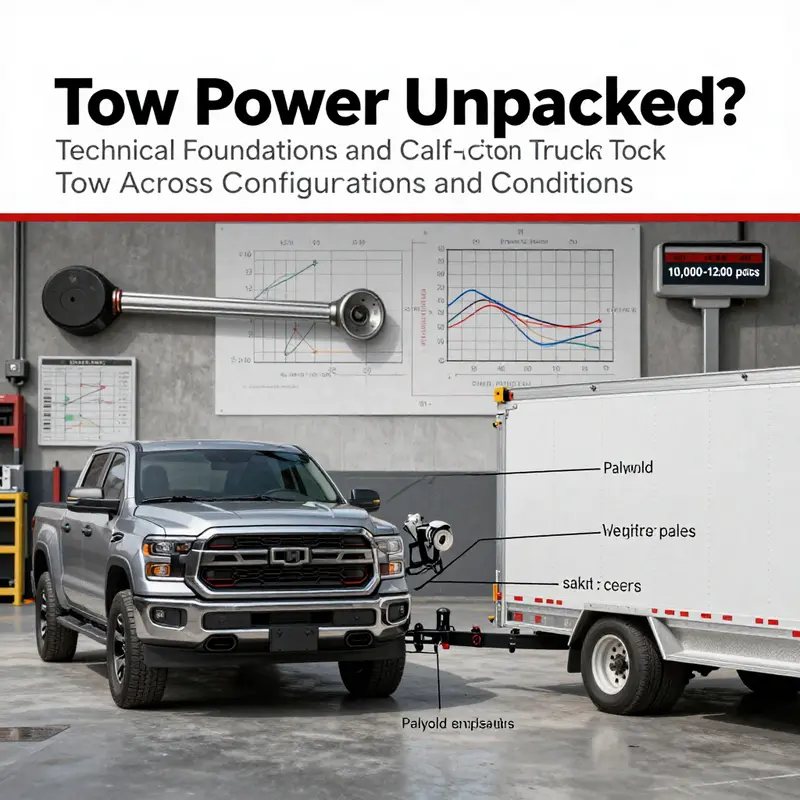
All this technical choreography—engine output, transmission behavior, drivetrain configuration, chassis strength, cooling, suspension, and hitching strategy—leads to a practical reality. The typical towing capacity range for a half-ton pickup, when configured for light-to-moderate hauls and used within design limits, sits roughly between ten thousand and twelve thousand pounds. This window captures most everyday scenarios, including camping trailers, larger boat trailers, and substantial enclosed or open trailers used for work or recreation. Yet the same class of trucks can approach or exceed fourteen thousand pounds in configurations engineered for higher-demand towing, with specialized powertrains, upgraded cooling, and reinforcing hardware. Conversely, some setups with smaller engines or lighter chassis elements will settle toward the lower end of the spectrum, around eight thousand pounds. These variations remind us that a number printed on the window sticker is a snapshot—one that must be interpreted in light of the specific truck’s configuration and the trailer’s weight and distribution. In real-world terms, that means you need a comprehensive plan before you hook up anything significant. You should evaluate your cargo, your trailer, and the route you intend to travel, then verify the exact numbers from the manufacturer’s specifications for your exact year, trim, and option package.
To connect this framework to practical decision-making, consider the following approach. Start with the trailer’s gross weight, including everything on board and inside, and add a clear estimate of the tongue weight, which you can compute or measure by following standard guidelines. Next, subtract the trailer’s weight from the vehicle’s stated towing capacity to understand how far you are from the limit. Remember to account for payload in the truck rails; even if the trailer’s weight is within the stated range, the combined load of passengers and cargo in the truck can encroach on the margin and, in extreme cases, push the actual capacity below the trailer’s weight. A careful calculation is not merely about meeting a number; it’s about preserving braking performance, steering precision, tire load capacity, and overall vehicle safety. If you anticipate frequent or long-haul towing with near-limit loads, a more conservative plan—opting for a trailer lighter than the maximum and maintaining a generous margin of safety—will pay dividends in reliability and peace of mind. Thoughtful preparation also means staying within legal limits and checking that every component—hitch, wiring, brakes, tires, and load distribution—meets the prescribed standards.
For a practical, model-specific reference that translates the general rules into concrete guidance, you can consult a dedicated, user-focused overview that helps translate the numbers into real-world choices. How much can my truck tow? This resource walks through the kind of calculations and considerations that shape safe towing for any given configuration, keeping the focus on practical outcomes rather than abstract maximums. How much can my truck tow offers a disciplined framework for evaluating your exact setup and matching it with a trailer that respects the vehicle’s limits. Beyond the formula, the discussion emphasizes the importance of balancing performance with control—using weight-distribution strategies, choosing appropriate hitch hardware, and respecting the trailer’s braking needs to maintain reliable handling on the highway.
In the end, the capacity of a half-ton truck to tow is not a single figure but a function of the entire system—a relationship among engine and transmission, drivetrain, structural strength, cooling, suspension, and the hitching arrangement. When you combine a capable powertrain with a well-designed support system and a trailer that respects the truck’s limits, the towing experience becomes not just about pulling weight but about maintaining control, safety, and comfort on the road. The practical takeaway is clear: know your exact configuration, understand how weight distributes across the rig, and plan for real-world conditions rather than chasing the theoretical maximum. With careful planning, you can tow confidently, knowing your half-ton pickup is operating well within its technical foundations and capacity determinants.
External resource for safety guidance: https://www.equalizerhitch.com/blog/how-to-tow-safely-with-a-half-ton-truck/
How Much Can a Half Ton Truck Tow? Real-World Configurations and Model-Specific Capacities
When people inquire about the towing limits of a half ton pickup, they are often chasing a single number that will reliably apply in every situation. Yet the reality is more nuanced. A half ton truck is a category defined by its payload capacity, roughly around 1,000 pounds in the bed, not by a single towing ceiling. The towing capacity you actually see on the label in your door jamb is a composite figure that reflects choices made at the factory—engine, drivetrain, axle ratio, transmission, and whether you opt for a specialized trailer tow package. Given those variables, the practical towing range is not a single line but a spectrum, typically starting near ten thousand pounds and climbing well past that under the right configurations. The same chassis that carries gear in its bed can, with the correct powertrain and towing gear, haul considerably heavier trailers. It is a reminder that towing capability is a system property, not a solo attribute of the frame or the engine alone. To understand what that means in everyday terms, it helps to trace how the different pieces interact and why the numbers you see on the sticker may not tell the whole story of what you can safely tow in real conditions.
The core concept to keep in mind is the distinction between payload and towing. Payload, the bed load plus passengers, speaks to how much you can carry in the truck itself without overworking the springs and the chassis. Towing capacity, in contrast, is the maximum weight of a trailer that can be pulled under specific test conditions, including certain speeds, braking, and sway control. The two figures are related, but they are not interchangeable. A model chosen with a robust towing package may surpass the baseline figures found on the simplest configurations, while a lighter setup with a smaller engine or fewer trimmings may fall toward the lower end of the range. The practical take-away is straightforward: if your job involves hauling a trailer, you want to match the trailer’s gross weight to a configuration that the manufacturer explicitly supports for towing, and you should verify this against the exact figure in your owner’s manual or the door jamb sticker for your specific build.
The spectrum of towing capacity within the half ton class reflects several levers that manufacturers pull to improve numbers. Engine design is the first lever. A more powerful V6 or V8, including turbocharged variants, can produce higher torque at the rpm range used during towing, which translates into better ability to move a loaded trailer from a standstill and maintain speed on grades. The transmission and its gearing are the next critical piece. A transmission that can hold higher torque without overheating, paired with a suitable torque converter or dual clutch arrangement, reduces heat buildup and keeps the driveline within safe limits when towing heavy loads. The rear axle ratio is another big factor. A taller numerical ratio (for example, a 3.55 or 3.73) improves pulling power but can affect highway fuel economy. The balance chosen by the manufacturer reflects expected usage: everyday commuting with occasional heavy towing, or frequent, long-distance towing of heavier trailers.
Another essential element is the trailer package itself. The heavy-duty tongue and hitch, along with integrated trailer brake control, stabilizing features, and trailer sway control, can turn what might be a theoretical capacity into practical performance. A heavy-duty hitch and a properly tuned brake controller matter, especially for longer tows or those with a steep grade, where braking force and trailer stability become the main limiting factors. The overall weight of the trailer and its cargo, the distribution of that weight, and the rolling resistance plus wind resistance encountered on the road can shift how close you get to the label’s limit. This means two identical half ton pickups with the same engine can perform differently if one is paired with a different hitch, braking system, or trailer setup. The sticker you find on the driver’s door jamb is not merely a number; it is the manufacturer’s composite judgment about how the whole configuration behaves under prescribed testing and safe operating limits.
With these ideas in mind, the typical towing range you will encounter in the market sits roughly between ten thousand and twelve thousand pounds for many base-to-mid configurations. This is the practical norm where most entry-to-mid trim levels, when equipped with a suitable tow package, tend to land for everyday towing tasks such as landscaping trailers, small to medium campers, or trailer units used in light commercial work. It is common to see higher capacities—up to or beyond twelve thousand pounds—in models that offer stronger engines, upgraded transmissions, and a dedicated heavy-duty tow package. In those higher configurations, some trucks can approach fourteen thousand pounds when the engine, transmission, cooling, and trailer package all align with the demands of a heavy load. At the lower end, where smaller engines or lighter chassis are paired with less robust towing options, the rating can slip closer to eight thousand pounds. This spread is not a flaw; it is a reflection of an industry that shares a base chassis across several trims and powertrains, then tailors the capabilities to target different work and lifestyle needs.
An important caveat for anyone planning a specific tow task is that the stated towing capacity is not a blanket guarantee for every trailer of that weight. It assumes proper loading, correct hitch selection, and adherence to the manufacturer’s guidelines. Tow less than the maximum, but do it consistently, and you gain a margin that helps protect the drivetrain, brakes, and cooling system. To translate this into practical steps, you begin by knowing the trailer’s gross weight rating and, more important, its gross vehicle weight rating when connected to the tow vehicle. The trailer’s weight should be considered alongside the vehicle’s GCWR—gross combined weight rating—which is the maximum permitted weight of the vehicle plus the trailer and cargo. If your intended combination approaches or exceeds the GCWR, you will be operating outside the manufacturer’s tested limits, even if each component seems within its own spec. This is not just a paper figure; it has real consequences for braking distance, steering response, and overall safety on the road. For this reason, many operators who tow regularly carry a gauge of caution, treating the manufacturer’s numbers as a ceiling rather than a target and planning trips with extra margin when possible.
In real-world driving, several conditions can erode that theoretical ceiling. Terrain plays a major role. Uphill climbs require more torque and can cause heat to accumulate in the transmission and engine. Strong crosswinds can produce trailer sway or add to the workload of the truck as it tries to maintain a straight path. Altitude can sap power from naturally aspirated engines and even turbocharged engines, depending on the design. Road surface matters as well; poor pavement, potholes, or uneven grades can shift weight transfer in ways that stress suspension and tires beyond what the rating counted on. Then there is the factor of maintenance and wear. A truck that only occasionally tows light loads may still be capable of handling heavier weights in a pinch, yet the wear on cooling systems, brakes, and drivetrain components grows with heavy use. These realities reinforce a simple rule of thumb: the label is a maximum, not a guarantee, and safe towing requires careful planning, conservative loading, and regular maintenance checks.
If you are new to towing, a practical approach is to start with your trailer’s weight, including cargo, and compare it to the lower end of the half ton pickup’s towing range. From there, you can choose a configuration that includes the trailer tow package, a suitable hitch class, and a properly rated braking system. It is also worth considering the payload capacity because it governs how you distribute weight. A trailer that is a bit heavier than your payload can still be towed if you keep passengers out of the cab and limit the cargo in the bed, but such an arrangement may reduce overall stability and increase the risk of overloading the rear axle. The sticker on the door jamb will typically show both the payload and the towing capacity for your exact build, a reminder that the two figures move in tandem as you choose options and trim levels. This is why the same family of trucks can appear in the market with a wide range of towing figures, and why it is essential to verify the precise capacity for your exact truck, not rely on a general shorthand.
For those who want a quick sense of how a given half ton can perform, there is a practical resource that outlines how these trucks are typically configured for towing and how the numbers come together in everyday use. This guide emphasizes the importance of configuration and what it means to pair the truck with a well-muited trailer and hitches. It presents a realistic picture of how the weight, the trailer, and the road conditions interact, and it avoids the trap of treating the label as a single, definitive maximum in all situations. For readers seeking a concise, real-world orientation with practical takeaways, this resource offers a grounded perspective on the interplay of engine, drivetrain, and trailer in the half ton segment. How Much Can My Truck Tow provides a practical overview of how configurations influence towing performance and what to verify before you hitch up.
In addition to these considerations, qualifying your own needs helps determine the right configuration. If you regularly move heavy trailers for work, the economics of upgrading to the higher end of the spectrum pay off in reduced strain on the powertrain and more predictable handling. If towing is occasional or limited to small trailers, a base-to-mid configuration with a robust tow package often delivers ample capability without adding unnecessary cost or weight. The consumer decision becomes a question of how often you tow, how far you travel, and what kind of terrain you encounter. The kind of trailer you pull—whether it carries equipment, livestock, or a family camper—also shapes the choice of hitch, braking system, and load distribution strategy. The more you know about your typical towing profile, the more accurately you can align the truck’s configuration with your real-world needs, ensuring you stay within the safe envelope while still enjoying the convenience and versatility that a half ton pickup offers.
For readers who want to ground this discussion in official figures, there is value in looking at manufacturer specifications, which exist to guide buyers toward safe and reliable configurations. The towing capacity is not a single universal ceiling; it is a carefully calibrated number that accounts for the entire system—engine cooling, transmission resilience, braking capacity, suspension limits, and the dynamics of towing at highway speed. While the common range for many half ton trucks sits in the ten to twelve thousand pound band, it is entirely possible to see figures that stretch toward fourteen thousand pounds in the right setup, or drop toward eight thousand pounds in lighter configurations. The critical practice is to confirm the exact capacity for your exact model and trim level and to tail the trailer choice and hitch setup to that specification. This disciplined approach helps prevent overloading and ensures longer life for the drivetrain while maintaining safe handling on the road.
For readers who want a quick, practical anchor, remember that the door jamb sticker is your first and most trustworthy reference. Then, use the trailer’s weight and the GCWR to map out a safe operating window. If your plan involves longer trips or heavier payloads, consider a configuration upgrade that aligns with your towing goals. The goal is not to chase peak numbers but to achieve a reliable, repeatable towing setup that prioritizes safety, stability, and long-term vehicle health. As you explore the market, you will encounter a broad spectrum of configurations. The same underlying chassis can serve a variety of needs, and the right choice hinges on how you plan to live with your tow rig day to day. For those who want to see the broader landscape of implications and practical guidelines for towing with a half ton pickup, the discussion here aims to translate numbers into a sensible, road-ready approach that respects the limits while enabling dependable performance. In the end, towing capacity is a tool, not a trophy; used wisely, it helps you move your world with confidence and safety.
To summarize, there is no single number that captures the full story of how much a half ton truck can tow. The figure shifts with engine choice, gearbox, axle ratio, and the presence of a dedicated trailer tow package. Across the half ton spectrum, you can expect a practical window from around eight thousand to just over fourteen thousand pounds, with the majority clustering near ten to twelve thousand for standard configurations, and higher figures achievable with the most capable combinations. The key is to verify your exact build, understand the GCWR, and respect the conditions under which the rating was determined. With careful planning, the right equipment, and a clear view of your towing needs, a half ton pickup can be a versatile and capable partner for a wide range of towing tasks—one that is defined by thoughtful configuration as much as by raw power.
For an external reference that adds clarity to model-specific discussions and official specifications, see manufacturer guidance that details towing capacities by configuration and option packages: https://www.ford.com/trucks/f-150/.
Tow Capacity Realized: The Economic and Operational Realities of Towing with Half-Ton Pickups

When people ask how much a half-ton truck can tow, they often imagine a simple ceiling that resembles a single number on a spec sheet. Yet the reality is more nuanced. A half-ton pickup is built around a defined payload capacity—roughly one thousand pounds in the bed—that governs how much weight the truck can carry while in motion. Tow capacity, however, is a separate calculation tied to the engine, cooling system, transmission, axle gearing, and the vehicle’s overall chassis design. It is not only about raw power; it is about how that power is managed, how the weight is distributed, and how well the truck can sustain performance across a journey that includes hills, long stretches of highway, and the frequent stops that mark real-world use. In practical terms, half-ton pickups commonly tow a broad range that stretches from ten thousand pounds to twelve thousand pounds under properly configured setups. This bracket reflects a balance between capability and safety, and it assumes the right equipment—heavy-duty trailer hitches, snug engine tuning, and a drivetrain designed to handle sustained load. It is not a universal guarantee, and it can vary markedly between trim levels, engine choices, and even the addition of features like upgraded cooling, transmission coolers, or integrated trailer sway control. Some configurations, particularly those equipped with larger, more robust powertrains and heavier-duty chassis components, approach higher limits, and a few outliers in the broader half-ton family have even pushed toward fourteen thousand pounds in specific, well-balanced configurations.
It is crucial to interpret these numbers as maxima under controlled conditions, not as a mandate for every heavy trailer that passes by. In real life, every towing decision begins with a careful assessment of the gross trailer weight, the tongue weight, and the vehicle’s own weight rating. The tongue weight—the portion of the trailer’s weight that rests on the hitch—typically amounts to about ten to fifteen percent of the trailer’s total weight. This figure matters more than most drivers realize, because tongue weight directly affects steering feel, braking effectiveness, and overall handling. A trailer that is too heavy at the tongue can push the vehicle forward or cause the rear suspension to compress in ways that degrade control. Conversely, a trailer that is too light at the tongue can produce sway and instability in gusts of wind or sudden lane changes. The interplay between tongue weight and gross trailer weight is a constant negotiation that drivers navigate with a mix of math and intuition learned through experience.
To put the numbers in a useful frame, consider a scenario where a half-ton pickup is towing a trailer near its upper limit while traveling on a grade. In such a setting, the drivetrain and cooling system must work in concert for extended periods. The engine must produce enough torque to accelerate from a standstill and maintain speed on climbs, the transmission must sustain appropriate gear ratios without overheating, and the brakes must dissipate energy from a heavy load on descending grades. The vehicle’s suspension must manage the weight transfer that comes with braking and cornering, all while keeping ride stability for the occupants and ensuring that the trailer remains aligned with the tow vehicle.
These are not abstract concerns. They translate into measurable consequences: higher fuel consumption, increased wear on components, and, crucially, a shift in the vehicle’s handling characteristics. When any of these aspects push toward their limits, the chance of fatigue in the engine, transmission, brakes, or suspension rises. That is not an existential warning about a single trip; it is a sober reminder that every additional mile under load compounds stress, and with stress comes the potential for longer maintenance intervals or unexpected repairs.
The economic dimension of towing with a half-ton truck is inseparable from these mechanical realities. Fuel economy drops when a trailer is attached, particularly if the towing involves frequent accelerations, climbs, or headwinds. The engine operates at higher loads for longer periods, which pushes it to burn more fuel per mile. The cost implication compounds over time: more frequent maintenance to address heat-related wear, earlier tire replacement due to added rolling resistance, and potentially higher insurance premia if a vehicle is used to tow in a high-risk or high-mileage context. For households or small businesses that rely on a half-ton pickup for regular towing, these costs accumulate. It is essential to compare not only the upfront capability but also the long-term operating expenses.
The broader story includes safety—both in the moment and across the vehicle’s life. To tow near the maximum rating or to routinely carry heavy loads, drivers should ensure the tow package is complete with a sturdy hitch, a rated load ball, brakes engineered for towed weight, and, when appropriate, a weight distribution hitch that redistributes some of the trailer’s tongue load to the tow vehicle’s front axle. Without these elements, even a vehicle with ample theoretical towing capacity may underperform in practice, or worse, experience stability problems at critical moments such as emergency maneuvers or steep descents.
The distinction between maximum towing capacity and everyday towing is therefore not merely academic. It shapes how owners plan trips, how they service their vehicles, and how they weigh the economics of their transportation choices. In that regard, some traders of experience describe a practical rule of thumb: treat the official towing rating as the ceiling you seldom touch, and structure trips around a conservative margin that accounts for terrain, weather, and trailer condition. This mindset preserves both safety and vehicle longevity, while also preserving the truck’s resale value by avoiding repeated near-limit operation.
It is also important to recognize the nuanced difference between GVWR — the gross vehicle weight rating, which includes payload in the truck bed and any passengers — and the towing capacity, which speaks to the trailer’s weight under towing conditions. Exceeding either number invites safety risks and may invalidate warranties, depending on the manufacturer’s terms.
For the reader who wants a practical compass, consider this: before attaching a trailer or any heavy load, measure the trailer’s gross weight and compute the tongue weight. Validate that the sum of the trailer weight and the vehicle’s own weight, including passengers and cargo, stays under GVWR, and that the trailer’s weight does not exceed the vehicle’s stated tongue and overall towing limits. If you intend to use the truck in a high-frequency towing context — such as recurring boat hauling, large equipment transport, or frequent long-distance trips on hilly roads — explore whether the model family you are considering offers optional upgrades that improve cooling capacity and transmission robustness. These upgrades tend to translate into better real-world performance, less heat soak, and longer life for critical components under sustained load.
Acknowledging these realities, it becomes clear that decision-making around towing is not solely about peak numbers; it is about the confidence to pull safely and efficiently, day after day. For readers who want a concise path to broader understanding, a practical resource worth consulting addresses the everyday question of “What can my specific truck tow?” The answer depends on the exact configuration, including engine, drivetrain, hitch class, and any towing-enhancing packages. A careful read of manufacturer guidance, paired with a realistic appraisal of how you plan to use the vehicle, yields a plan that respects both capability and limits.
If you want to connect this call to action with a concrete starting point, see the detailed guidance on a related topic that focuses on the practical limits of a given truck and its towing opportunities: How Much Can My Truck Tow. This resource can help translate the general framework described here into model-specific expectations and planning, while reminding readers that the safest, most economical approach is to build a margin into every towing scenario.
Tow planning also benefits from appreciating the environmental side of the equation. Towing imposes additional engine load, which can alter exhaust emission profiles in ways that are sensitive to operating mode. Acceleration, sustained cruising, and even idling through stops influence NOx and CO emissions. In studies of light-duty trucks, researchers have shown that emissions can vary significantly with the mode of operation and that towing generally elevates emissions compared with unhooked driving. These findings matter not only for compliance with environmental standards but also for the broader footprint of personal and fleet towing. They remind operators that the cost of heavy towing can extend beyond fuel and maintenance, touching regulatory considerations and community impacts as well.
The practical takeaway is straightforward: towing a heavy trailer with a half-ton pickup is a powerful capability that delivers substantial utility but comes with responsibilities. It demands respect for the rating, prudent load management, and an awareness of how sustained weight affects the vehicle’s mechanical integrity, fuel economy, and emissions. The decision to tow near or at the upper end of the capacity range should follow a deliberate calculation that weighs the benefits of the extra utility against the costs — fuel, wear, potential risk, and the environmental footprint.
The landscape of modern half-ton pickups is rich with options to tailor performance to real-world needs. Yet every choice carries a trade-off. Buyers who intend to rely on heavy towing should budget not only for the trailer itself but for enhanced cooling, robust braking systems, and possibly upgraded suspension components. They should also plan for a higher frequency of routine maintenance and a more attentive approach to vehicle load management, including load distribution, tongue weight control, and hitch compatibility.
The overarching message is that capacity is a tool — one that can transform how a household or a small business operates when used wisely. Before a heavy pull, the prudent step is to confirm that the load is within a safe margin of the vehicle’s official rating, ensure the hitch and braking system are designed for the task, and commit to ongoing maintenance that preserves performance under load. In that sense, the half-ton truck remains a remarkably versatile class, capable of moving substantial weights while serving daily duties with efficiency and reliability.
The numbers, while impressive, are only part of the story. The real value arises when drivers pair capability with disciplined practices, making informed choices about when to tow, how to distribute weight, and how to maintain the vehicle so that the journey remains smooth, predictable, and within the bounds of safety and responsibility.
For readers who want to deepen their understanding of the broader implications of towing on performance, cost, and emissions, the EPA offers guidance on light-duty truck emission rates in towing scenarios that complements the practical insights shared here. External readers can consult the EPA’s emissions guidance to better understand how towing influences pollutant outputs across different operating modes. External resource: https://www.epa.gov/vehicleandfuel-emissions-guidance/light-duty-truck-emission-rates-towing
null
null
Final thoughts
The practical takeaway is clear: for everyday drivers, residents, and professionals who rely on light-duty pickups, a half-ton truck sits at a precise balance point. Its bed payload plus its towing capacity are both engine- and configuration-dependent, so confirming exact numbers for your trim, drivetrain, and hitch setup matters before pulling heavy loads. By interpreting engineering foundations, examining model-specific configurations, weighing economic and operational impacts, and adhering to safety and regulatory guidance, you can maximize efficiency, protect equipment, and reduce risk. When towing beyond the recommended limits, consider higher-capacity platforms or professional fleet solutions to keep progress steady and safe.