
Towing is a frontline service that keeps roads clear after breakdowns, accidents, and heavy congestion. Earnings vary widely across Canada and the United States, driven by technology platforms, local demand, and how work is organized. Everyday drivers, residents and commuters who rely on roadside assistance, truck owners who maintain fleets, auto repair shops and dealerships that depend on reliable service, and property managers coordinating on-site support all feel the impact of pay structures in this sector. This piece connects three lens facts to the bottom line: the technology that matches jobs and routes, the macro and regional economics that set pay floors and premiums, and the social dynamics shaping who works in towing and under what terms. By weaving together data from major markets with practical implications for service levels, pricing, and partnerships, readers gain a holistic view of how much tow truck drivers make and why those numbers differ. The following chapters translate complex market signals into actionable takeaways, so drivers can position themselves for higher earnings, shops can optimize dispatch and staffing, and property managers and residents can anticipate response times and costs.
null
null
Tow Wages on the Open Road: The Economic Landscape and Regional Variations Shaping Tow Truck Driver Earnings
Wages for tow truck drivers don’t rise or fall in a vacuum. They ride along the curves of geography, demand, and the daily realities of work schedules. In the broadest terms, pay reflects where you operate, how you operate, and how much value an employer assigns to the skill set required to haul disabled vehicles, clear accident scenes, or respond to sudden roadside crises. The picture is complex but navigable if you read the terrain carefully. A useful starting point is the way pay is reported in major labor markets. In the United States, the latest compilations place the national average around the low twenty-dollar range per hour—roughly $21.13 on an hourly basis when drawn from thousands of salary reports accumulated over a multi-year window. That figure isn’t a ceiling; it’s a baseline, and it gains or loses altitude with shifts in traffic, weather, and the likelihood of overtime and shift differentials. In practice, those who work in dense urban centers and who have accumulated experience—especially in firms with more demanding call volumes or specialized fleets—often see the hourly mark push past $25. In some workplaces, overtime and premium shifts can lift earnings toward or beyond the mid-$30s per hour, depending on the region and the employer’s compensation strategy. The essential takeaway is that the U.S. market rewards volume and reliability. Where there are more calls, more towing requests, and more accident-related incidents, the potential to earn increases, particularly when the shop maintains a policy that monetizes overtime, after-hours calls, or night shifts. The constant variable in the American landscape is not the math of rates alone but the balance between pay and the cost of living in a given metro area. This balance matters because a dollar earned in a high-cost metropolis buys less in real terms than the same dollar earned in a lower-cost region, even if the hourly rate appears higher on paper.
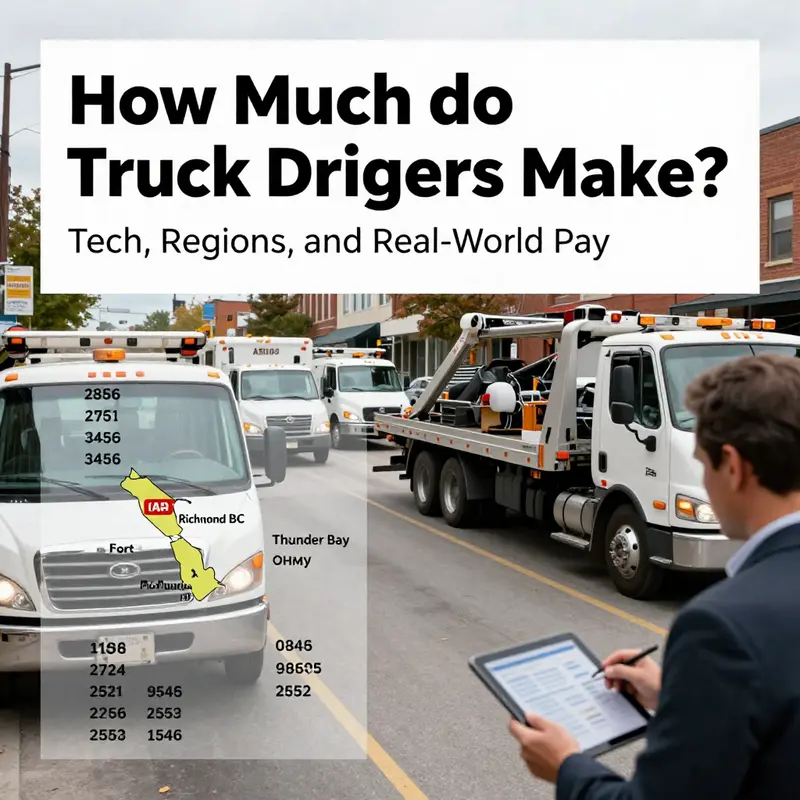
Across the border to Canada, the wage story follows a similar logic but with its own regional contours. The national snapshot in Canada places the average around $17.75 per hour, based on summarized salaries reported in recent years. That figure sits near the U.S. midpoint in many provinces, but the regional spread is wide enough to matter for drivers evaluating career options, shifts, and liveable wages. In British Columbia, the overall average hovers close to the national figure at about $17.85 per hour, but there are pockets within the province where the pay vaults higher. The coastal city regions can push average earnings up, with some centers showing a consistent pattern of higher pay for experienced drivers or those who handle specialized assignments. For example, the highest-paying city in British Columbia among reported data sits around the mid-$24 per hour mark, a clear signal that urban demand, traffic density, and fleet requirements combine to elevate compensation. In practice, in Metro Vancouver and other large BC municipalities, the base rate frequently converges toward the national average, while seasoned drivers who take on complex tasks—such as recovery operations, heavy-duty tows, or complex unlocks in congested markets—can approach or exceed the mid-$20s per hour. Alberta presents a more variegated view. On average, Alberta pays about $16.01 per hour, which sits roughly 10 percent below the Canadian national average. Yet Alberta is also home to dramatic case studies where pay scales rise sharply in high-demand contexts. In energy-rich hubs, where demand for tow services spikes during emergency responses or heavy industrial activity, wages can jump to the upper end of the spectrum. For example, in Fort McMurray, pay ranges reported for tow drivers show numbers in a much higher bracket, with some postings listing wages that translate to well over $40 per hour on an hourly basis. Calgary and Edmonton also report above-average figures in certain postings, with individuals able to command roughly $36 to $39 per hour in specialized or senior roles. Ontario’s landscape is perhaps the most varied of the Canadian provinces. In Thunder Bay, the reported hourly wage peaks around $26.53, the highest in the country among the cited data, signaling that northern markets with larger geographic terrains and unique service demands can sustain higher base rates. Ottawa’s market settles around $25.19 per hour, while Whitby and other Ontario centers show a broader amplitude—some listings translate annual earnings for full-time roles to roughly $50,000 to $80,000, which, when broken down, can equate to about $24 to $38 per hour depending on the structure of the job and the number of hours worked. The Ontario range highlights a practical reality: full-time, well-supported positions—especially those with extended hours or weekend coverage—tend to bring in higher annual compensation that, on a per-hour basis, can exceed the standard hourly rate in other parts of Canada.
The maritime province of Nova Scotia offers its own narrative. In Dartmouth, the typical hourly wage falls around $15.70, which sits noticeably below both the Canadian and U.S. national averages in this specific dataset. The Nova Scotia numbers remind readers that regional demand for towing services and the density of call volumes influence what a driver can reasonably expect to earn. It is not that the work becomes intrinsically more or less demanding in these areas, but rather that the market pressure to sustain a full-time operation, the availability of steady calls, and the willingness of local fleets to offer competitive compensation differ from one province to the next.
The broader job-market insights behind these figures emphasize a simple but powerful principle: pay scales tend to track urban density, traffic flow, and the scope of services offered by a shop. In high-traffic metropolitan areas—whether in the United States or Canada—drivers often contend with longer shifts, greater unpredictability, and a steadier stream of emergency or on-demand work. The result is a compensation structure that rewards dependability and persistence. Full-time roles in such markets frequently provide more robust benefits, more predictable hours, and clearer career ladders that can justify higher wage floors. Even within the same city or region, the compensation can differ substantially based on whether the employer operates a large fleet with a formal wage schedule or a smaller shop that negotiates rates on a case-by-case basis. The risk-reward calculus for the driver thus goes beyond a single hourly figure; it includes the frequency of calls, the type of tows (breakdowns versus recoveries versus emergency response), and the stability of the employer’s schedule and benefits.
Beyond the headline numbers, there are practical, day-to-day factors that shape pay. Premium pay is a common feature in this field, reflecting the realities of working odd hours, weekends, and difficult weather. Night shifts and weekend calls often carry a premium that makes the hourly rate more attractive, especially when the base rate is tempered by the cost of living in a given region. In some markets, the premium for hazardous weather, high-risk scenes, or complex recoveries can be significant enough to push the overall earnings toward the higher end of the local spectrum. The bottom line is straightforward: the more demanding the operating environment, the more employers tend to invest in compensation to attract and retain capable drivers.
To paint a concrete, non-generic picture, consider the sort of real-world scenarios a tow truck driver might navigate. In large urban centers with heavy traffic, drivers are likely to face longer response times, frequent roadside incidents, and the need to coordinate with police departments, road services, and insurance partners. These drivers gain experience at a speed that translates into better pay through overtime and shift differentials. A driver who has earned a reputation for safe, efficient, and reliable service may find that their value rises as they take on more complex recoveries and more time-sensitive calls. Conversely, in rural or lower-demand areas, the volume of calls may be steadier but less intense, so base rates tend to be lower, and opportunities for overtime are fewer. In such settings, employers may lean on a lower cost base to sustain operations, even though the work remains essential to keeping roads accessible and safe.
The earnings narrative also has a practical, personal dimension. For someone evaluating a career in this field, the math involves more than the hourly rate; it includes how many hours one can realistically work, how many days per week, and whether the job offers a predictable schedule that aligns with personal life. In markets with high call volume and robust dispatch operations, a driver may be able to keep a steady rhythm of shifts, including nights and weekends, while still securing a sustainable lifestyle. In markets with fewer calls, a person may need to supplement with additional side work or diversify into related roles, such as fleet maintenance, training, or related emergency-response positions. The best-paid drivers often combine technical skill with strategic scheduling and a willingness to work across shifts that others may avoid.
From an employer’s standpoint, the economics of tow services hinge on balance—between the cost of maintaining a fleet and the revenue from rapid, reliable service. In many large markets, a stable pay framework is paired with structured benefits, paid time off, and a clear pathway for advancement into supervisory or training roles. In smaller markets, the model may be more flexible, with pay tied to performance metrics, call quotas, and the ability to handle a broader array of tasks with limited manpower. In both cases, the key to maximizing earnings is consistent performance, geographic flexibility, and an understanding of when to pursue higher-paying shifts or more demanding assignments.
For readers seeking current, role-specific pay estimates, the landscape is easily navigated through salary platforms and labor market reports. In the U.S., multiple sources converge on the figure around $21 per hour as a baseline, with potential to exceed $25 in high-demand areas and with experience. In Canada, the averages hover near $18 per hour, with notable exceptions in major urban centers and in particular provinces where specialized or unionized roles can push rates to $36.10 per hour or higher, depending on the local market and the nature of the work. The overall message remains consistent: regional variations are not merely numbers on a page; they reflect a mosaic of call volume, cost of living, and the strategic choices drivers and employers make about scheduling and incentives.
For those curious about the broader context of how these wages translate into real-life decisions, it helps to examine the mechanics of a typical full-time position. A full-time tow truck driver often has a baseline hourly wage augmented by overtime, after-hours bonuses, and shift differentials. In parts of the market, there are even structured compensation packages that include guaranteed weekly hours and benefits. While shifts can be highly variable—depending on weather, holidays, and the timing of incidents—consistent, reliable drivers who can handle complex or high-volume routes will find that their earnings accumulate in a way that surpasses the minimum expectations of the job. In this sense, the work becomes not only about the miles traveled but about the value created by dependable, timely service under pressure. The more a driver is trusted to respond quickly, to recover difficult vehicles, and to operate safely under challenging conditions, the more that value is recognized in pay either through higher hourly rates, overtime, or a more favorable overall compensation package.
A practical note for prospective readers who want to gauge their own potential: start with the numbers, then consider how your locale and your skill set interact. If you live in a city with high traffic density and a dispatch-first operation, your earning potential increases with every late-night tow and every weekend call you take on. If you are in a region with fewer calls but steadier demand and a favorable cost of living, your base pay may be sufficient to sustain a solid, predictable lifestyle. If you bring specialized skills—such as heavy-duty towing, recovery from difficult terrains, or coordination with emergency response agencies—you can position yourself for premium pay in both the U.S. and Canadian markets. And if you are evaluating a career change or entering the field, you will find that the job market rewards the combination of practical experience, reliability, and a willingness to adapt to the rhythms of the road—and that those attributes, more than any single rate, shape long-term earnings.
For readers who want a quick, practical sense of current pay ranges in the United States, the data show a consistent pattern: the average hovers around $21 per hour, with significant upside in urban hubs and for experienced drivers who can leverage overtime and special duties. Canada presents a similar arc, with a wider dispersion that reflects provincial economies and local demand. In Alberta’s energy-focused towns, a striking contrast emerges between the provincial average and the upper-tier postings seen in service-heavy, high-demand contexts. Ontario’s market showcases similar dispersion, where northern and southern centers may offer different scale and opportunities, while the annual compensation in some full-time roles can translate into relatively generous hourly equivalents when viewed through the lens of annual pay. Nova Scotia and Atlantic markets generally show lower base rates, underscoring how regional demand and market competition shape earnings in more rural or smaller-city settings. Across these patterns, the constant is clear: the trade-off between volume, timing, and complexity of work—that trio of elements that makes a tow truck driver essential to road safety and mobility—also defines the spectrum of pay.
If you want to explore the underlying questions that frame these wages—how much a tow truck costs to operate, what drives pricing for tow services, and how market dynamics translate into a driver’s take-home pay—there is a rich, practical resource you can consult. The linked discussion provides a grounded look at the cost structures, labor dynamics, and regional differences that shape earnings in the towing world. You can read more about it in the article on how much a tow truck costs and how that cost structure feeds into driver pay and business models. How much is a tow truck
In sum, tow truck driver earnings are not a single number but a spectrum shaped by where you work, the size and type of employer, and how much responsibility you take on. The highest earnings tend to cluster in urban markets with high call volumes, complex towing scenarios, and robust overtime policies. Yet even in markets where the base rate is lower, a driver who combines experience, reliability, and the willingness to work challenging shifts can build a solid financial picture over time. For job seekers, this means that choosing the right region, aligning with a firm that values steady coverage, and pursuing opportunities that offer overtime or premium shifts can transform a modest hourly rate into a meaningful annual income. For employers, it underscores the importance of building dispatch systems, safety programs, and incentive structures that attract and retain drivers who can deliver fast, safe, and reliable service when the roads demand it most.
External resource: https://www.indeed.com/career/tow-truck-driver/salaries
null
null
Final thoughts
Across borders, tow truck earnings hinge on three pillars: technology that speeds the right job to the right driver, market conditions that reward scarcity or volume with premiums, and workforce choices that affect stability and growth. For Everyday Drivers and commuters, faster response times and predictable pricing are balanced by higher costs in hot markets. Truck owners and auto shops gain from reliable dispatch and well-trained crews that maximize utilization. Property managers benefit from clearer pricing and dependable on-site support. Canadian and U.S. data show averages in the low to mid-20s per hour in the United States and Canada roughly in the mid-teens to mid-20s, with regional outliers where premium pay is possible. Understanding these dynamics helps stakeholders negotiate service agreements, budget maintenance, and plan capacity. As technology evolves and regional markets shift, earnings will continue to move with demand, competition, and policy changes. The practical takeaway is to align expectations with local markets, leverage tech-enabled dispatch to boost efficiency, and choose employment structures that balance income stability with earning potential.