
Understanding how much your truck can tow affects daily commutes, weekend projects, and professional decisions alike. Towing capacity isn’t a single number; it results from how a vehicle is built, the ratings it carries, and the trailer and cargo you plan to haul. Distinguishing towing capacity from payload—the weight you can carry in the bed and cab—helps you avoid unsafe overloading and costly penalties. This guide speaks to Everyday Drivers who rely on their truck for family trips, Residents and Commuters who occasionally haul gear, Truck Owners weighing trailer upgrades, Auto Repair Shops and Dealerships advising customers, and Property Managers moving equipment between sites. The following chapters build a practical framework: Chapter 1 clarifies towing vs payload basics; Chapter 2 explains GVWR, GCWR, axles, and power as core determinants; Chapter 3 grounds the discussion in real-world data, legal considerations, and how to find your exact capacity. Together, they form a holistic view that empowers safe, compliant towing for any scenario.
Tow Limits Demystified: Reading GVWR, GCWR, Payload, and Tongue Weight in Everyday Hauling
When you start planning a move, a camping trip, or a weekend project that needs a trailer, the first question is rarely just “how much can I tow?” It’s more like a puzzle where several moving parts must align: the truck’s own weight, the cargo inside and on the truck, and the weight you intend to pull behind it. The goal isn’t simply to find a big number on a spec sheet. It’s to understand how the numbers relate to each other so you can tow safely, legally, and efficiently. This is where the distinction between towing capacity and payload becomes essential. Towing capacity is the maximum weight a truck can pull behind it, while payload is the weight the truck can carry inside or on it—passengers, tools, cargo in the bed, and any hitch-mounted accessories. Confusing the two is a common mistake that can lead to overstressing suspension components, brakes, and wheels, or worse, compromising stability on the road. The careful reader learns to read the full set of ratings that come with any heavy-duty machine and to apply them to real-world loads with discipline and care.
At the heart of every towing decision rests a trio of core numbers that describe how a vehicle behaves when it is loaded up and connected to a trailer: GVWR, GCWR, and GTW, with tongue weight adding a crucial note on stability. GVWR, or Gross Vehicle Weight Rating, is the maximum allowed weight of the fully loaded vehicle itself. It includes the curb weight—the truck’s own mass without occupants or cargo—plus every passenger, tool bag, fuel, and any other items inside or attached to the truck. Exceeding the GVWR is not just a rule violation; it is a limit on performance and safety. The GCWR, or Gross Combined Weight Rating, goes a step further. It’s the upper limit of the total weight of the truck plus the trailer and its cargo. This figure captures how the whole pairing behaves on the road, including braking, steering, and engine load. Finally, the tongue weight—the downward force the trailer hitch exerts on the hitch receiver—speaks directly to how the rear axle and the hitch interact with the entire system. Too little tongue weight can invite trailer sway; too much can overload the rear suspension and diminish steering control. The sweet spot for tongue weight is commonly about 10 to 15 percent of the trailer’s gross weight, a guideline that helps movement stay stable while braking and cornering.
To see how these pieces fit together in practice, consider how a typical light-duty pickup handles a mid-sized trailer. A truck of this class might have a GVWR around 7,000 pounds. If its curb weight—what the truck weighs empty—sits near 4,000 pounds, the payload is roughly 3,000 pounds. If the manufacturer lists a GCWR of 14,000 pounds, the maximum safe combined weight would cap the trailer’s gross weight such that the total cannot exceed that 14,000 pounds. A straightforward way to frame the math, as many technicians and drivers do, is to think of the towing capacity as GCWR minus the truck’s own weight when loaded with payload. In this example, the usable towing capacity would be about 7,000 pounds, or three and a half tons. Of course, this is a simplified illustration. Real fleets must also respect the limits of the hitch, transmission cooling, brake systems, and axles. Still, the principle remains: GCWR minus the truck’s own loaded weight defines, in broad terms, the edge of what you can safely pull.
A second, more capable class of trucks shifts the scale. Medium-duty trucks, designed for heavy hauling in construction or farming contexts, typically report towing capacities in the range of 10,000 to 20,000 pounds. Here the same logic applies, but the margins and the safety margins widen. The GCWR climbs, so the system can handle heavier trailers with proportionally more caution in how they’re loaded and braked. The heaviest of conventional consumer options—a truly heavy-duty class—pushes well past 20,000 pounds of towing capacity for the most robust configurations. In those cases, the system isn’t just about a bigger engine; it’s about stronger drivetrains, multiple axles, enhanced cooling, and beefier braking systems, all of which contribute to a higher GCWR and a larger payload before you reach the tipping point of control and safety.
One of the most important reminders in these conversations: the numbers you read are maximum allowable limits under specific conditions. They aren’t a mandate to max out every component with every load. The specifications assume the truck is equipped with the appropriate hitch, proper tires, and the right transmission and cooling configurations, and that the entire pairing adheres to the manufacturer’s setup for towing. Exceeding these limits does not just invite fines or penalties in regulated environments; it directly increases the risk of tire blowouts, brake fade, steering instability, and sway. That risk grows with higher speeds, winding roads, windy days, or when towing an especially long or tall trailer. In other words, the towing capacity is a ceiling, not a target for every trip.
To translate these concepts into everyday planning, think of the towing decision as a balance that begins with your truck’s ratings and ends with a trailer that respects those ratings. The first step is always to review the owner’s manual and locate the official numbers for GVWR, GCWR, and any stated limit for the trailer tongue or hitch weight. A sticker inside the driver’s door jamb—often called the placard—will list GVWR, GAWR (Gross Axle Weight Rating) for the front and rear axles, and GCWR close to the top of the sheet. This placard is your first, most reliable reference, and it should be checked each time you load or tow. Beyond that, there are reputable online tools and manufacturer pages that help you cross-check. Some drivers rely on calculators that account for factors like payload, fuel, and passenger count, while others prefer to balance the numbers with the actual weight of their loaded trailer. In any case, the guiding rule remains the same: stay within the GCWR and ensure the trailer’s GTW does not push the system beyond that combined weight.
As you accumulate more experience, you’ll begin to differentiate between what the numbers promise and what your particular setup can handle. Tongue weight, for example, is a subtle but critical factor. If you’re towing a trailer with a heavy load near the trailer’s rear, you’ll see more tongue weight transmitted through the hitch. This increases steering load, reduces weight transfer to the front wheels, and can compromise steering response if not managed. Conversely, trailer setups with lighter tongue weight can reduce rear-axle load but increase the risk of rear-end instability, especially at highway speeds. The sweet spot—typically around 12 percent of the trailer weight—helps maintain a predictable and controllable relationship between the tow vehicle and the trailer. For this reason, weight distribution hitches and dual-cam systems become common enhancements for drivers who regularly tow sizable loads. They help keep the tongue weight within a safe band while distributing hay, lumber, bikes, or campers across the axles of the truck in a way that preserves braking performance and steering feel.
When you move from theory to practice, the numbers begin to interact with a host of other variables. Transmission and engine power influence how quickly you can accelerate with a trailer in tow and how effectively you can maintain speed on inclines. The gear ratio matters too; more aggressive gearing can help you stay in the right torque band when starting from a stop, particularly with a heavier GTW. The axle configuration is another layer of nuance. An extra rear axle or a particular axle ratio can widen the towing envelope, but it also adds weight and changes the dynamics of handling, braking, and acceleration. This is why the same GCWR value can translate into different usable towing capacities depending on the truck’s drivetrain and axle arrangement. The lesson here is soft but crucial: the capacity is a function of many interacting parts, not a single number that stands alone.
To bring these abstractions into the everyday garage, you’ll want a practical method for confirming your plan before you hit the road. The first practical step is to locate the exact numbers in your manual or on the placard and compare them to the trailer’s GTW, as well as the tongue weight you expect to encounter. Then, consider a scale weighing the truck and trailer together to verify you aren’t drifting into overcapacity. Weighing the combined rig at a commercial scale or a truck-stop scale can reveal whether your actual setup stays within GCWR and GVWR for the full journey. It’s a simple check that can prevent trouble down the line and make the trip smoother, safer, and more predictable.
For a broader sense of how these principles play out in the real world, imagine the upper end of the spectrum. A six-axle heavy-haul configuration used for long-haul freight operates under a legal total weight limit that can approach fifty tons, including the truck, the trailer, and the cargo. This figure underscores the difference between towing a trailer behind a standard pickup and moving enormous, multi-ton payloads under highly specialized conditions. It’s a reminder that the definitions you use in everyday driving are scaled to match the job at hand. The same care and attention that keeps a light-duty pickup within its 2–4 ton envelope is what keeps the most powerful professional machines secure on the road. It also reaffirms a critical principle: never push a system beyond its designed limits, and always respect the legal restrictions that govern what you can pull on public highways.
When you’re ready to translate these concepts into a concrete plan, you’ll want to consult multiple sources and apply a disciplined approach. Open your owner’s manual and read the towing section, then locate the door- jamb placard for GVWR, GCWR, and payload limits. If you prefer online tools, you can use reputable calculators or the manufacturer’s official pages to confirm the numbers. For instance, a practical reference that helps bridge the gap between numbers and decisions is a resource that speaks directly to the realities of towing services and the costs they entail. This resource can offer additional context on how tow scenarios influence planning, budgeting, and safety decisions. For a practical sense of the real-world considerations around towing services and the realities of moving a load, see How Much Is a Tow Truck. How Much Is a Tow Truck
All these steps culminate in a simple, essential practice: never assume your vehicle can tow anything you attach to it. The ratings reflect a designed balance between performance, control, and safety. If you ever feel unsure about a specific trailer, weight, or road condition, err on the side of conservatism. Plan for 10 to 15 percent more tongue weight than you think you’ll need, verify your GCWR against the total mass of the loaded truck and trailer, and adjust hitch, tires, and braking accordingly. And when in doubt, seek professional guidance to ensure your setup is within the safe operating envelope. The goal is not merely to hit a number; it is to keep your journey smooth, legal, and safe for you, your passengers, and everyone else sharing the road.
The discussion above is not just about satisfying a regulatory checkbox. It centers on your responsibility as a driver and planner: to know what your machine can truly handle, to recognize the limitations that come with larger loads, and to manage the trip with a careful eye on weight distribution, braking capability, and handling stability. In the end, the chapter on towing is really a chapter about understanding the dynamics of your vehicle as a system. When you respect GVWR and GCWR, when you calculate payload accurately, and when you align tongue weight with the trailer’s gross weight, you create a towing situation that is safer, more predictable, and more enjoyable regardless of whether you’re hauling a small utility trailer or a long, heavy camper. The road rewards careful planning with better braking performance, steadier steering, and less wear on tires and suspension. By internalizing these concepts, you’ll be better prepared to face real-world towing scenarios with confidence and the discipline necessary to keep you and others safe.
External resource: https://www.ford.com/trucks/towing/
Tow Limits Revealed: Decoding GVWR, GCWR, Axles, and Power for Real-World Hauling
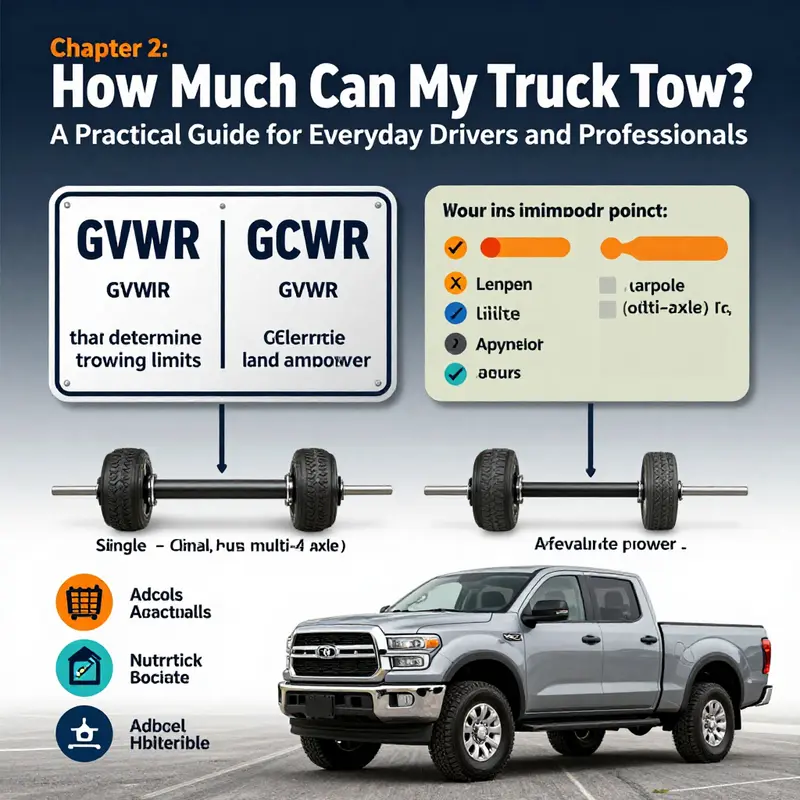
Tow limits are a conversation of several variables, not a single number. This chapter explains the four pillars that govern safe towing: GVWR, GCWR, axle configuration, and the powertrain, and how they interact with a trailer in real-world conditions. The key distinction to keep in mind is between towing capacity and payload. Towing capacity is the maximum weight you can pull behind the truck, including the trailer itself and any cargo it carries. Payload is the weight the truck can carry in its bed and cab. GVWR is the maximum weight the vehicle can be built to support; GCWR is the maximum combined weight of the tow vehicle and trailer. Both matter for safety and legality. Axle configuration affects load distribution and stability; more axles can improve handling with heavy trailers but add vehicle mass to be controlled. The powertrain – torque, gearing, transmission, and cooling – determines how well the truck can accelerate, climb grades, and dissipate heat while towing. Real-world ranges: light-duty pickups typically fall in the 2-4 ton range (roughly 4,000-8,000 lb) of towing capacity; higher-performance variants can approach 6 tons. Mid-range or medium-duty trucks commonly tow about 10,000-20,000 lb; heavy-duty long-haul equipment can exceed 20 tons in some configurations. But these are guides; your exact numbers come from the model-year documentation for your exact build. Always check GVWR and GCWR on the door placard and in the owner’s manual, including any equipment or tire changes that affect weight. Conditions such as hills, heat, and wind reduce usable capacity, so plan for worst-case scenarios when you tow. A practical rule: keep the sum of the vehicle’s weight, the trailer’s weight, and the trailer’s payload within both GCWR and GVWR. Use a proper hitch and, if needed, a weight-distribution system to improve load sharing on the axle group and braking. If you tow near the upper limits, consult a technician to verify cooling and braking capability for sustained operation. Finally, rely on exact specifications rather than generic estimates; manufacturer data, door placards, and owner’s manuals are the authority. This groundwork helps you plan trips with confidence while meeting safety and legal obligations.
Tow Limits Unlocked: Real-World Data, Legal Boundaries, and Pinning Down Your Truck’s Exact Capacity
When people ask how much their truck can tow, they’re usually staring at a brochure number and hoping the math works out in the real world. In truth, that headline figure is a ceiling under perfect conditions. Real-world towing is a balancing act among weight, balance, and the constraints built into the truck itself. The journey from a manufacturer’s maximum trailer weight to what you can safely pull down your driveway or up a hill involves understanding several moving parts: the difference between towing capacity and payload, the way weight is distributed between the vehicle and the trailer, and the way road rules and vehicle design interact in everyday driving. To get a handle on this, you need to look at the numbers that matter, and you need to translate them into the way you actually load and operate your rig. The result is a clearer, safer plan for towing that keeps both the truck and its occupants out of harm’s way while staying on the right side of the law.
First, it helps to separate two related concepts that are often confused: towing capacity and payload capacity. Towing capacity — sometimes called maximum trailer weight — is the highest weight class your vehicle is designed to pull behind it. This number is derived from the combination of engine torque, transmission cooling capacity, braking capability, suspension tuning, and the structural strength of the frame and hitch. Payload capacity, on the other hand, is the maximum weight you can carry inside the cab and in the truck bed while keeping the vehicle within its own limits. It includes passengers, cargo, and added equipment. When you’re planning a trip or a move, both numbers matter, but they govern different parts of the equation. The key is not to confuse them. The moment you mix the two up, you risk pushing the vehicle beyond its safe envelope, even if you stay within the advertised trailer weight.
Equally important is understanding how weight is actually managed on the road. The critical metric you’ll hear about in more technical discussions is the Gross Combined Weight Rating, or GCWR. This is the maximum allowable weight of the vehicle plus the trailer combined. It isn’t just a box to check; it’s a cap that impacts engine heat, braking performance, steering response, and overall control during critical maneuvers. If you exceed GCWR, you’re asking the drivetrain, frame, and brakes to handle more mass than they were designed to tolerate. The practical upshot is simple: your safe total pulling combination—truck plus trailer plus cargo—must stay under GCWR. Your vehicle’s curb weight, its payload, and the weight you add in fuel, passengers, and accessories all strip away some of the available headroom. That’s why a truck that’s rated to tow 8,000 pounds might feel comfortable at a much lighter trailer, while a nearly full load in the cabin and bed can drastically shrink the ceiling.
This is why the door jamb placard and the owner’s manual matter so much. They are not ornaments but maps. The door placard lists GVWR, GCWR, and payload limits in a single glance, and the manual expands on how those numbers were derived and how you should use them. It’s not glamorized mathematics; it’s the safety envelope. When you’re assessing whether a trailer is a good match for your truck, start by identifying the GVWR (the maximum the vehicle itself can weigh when loaded). Then find the GCWR (the maximum combined weight of the truck and the trailer). Subtract the curb weight of the truck from the GCWR to get a rough sense of how much trailer weight your vehicle can handle, with a cushion for tongue weight and hitch, plus any other ballast that comes with cargo. In practice, many drivers do the opposite calculation: they look at the stated trailer weight and back it into the numbers they know about their cab and bed. Either approach works, as long as you consistently account for every element that adds mass to the system.
When you translate these numbers into the real world, the second factor that becomes indispensable is axle configuration and engine power. More axles generally mean higher capacity and better weight distribution, especially with heavy trailers. Multiple axles also affect the way brakes are applied and how the vehicle responds in turns and declines. A robust engine and a well-mroved transmission can help, but they can’t overcome a poorly balanced load. A trailer that pulls with a heavy tongue weight demands a proportionally sturdy hitch setup, and the hitch itself is a major contributor to how much you can tow without compromising control or safety. A heavy payload in the truck bed or the cab busies the suspension and can cause squat at the rear, reducing traction and steering feel. The presence of a weight-distribution hitch or a higher-capacity hitch can alleviate some of that, but only if the trailer weight and tongue weight stay within the system’s design limits. The idea is not to push the truck to the limit, but to keep the combination within a safe, controllable zone that honors the vehicle’s design intent.
A common trap is to rely on the brochure figure for every departure, even when the trailer you’re considering has a complex or irregular load profile. Real-world testing and towing experience show that many drivers operate closer to 75–90 percent of the stated towing capacity under typical conditions. Why such a discrepancy? Because the manual figures assume ideal conditions: flat road, optimal aerodynamic trailer, clean hitch setup, no wind, perfect tire condition, and a full suite of safety equipment. In the real world, you’ll contend with passengers and gear moving inside the cabin; fuel mileage shifts as the mass grows; crosswinds from open stretches or from passing trucks buffet the trailer; and braking performance changes as the trailer’s weight interacts with the truck’s own mass. Even tire load ratings can become binding factors once you’ve loaded passengers, cargo, and fuel and added a trailer with significant tongue weight.
This is where the GCWR concept becomes not only a theoretical safety cap but a practical guardrail. The more you understand it, the more you can avoid a misstep that leads to brake fade, poor handling, or tire overload under emergency maneuvers. The Department of Transportation has long underscored the safety implications of exceeding weight limits. While the precise rules vary by jurisdiction, the core message resonates: heavier combined loads demand more careful maintenance, more robust braking systems, and stricter adherence to maximum weight limits. The consequence of ignoring these considerations ranges from increased stopping distance to structural damage and, in the worst case, loss of control. The intersection of real-world data and legal standards, then, is not a narrow domain of interest but a practical framework for every trip you tow.
Looking at the landscape of typical truck classifications helps ground the discussion in reality. For light-duty pickup trucks, such as the archetypal everyday models, the towing capacity commonly falls in the range of roughly 2–4 tons (4,000–8,000 pounds). Some high-end or specially tuned variants can push toward or beyond 13,000 pounds, which is roughly six and a half tons, but those figures assume near-ideal conditions and careful load management. In normal usage, you often won’t reach those upper numbers unless you optimize every aspect of the load, maintain a conservative payload, and ensure the trailer’s mass distribution is ideal for your vehicle. By contrast, medium-duty trucks—how the market often segments trucks designed for heavier hauling, like certain heavy-spec pickups and chassis cabs—tend to offer towing capacities from about 5–10 tons (10,000–20,000 pounds). These are the workhorse vehicles that see service in construction sites, farming operations, or rugged rural settings where the work demands more than a casual weekend haul. Finally, heavy-duty trucks, including Class 8 tractor-trailers and other large configurations, commonly span a broad range from 10–20+ tons (20,000–40,000+ pounds). These are purpose-built for long-haul freight or heavy industrial tasks, with towing capacity that shifts with the configuration—tractor-trailer setups, axle counts, and air brake systems all playing decisive roles. It’s worth noting that some specialized heavy equipment used in mining or infrastructure projects can clear even higher numbers, but those are not standard commercial vehicles. The bigger point is this: the class of truck you own sets the ballpark, but your exact capacity within that ballpark depends on a fusion of design limits, load balance, and how you plan to use the trailer.
The chapter of the story you’ll actually live is written in concrete steps you can take before you leave the driveway. The first step is to locate the precise figures for your vehicle. Open the owner’s manual and hunt for the sections labeled “Towing Capacity” or “Maximum Trailer Weight.” The door placard on the driver’s side is another authoritative source; many people overlook it because they expect the numbers to be nested in the manual’s pages. The placard lists GVWR, GCWR, and payload limits in a single, easily digestible line. The trick is to read the numbers aloud as you assemble your load plan. Start with GVWR, then review payload, and then consider how the trailer’s weight figures into GCWR. The offer becomes clear: you’re not calculating a single line item; you’re balancing what the vehicle can bear in total. If you want a practical, VIN-specific reading, most manufacturers now provide online tools where you can enter your VIN to retrieve the exact GVWR and GCWR along with the maximum trailer weight. This is especially valuable if you’ve added aftermarket modifications, premium wheels, or specialized towing gear that could alter the vehicle’s performance profile.
If you prefer third-party validation or a broader set of data points, there are reputable calculators and databases that aggregate testing results across models and years. These can be helpful as a sanity check, but they should never replace the raw manufacturer data or your own vehicle’s placard. The caution here is simple: every vehicle ages, every trailer adds a new dynamic, and changes to tires, brakes, or suspension can shift safe towing limits. It’s wise to re-check your numbers after major maintenance or changes to the load profile of your trips. In practical terms, this means frequent checks of tire pressures and tread, ensuring your braking system is up to the challenge, and using a tongue-weight scale for precise hitch load measurements. It’s not glamorous, but it pays off in smoother towing and fewer surprises on the road.
As you build a robust understanding of your capacity, you’ll start to recognize where legal and safety considerations come into play. States across the union regulate trailer length, weight distribution, and required equipment—brakes on heavier trailers, lighting, and mirrors among the typical requirements. Some states mandate electric brakes for trailers above a certain weight; others limit axle weight distribution to protect road surfaces and infrastructure. Violating these regulations can lead to fines, license penalties, or even liability in the event of an accident. While the Federal Motor Carrier Safety Administration (FMCSA) provides overarching guidelines for commercial vehicles, non-commercial towing must still comply with general safety standards. The practical upshot is that the safe limit for a privately towed trailer is not only about not exceeding a label but about respecting the broader road-safety ecosystem in which you operate.
With all this in mind, how exactly do you translate a rating into a safe daily practice? Start with a methodical approach to calculating the safe towing load for your specific configuration. Use the GCWR to figure the maximum combined weight you may legally and safely pull. Then determine how much your own truck weighs when empty (curb weight) and how much payload you have left after accounting for occupants and gear. Subtract your payload by the weight of fuel and any cargo in the bed to approximate the available mass you can safely apply to the trailer. Then select a trailer with a weight that, when added to the vehicle and standard tongue load, remains under GCWR. Don’t forget the tongue weight, which typically accounts for around 10–15 percent of the trailer’s loaded weight. For a heavier trailer, this means you may need to shift weight distribution, upgrade hitch hardware, or adjust what you carry in the bed to maintain proper balance and ensure the tow vehicle remains stable while braking and accelerating. These steps are not a single calculation but a disciplined process. The most important rule is to err on the side of caution. If you’re close to the limit, reduce the trailer’s load or select a lighter trailer, even if your vehicle could handle more mass in theory.
In the broader arc of safety and science, the data you gather about your own vehicle’s performance should inform every choice you make behind the wheel. Real-world data from towing experts and independent testing consistently shows that many drivers exceed their truck’s actual towing capacity because they misjudge the total weight of cargo, passengers, fuel, and accessories. For example, a pickup labeled with a 10,000-pound towing capacity can end up limited to around 8,500 pounds once fully loaded with passengers and gear. This discrepancy is not a critique of the manufacturer’s numbers; it’s the practical reality of how the world adds weight. It underscores the importance of using GCWR as the anchor for safety rather than relying on the bare tow rating. It also reinforces the imperative to consider the full spectrum of factors that can degrade performance: tire load ratings, suspension sag, and the condition of the hitch itself. A worn hitch or a misaligned hitch can dramatically alter how much a trailer matters to braking and steering. Even small changes in bumper-to-trailer clearance can affect how your trailer responds when you steer, brake, or accelerate. The takeaway is straightforward: keep the towing system within its designed envelope and monitor the system’s behavior in real-world driving.
Another dimension of the discussion is the legal risk that comes with pushing past your vehicle’s safe limits. Exceeding weight limits isn’t just a mechanical risk; it carries legal consequences that vary by jurisdiction. Some states enforce strict penalties for overweight combinations, including fines and potential impoundment of equipment. Others are stricter about trailer braking requirements and lighting configurations, which can influence your ability to pass inspection or comply with road safety standards. The FMCSA provides guidelines for commercial operations, but even non-commercial towing must adhere to the general safety standards that keep roads safe for everyone. For private owners, the interplay of these rules can be complex, especially if you cross state lines or operate in areas with steep grades and heavy traffic. A careful approach to weight, which aligns with GCWR and state requirements, reduces the likelihood of fines and, more importantly, reduces risk to you and other travelers.
In summary, your truck’s towing capacity sits in a spectrum rather than a single fixed number. The nominal rating is the ceiling under ideal conditions, but your real-world limit is shaped by payload, tongue weight, passenger load, fuel, suspension health, tire ratings, and the exact configuration of the hitch and trailer. The most reliable way to determine your exact capacity is to read the manufacturer’s labels, verify the VIN-specific data whenever possible, and perform a conservative load calculation that accounts for all the elements that enter the system during operation. Armed with this knowledge, you can plan trips with confidence, knowing your tow setup isn’t just capable on paper but safe on the road. If you’re curious about the broader economics and logistics surrounding tow equipment, you can explore the practical considerations behind tow equipment costs and availability at how-much-is-a-tow-truck. This kind of context can help you pair the mechanical side of towing with the practical realities of owning and using a tow vehicle, from budgeting for the right hitch to understanding how your choice affects fuel efficiency and maneuverability.
Finally, for readers who want official safety guidance beyond the home mechanics of weighing and balancing loads, turn to established authorities that lay out the best practices for towing and trailer safety. The National Highway Traffic Safety Administration offers extensive resources to help consumers verify their truck’s capabilities and to promote safer towing practices. You can access their latest recommendations and tools at the following external resource: https://www.nhtsa.gov/vehicle-safety/towing-and-trailer-safety. This resource complements the practical, vehicle-specific steps outlined here by situating towing within a national safety framework and offering guidance that applies whether you’re towing a small utility trailer or a large, multi-axle caravan.
With these perspectives in place, you’re positioned to translate the numbers on the page into a real-world plan that meets your needs without compromising safety or legality. The next step is to take the numbers you’ve gathered, run the calculations, and translate them into a loading and driving plan that keeps your truck within its safe envelope on every trip. If you plan to push beyond the basics—such as pulling specialized trailers or operating in regions with tighter weight restrictions—revisit the placard and consult the manufacturer’s resources or a qualified technician to confirm your setup. The road to safe towing is less about chasing a single maximum and more about understanding and applying the balance between weight, balance, and control across all your drives.
Final thoughts
Knowing how much your truck can tow is a practical mix of ratings, physics, and responsibility. By distinguishing towing from payload, understanding GVWR and GCWR, and checking your door placard or manufacturer specifications, you can plan safe, efficient tows that meet legal requirements. Use real-world examples to benchmark your setup, and always verify the exact capacity before hitching a trailer. With clarity on these factors, Everyday Drivers, residents, and professionals can approach towing with confidence rather than guesswork.