
Flatbed tow trucks move non-running vehicles, support auto repairs, and help property managers recover disabled autos. Whether you’re a daily commuter, a resident needing service, a truck owner, an auto repair shop, or a property manager coordinating fleet support, understanding CDL requirements matters. The question isn’t simply “do I have a license?” but “does my operation trigger a CDL based on weight and how I tow?” You’ll find the answer hinges on (1) the tow truck’s GVWR, (2) the combined weight when towing, (3) how you perform the tow (flatbed loading with ramps or winching), and (4) where you operate (interstate vs intrastate). This guide uses a practical, five-chapter approach to demystify the thresholds, translate weight into licensing needs, highlight safety implications, explain regulatory scope, and outline training and best practices. By tying weight, method, and geography to real-world scenarios, everyday drivers, residents and commuters, truck owners, auto repair shops, and property managers can plan for compliant, safe, and efficient flatbed towing without over- or under-licensing.
Weight on Duty: Unpacking CDL Needs for Flatbed Tow Trucks and the GVWR Boundary
In the dim glow of a dawn shift, a tow operator slides behind the wheel of a flatbed unit and runs a practiced check on the numbers that determine his license more reliably than any gauge on the dash: the GVWR, the gross vehicle weight rating, and the GCWR, the gross combined weight rating. These are not mere specifications on a plate; they are gatekeepers that define who is legally allowed to drive, how they may operate, and when extra training becomes non-negotiable. A flatbed tow truck, with its long, sturdy bed and the delicate choreography of securing a non-running vehicle for transport, sits at the crossroads of weight and purpose. The question of whether a Commercial Driver’s License is required is never a single yes or no; it is a layered determination that blends the vehicle’s own weight with what you intend to haul and where you plan to travel with it.
At the heart of the CDL decision is GVWR—the maximum weight the manufacturer assigns to the vehicle when fully loaded, including fuel, cargo, passengers, and the inherent ballast that keeps it stable on the highway. For many flatbed tow trucks, that number edges past the 26,000-pound line. When a vehicle’s GVWR exceeds 26,000 pounds, the federal rulebook generally requires the operator to hold a CDL. This is not a mere technicality; it is a recognition that a heavier vehicle demands greater training, more rigorous testing, and a higher standard of road readiness. The practical implication is straightforward in principle: if your flatbed truck itself weighs more than 26,000 pounds when loaded, you should be pursuing a CDL to stay compliant and to maintain safety on the road.
But weight does not exist in a vacuum. The story becomes more nuanced when you add a towed vehicle into the equation. The weight of the towed vehicle matters in the sense that the combination can cross weight thresholds that trigger CDL requirements for the driver operating the rig. In federal terms, when the towed vehicle weighs more than 10,000 pounds, the CDL requirements can extend to the operator of the combination, particularly if the combination’s GCWR—its gross combination weight rating—surpasses the 26,001-pound threshold. The moment you are pulling a heavy towed unit, the clock starts ticking on whether a CDL class A or class B license is necessary, and whether particular endorsements or qualifications apply. This is not only about legality; it maps onto the realities of braking systems, steering dynamics, and the longer stopping distances that accompany heavier tows.
To anchor these rules in a concrete example, consider a flatbed tow truck whose own GVWR is 26,001 pounds. Suppose it is actively towing a vehicle weighing 10,000 pounds. The regulatory analysis hinges on the precise language in 49 CFR § 383.5. Because the tow truck itself already exceeds the 26,000-pound threshold, the operator is, in this scenario, positioned squarely within CDL requirements independent of the towed vehicle’s exact weight. The fact that the towed vehicle weighs 10,000 pounds does not, in this particular setup, remove the CDL obligation. The logic is pragmatic: the heavier the platform you drive, the more you must be prepared to demonstrate proficiency behind the wheel and in the cab—handling, braking, lane discipline, and the ability to manage a heavy, dynamic load during turns and lane changes.
This appraisal aligns with the broader federal framework that governs CDL eligibility, since it emphasizes the vehicle’s weight as the primary gateway to licensing, with the towed weight introducing a potential second gate when the combination capacity crosses certain limits. The operational reality follows the same thread: heavy fleets often must go through more comprehensive training, including knowledge of air brakes, vehicle inspection, and, in many states, endorsements that recognize specialized equipment and hauling scenarios. For a flatbed operator, this can mean pursuing a Class B CDL if the vehicle itself weighs beyond the threshold but with limitations on towed weight, or advancing toward a Class A when the combination’s GCWR travels into higher weight territory. Each case requires careful parsing of the specific vehicle’s GVWR and GCWR, along with the intended duty cycle—interstate travel frequently inviting stricter scrutiny and more stringent documentation.
From a practical standpoint, what does this mean for a tow operator running a flatbed that exceeds the GVWR threshold? It means recognizing the inevitability of investment in training and licensing when your equipment sits on the heavier side of the spectrum. It means recognizing that the gear you operate dictates the tempo, and often the route, of your work. A CDL is more than a license to drive; it is a credential that signals compliance with safety standards, compliance checks, and the discipline required to manage long, heavy vehicles across varied road and weather conditions. It also has tangible insurance and regulatory implications. A heavier unit typically entails higher insurance requirements and more rigorous inspection regimes. Because state departments of motor vehicles and local authorities may apply their own interpretations or add endorsements relevant to the weight, routes, and cargo, operators sometimes navigate a patchwork of state rules alongside federal baselines. The upshot is clear: if your flatbed’s GVWR sits above 26,000 pounds, obtaining and maintaining a CDL is not optional—it is the professional baseline for lawful operation.
Understanding the intersection of GVWR and towed weight also clarifies why some operators still debate the specifics in their shop discussions. The rule of thumb is simple in practice but layered in application. If the vehicle’s own weight falls over the threshold, the driver is positioned for CDL requirements. If the vehicle weight is under threshold, CDL may not be required unless the towing arrangement or the intended use pushes the GCWR beyond the threshold. And in real-world towing operations, there are legitimate concerns about how a heavy load is secured, how it affects braking and steering dynamics, and how little margin there is for error during shoulder-swap maneuvers, lane shifts, or on-ramp merges. These concerns are exactly why federal licensing rules emphasize trained operators for heavy platforms and why many fleets insist on the higher credential regardless of a particular job’s minimal towed weight.
For drivers and fleet managers, the practical takeaway is to map your equipment to the licensing path before a job is planned. Confirm the GVWR of the flatbed itself, verify the GCWR for any anticipated towed load, and ensure you understand the state requirements where operations occur—especially if interstate travel is on the schedule. If there is any ambiguity, a careful review of the CFR language or a consult with a licensing specialist can prevent a last-minute license gap that could incur penalties or jeopardize a contract. Operators who take a proactive approach—documenting GVWR, confirming weight distribution, and aligning training with the vehicle’s capabilities—tend to keep their on-road hours within the boundaries of safety and law, a combination that protects both driver and company.
For readers seeking a concise, practical synthesis on licensing classifications and how they apply to tow-truck operations, a deeper dive into the CDL framework is available through a dedicated resource that outlines the essential licensing pathways and how they map to vehicle weight and use. Accessing this guide can help you translate the regulatory language into everyday decisions on the yard floor and on the highway: CDL tow-truck guide.
Ultimately, the weight thresholds that govern CDL requirements serve a dual purpose: they safeguard road safety by ensuring operators are tested and trained for heavier vehicles, and they provide a clear framework for fleet planning and compliance. When a flatbed’s GVWR crosses 26,000 pounds, or when the combination weight approaches or surpasses the same threshold, licensing considerations become a central part of operational strategy. The exact boundary line—where CDL is required and which class of license applies—depends on the specific vehicle characteristics, and it can shift with the addition of a towed load. Yet the principle remains steady: heavier equipment, more responsibility, and a licensing pathway designed to keep drivers and the road safer.
External reference: For the official regulatory language that underpins these guidelines, see the federal rule at https://www.ecfr.gov/current/title-49/chapter-I/subchapter-B/part-383/section-383.5.
Weight on the Line: Combined Weight Rules and the CDL Question for Flatbed Tow Trucks

Steering a flatbed tow truck is a job where weight becomes a constant companion. The metal platform, the winch, the hydraulic systems, and the careful balance of load all sit against a line drawn by law and physics alike. In discussions about licensing, the question do you need a CDL to operate a flatbed tow truck centers not merely on the truck’s own mass but on the total heft you’re permitted to move. The practical answer hinges on combined weight and the duties you perform, a framework that puts numbers at the heart of every transport decision. The core idea is straightforward: the licensing boundary is weight-based. If the tow truck itself carries a gross vehicle weight rating above 26,000 pounds, you typically need a Commercial Driver’s License. In many outlines, that means a Class B license for single-vehicle operations. Yet the real story grows more intricate once you add a towed vehicle into the equation, especially when the load isn’t simply a fellow wheeled vehicle but one that is non-running or requires a winch to engage. The moment you contemplate towing a heavy car, truck, or equipment that pushes the combined weight past 26,001 pounds, the licensing line often shifts again. These rules are ubiquitous in federal doctrine, but the precise enforcement can still blend into state practice, so care and due diligence matter as you move from city streets to interstate corridors. The more one learns, the clearer the picture becomes: combined weight matters more than the weight of the tow truck alone.
The interpretation rests on common metrics—GVWR, GCWR, and how the two interact in the real world. When the tow truck’s GVWR exceeds 26,000 pounds, a CDL is typically required to operate the vehicle as a commercial operator. If the towing operation involves a towed vehicle that, when combined with the tow truck, pushes the total over 26,001 pounds, the same licensure boundary often applies, particularly if the towed vehicle isn’t merely rolling freely but requires winching or other heavy-load techniques. For lighter flatbeds, with GVWR under 26,000 pounds, standard licensing can cover routine towing tasks, but even here a careful risk assessment matters. Flatbed work often involves lifting, strapping, or winching delicate loads—procedures that heighten the need for training and compliance beyond simple road operation. These are not cosmetic distinctions; they bear directly on safety, insurance, and the legal accountability of the operator.
Consider the practical implications of a common chassis configuration, such as a small flatbed designed to handle specialty or performance vehicles. The 6×4 design, prized for its low-profile deck and the ability to load without scraping, is a familiar sight. It often ships with an integrated heavy-duty winch and a deck engineered to minimize friction during loading. These features improve efficiency and reduce damage during transport, but they don’t rewrite the weight-based rules. A 6×4 flatbed’s enhanced capabilities can make the job feel easier, yet if the combined weight of the tow truck and the vehicle it’s carrying crosses the regulatory threshold, the licensing requirement remains tied to that weight math. In this way, the engineering of the platform interacts with the regulatory framework, but it does not override it. Operators must continually calculate, verify, and document weights to ensure compliance and avoid penalties. This is not merely an exercise in bureaucracy; it is a core aspect of safe and lawful operation on the road.
The weight-based realities extend beyond the shop floor. When you transport non-running vehicles—common on flatbeds—there’s often an added layer of complexity. Non-running vehicles may require winching, specialized ramps, or careful stabilization procedures to prevent damage to the vehicle and to the tow rig itself. Each of these steps introduces additional dynamic factors—center of gravity shifts, winch line tension, and the interplay of braking and steering under load. All of these factors are most safely managed by operators who understand weight distribution and the licensing framework that governs heavier loads. In practice, this means that even if your tow truck’s GVWR sits just below the 26,000-pound line, the act of loading a heavy, non-running vehicle can push you into a scenario where broader training and stricter compliance are advisable or required.
Interstate travel compounds the issue further. When operations cross state lines, federal regulations guide licensing for commercial hauling. The essence is that weight-based rules established at the federal level typically apply to interstate transport, setting a uniform threshold that helps prevent a patchwork of state requirements from creating unsafe gaps in coverage. If you routinely move loads across state borders, the CDL becomes not only a matter of driver qualification but a safeguard for broader safety standards and insurance expectations. For operators who frequently navigate multiple jurisdictions, the question shifts from “do I need a CDL” to “how do I structure licensing, training, and procedures so that every load, every mile, complies with the most stringent rule I might face.” The practical path is to adopt a conservative approach: calculate the maximum potential combined weight you might handle, verify the licensing needed for that scenario, and plan training accordingly. This mindset minimizes surprises at weigh stations, in audits, or during dispatch with a deadline looming.
To provide a concise roadmap within this broader landscape, many practitioners gravitate toward a practical, experience-informed standard: if the combined weight of tow truck and load routinely or potentially exceeds 26,001 pounds, plan for CDL involvement. If your typical operation stays beneath that barrier, a standard license paired with appropriate training for towing procedures, weight distribution, and safety protocols can suffice. Yet even within those guidelines, the specifics of your fleet, the type of loads you carry, and your travel patterns must inform your licensing strategy. The line is not a single blade of glass but a spectrum where policy, vehicle design, and on-the-ground operation intersect. In a world where a flatbed may be used to transport high-value or delicate vehicles, the value of diligent weight calculation and proactive licensing decisions grows larger, not smaller.
For operators seeking a crisp, practical roadmap, the CDL Tow Truck Guide provides an accessible framework that aligns with the realities described here. It offers a focused lens on how weight, load, and travel patterns shape licensing needs. CDL Tow Truck Guide
Beyond the internal calculations, every operator should maintain a current awareness of federal guidance to avoid drift into noncompliant territory. The US federal framework, administered by the Federal Motor Carrier Safety Administration, anchors weight-based licensing to standardized thresholds designed to safeguard traffic and cargo alike. When in doubt, consult the FMCSA’s official resources to confirm thresholds, endorsements, and requirements that might apply to your specific route, axle configuration, and load type. This diligence is especially important when the work involves multi-state routes or specialized cargo that introduces additional security and handling considerations. The weight-based model remains constant, but the practical enforcement can vary with geography, duration of trips, and the nature of the loads you are trusted to move.
From a day-to-day perspective, the decision tree is anchored by a few persistent questions: What is the GVWR of the tow truck? What is the possible weight of the towed vehicle, or what range of weights might it approach in load and unload operations? If the combined weight could push past 26,001 pounds, should the driver hold a CDL, and which class is most appropriate given the configuration? How might winching, ramps, or other loading techniques alter the effective weight and the risk profile of the operation? And, crucially, how will these answers influence training, insurance, and dispatch decisions in a regulated environment where safety is paramount? Addressing these questions with a disciplined, weight-aware approach can prevent licensing gaps, reduce liability, and ensure that flatbed operations remain both compliant and efficient.
The bottom line remains consistent: in flatbed towing, the weight line matters. It matters because it governs licensing, training needs, and the safe execution of loads that travel on busy highways, through dense urban cores, and across state lines. It matters because a single miscalculation can ripple into missed deadlines, insurance disputes, or legal exposure. It matters because, when properly understood and applied, weight considerations empower operators to work confidently within the law while delivering the care and precision that delicate tows demand. As you plan, document, and review your fleet’s operations, keep the weight at the center of your licensing strategy, and let that weight guide you toward the right combination of CDL compliance, training, and operational discipline. The road ahead for flatbed tow services is navigable, provided the weight calculus is clear and the licensing decisions are made with foresight.
External reference for deeper guidance: https://www.fmcsa.dot.gov/.
Weight on the Bed: Decoding CDL Requirements for Flatbed Tow Trucks
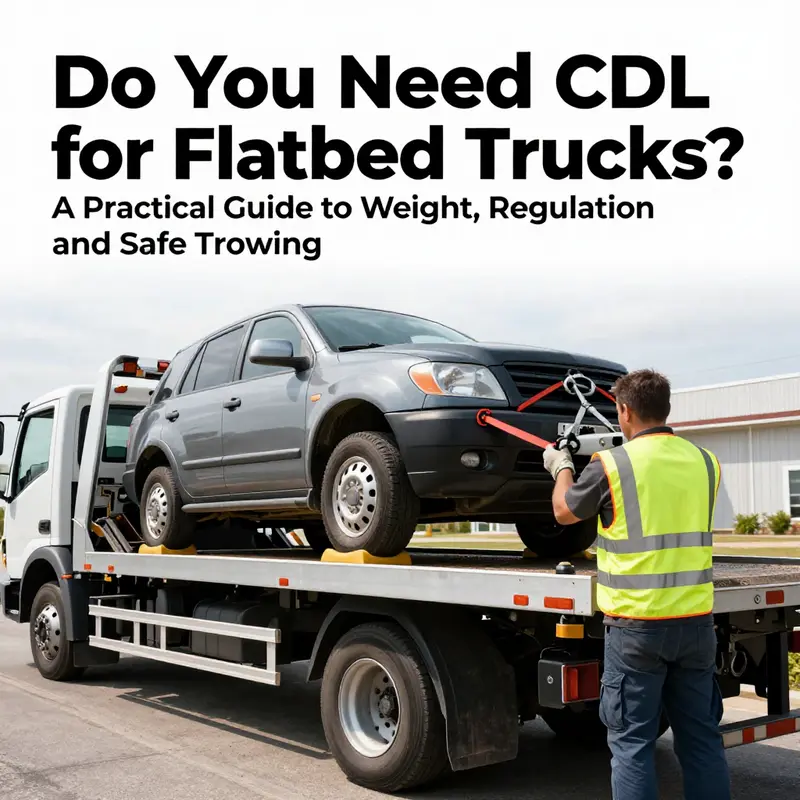
Flatbed tow trucks sit at the intersection of practicality and regulation. Their job is to move vehicles that won’t roll on their own, or to transport equipment and heavy loads from one place to another. That duty, however, is not governed by a single, simple rule. It rests on weight, how the vehicle is used, and where the operation takes place. The central question—do you need a CDL for a flatbed tow truck—unfolds like a landscape with shifting ridgelines. The answer, in short, is: it depends. But the logic behind it is stable and worth understanding, because it affects training, insurance, insurance costs, and the safety of everyone on the road you share with every day.
One of the clearest guiding principles is the vehicle’s weight. In the United States, the threshold most people encounter begins with the gross vehicle weight rating, or GVWR. If a single flatbed tow truck’s GVWR is 26,001 pounds or more, you typically need a Commercial Driver’s License (CDL). That rule is not about the towed vehicle alone, but about the truck itself. A heavier chassis, stronger braking, longer stopping distances, and higher payload capacity translate into a different category of driver qualification. In practice, most flatbed tow trucks fall into this category because they are designed to haul vehicles that dwarfs a standard car. When a vehicle can legally exceed 26,000 pounds by itself, the operator is generally required to hold at least a Class B CDL. The distinction between Class B and other classes matters not just for legality, but for the scope of routes you are allowed to run and the kind of endorsements you may need for more specialized tasks.
Yet weight is not a story with a single ending. If the combination of the tow truck and the vehicle being towed pushes the total over 26,000 pounds, then the weight issue becomes a combined weight question. The relevant metric here is the gross combined weight rating, or GCWR. If that combined figure crosses the threshold, a CDL may be required even if the tow truck’s own GVWR sits below 26,001 pounds. The nuance matters in real-world use, because the towed vehicle’s condition—whether it is operational, whether it must be winched, or whether loading happens via ramps—can influence whether a CDL is appropriate for the job. For example, a heavy flatbed designed to haul mid-to-large passenger vehicles often carries a GVWR well above the 26k mark, aligning with CDL requirements by default. In cases where the towed vehicle remains immobilized or requires specialized loading methods, the rules can tilt toward needing a CDL to ensure the operator has the expected training and compliance for those complex handling tasks.
This is where the practicalities of the job begin to merge with the paperwork of licensing. If you’re moving non-running cars, or heavy machinery, or you regularly winch or load with ramps, you’re entering a space where the licensing standard becomes more stringent. The presence of a winch, the use of heavy tie-downs, or the need to secure loads that could shift during transit are not mere technicalities; they are driver qualification cues. The federal framework anchors these decisions, but state rules add their own layer of nuance. Interstate movements often trigger stricter requirements, while some states maintain stricter endorsements or additional requirements for specific cargo classes, even when the weight alone wouldn’t demand a CDL under federal law. In short, the rules are designed to ensure that a driver not only operates a heavy vehicle safely but does so with an awareness of how heavy loads behave at highway speeds, during braking, and in changing weather.
For operators whose work touches hazardous materials, or that crosses state lines regularly, the licensing picture grows more intricate. A CDL itself can come with endorsements that reflect the cargo or the trip’s nature. Hazmat endorsements, for instance, add another layer of training and testing, designed to mitigate the risk associated with dangerous goods. The same is true for other potential endorsements, such as for passenger transport, if that happens to be part of a broader fleet operation. The bottom line is simple: if your flatbed tow work involves interstate commerce, or if it involves special cargo, you are unlikely to avoid the need for a CDL or the proper endorsements. The driver’s license must reflect both the vehicle and the duties—whether that means a Class B license with certain endorsements or, in some cases, a different classification depending on the fleet’s structure and the routes it serves.
This is not only a federal concern. States retain the right to impose stricter rules than the federal baseline, and many fleets find themselves navigating a patchwork of state regulations, especially those that cross jurisdictional lines or operate along major corridor routes. That is why it is prudent for operators and business owners to verify the licensing requirements specific to their state and to the kinds of jobs they perform. Relying on a general assumption about CDL necessity can lead to compliance gaps, insurance disputes, or, worse, a safety risk for operators and the public. The most reliable path is to begin with the weight-based framework and then drill down into the specific activities of the operation. If the vehicle’s GVWR is at or above the 26,001-pound threshold and the operation involves transporting a loaded, non-rolling, or winch-assisted load, the company and driver should expect that a CDL, along with appropriate endorsements, is part of the requirement set.
From a safety perspective, the licensure question is inseparable from the training and discipline that accompany it. A CDL is not just a piece of paper; it is a recognition that a driver has demonstrated competence with heavier, more complex machinery, and that the operator understands the physics of heavier vehicles. It means a deeper familiarity with air brakes, commercial vehicle inspection protocols, federal hours-of-service rules, and the heightened responsibility that accompanies longer stopping distances and greater momentum on the road. The weight-based thresholds are designed to ensure that drivers who tackle heavier flatbeds or heavier combined loads have the development experiences and safety-conscious mindset necessary for reducing risk to themselves and others. That is a practical, not merely regulatory, reason to take these distinctions seriously.
To those who run fleets or operate independently, the takeaway is straightforward but not simplistic. If your flatbed tow truck is built to handle heavy loads and your operations include moving other vehicles that are immobilized or require winching, plan for CDL readiness. Confirm whether your state follows the federal baseline or adds stricter requirements for certain operations. When in doubt, consult official resources and, if possible, a CDL instructor or a compliance professional who specializes in commercial vehicle licensing. The federal standard—while not the final word in every state—provides a solid compass for what kinds of licensing generally apply to heavier flatbeds and more demanding towing tasks. As a practical step, operators can explore focused references that translate the rules into day-to-day requirements and ensure that both the vehicle and the driver align with safety and regulatory expectations. For those who want a concise overview of the licensing landscape, a focused guide on CDL tow-truck requirements can offer a clear starting point and a practical map for complying with weight thresholds, combinations, and endorsements. See the CDL tow truck guide for a closer look at how these categories map onto real-world operations.
In the bigger picture, the question of whether a CDL is needed for a flatbed tow truck is not only a matter of the vehicle’s weight but also of how that weight is used on the road. The weight threshold provides a baseline, while the combination weight, the nature of the cargo, and the interstate dimension of the work refine the requirement. The safety culture around heavy towing depends on this precise alignment between vehicle capability, the driver’s training, and the regulatory framework designed to protect everyone who shares the highway. If you operate on highways across state lines, or if your loads fall into heavy, non-running, or specialized categories, you owe it to yourself and your customers to err on the side of compliance. The cost of getting it right is far smaller than the cost of missteps—whether those costs are legal penalties, insurance premium spikes, or, more importantly, the human costs that can accompany accidents involving heavy equipment. For a practical exploration of how these ideas play out in everyday towing work, you can refer to the CDL tow truck guide for a concise, fleet-aware overview. The goal is not to complicate the job but to simplify the path to safe, compliant operation on every mile of road you cover.
External resource: For the official federal overview of Commercial Driver’s License standards and related safety assurances, visit the FMCSA page at https://www.fmcsa.dot.gov/vehicle-compliance/vehicle-standards/commercial-driver-safety-assurance/commercial-driver-safety-assurance-overview.
null
null
Tow, Transport, and the Threshold: Understanding CDL Needs for Flatbed Tow Trucks
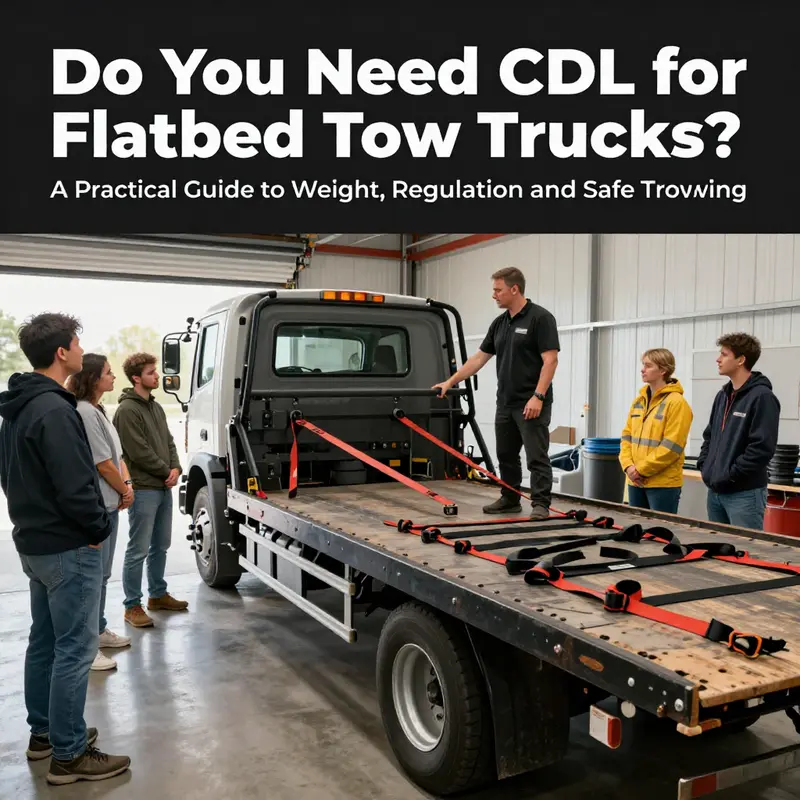
When a business shifts into the world of flatbed towing, the question of a Commercial Driver’s License often becomes the first pit stop on the regulatory map. The simple truth is that CDL requirements hinge on weight and how the vehicle is used, not merely on the act of towing itself. A flatbed rig, by design, is built to carry substantial loads. The critical line in the sand sits at a gross vehicle weight rating, or GVWR, of 26,000 pounds. If the flatbed tow truck weighs more than that, the operator generally needs a CDL, typically Class B. The logic is straightforward: heavier rolling stock means greater stopping power, longer stopping distances, and a higher potential risk to other road users. The highway safety framework is built to reflect that reality, and it applies across state lines as soon as crossing into interstate operation occurs. Interstate travel tends to sharpen the CDL requirement, even for operators who mostly perform routine, local tows when the vehicle itself is near or just below the threshold. The federal rules recognize that the combination of a heavy truck and a towed load can push a job into a higher risk category, which is why the weight of the towed vehicle matters as well. If the combined weight of tow truck and trailer exceeds 26,000 pounds, a CDL is likely required, particularly when the towed vehicle is not rolling freely or requires a winch, crane, or other equipment to load. In contrast, for lighter flatbed configurations with GVWR under 26,000 pounds, a standard driver’s license may suffice for basic towing tasks. The nuance here matters: many flatbeds used for heavier recoveries, long-distance moves, or intercity relocations cross that line, rendering a CDL not just advisable but mandatory under federal definitions. To keep pace with this evolving landscape, operators should view weight-based eligibility as a moving target rather than a fixed formality. The same approach applies to how the job is performed. A flatbed tow truck is frequently tasked with transporting non-running vehicles, a scenario that almost always involves winching, ramp loading, or other load-securement procedures. Those activities add layers of complexity in terms of vehicle handling and load security. In practical terms, if you regularly move vehicles that are not operable, use a winch, or require careful ramp alignment, you should anticipate the possibility that a CDL will be required or, at minimum, strongly expected by clients and regulators. Federal and state regulators do not look at the act of towing in isolation; they examine weight, use, and the risk profile of the operation. The official guidance from federal and state authorities emphasizes consistency in training, testing, and securement practices to ensure safe transport. The weight-based rule is mirrored in the practical steps a driver must complete to obtain a CDL: a written knowledge test that covers the general rules, followed by a skills test tailored to the vehicle type on which the license is sought. For flatbed towing, that means demonstrating competency in controlling a heavy truck, managing the unique dynamics of a flatbed trailer, and showing you can handle the seasonal variations that come with heavy loads, tricky access, and precarious recoveries. As part of readiness, many operators pursue endorsements on the CDL, with the most common being a T endorsement that authorizes towing of other vehicles. The T endorsement requires additional testing and training focused on load securing and the operational specifics of a flatbed trailer. The pathway to a CDL is well established: pass the written exam, complete the driving test in the desired vehicle category, and secure any necessary endorsements with the appropriate agency. In the real world, employers expect a driver to bring a baseline competence plus ongoing proficiency. That expectation is reinforced by industry bodies that advocate continual training in safety protocols, load distribution, securing methods, and emergency response procedures. The logic is not merely regulatory; it is practical. Proper training reduces the risk of damage to the recovered vehicles, protects the towing crew, and minimizes liability for the employer. For drivers who want a structured route toward licensing, the CDL Tow Truck Guide provides a clear, stepwise path through the requirements, testing, and endorsements. See more on that resource here: CDL Tow Truck Guide. In parallel, the Federal Motor Carrier Safety Administration FMCSA offers official guidance that is essential reading for any operator planning interstate work. The FMCSA framework emphasizes the need to understand cargo securement as a core safety discipline, with rules that apply to how a flatbed trailer carries loads on the road. In practice, securement is not a checkmark but a continuous discipline that begins long before the tow. It involves carefully selecting tie-downs and anchor points, applying them at correct angles, and verifying that every strap, chain, or binder can withstand the anticipated forces of highway motion. The rules governing cargo securement are anchored in rigorous standards, including the requirement to use tie-downs rated for the load and to leverage anchor points on the vehicle frame rather than suspension components. The securement process also calls for redundancy; a secondary restraint can be the difference between a secure load and a dangerous scenario should the primary method fail. A robust pre-trip inspection follows, and that inspection guards against mechanical surprises that could escalate risk on the road. TRAA, the Towing and Recovery Association of America, supplies industry-standard guidelines that blend safety with operational efficiency. These guidelines call for certified training, equipment that meets high safety standards, and a safety-first culture where every crew member has a responsibility for securement and road safety. Pre-trip checks under TRAA guidance emphasize the integrity of hydraulic systems, the health of winches and cables, the chassis and frame condition, tire and brake function, and the operability of lights and emergency equipment. The emphasis on a double-check system—one person securing the load and another verifying it before movement—has become a widely adopted best practice. The practical takeaway is simple: a CDL is not a mere credential but a safety regime. If your flatbed operation involves heavy loading, long hauls, or interstate travel, you are likely navigating a regulatory space that expects you to hold a CDL and maintain up-to-date training and endorsements. If you are uncertain about whether a specific job requires a CDL, consult the weight thresholds, the intended use, and the nature of the load. The decision rarely rests on the tow technique alone. It rests on the intersection of vehicle weight, load type, travel distance, and the regulatory requirements that govern safe highway operation. For anyone who wants to align practice with policy, the route forward blends licensing with ongoing education. Regular refresher courses, compliance audits, and staying current with FMCSA updates are not optional add-ons; they are core elements of professional practice in the flatbed towing world. The weight-based rules, the endorsement structure, and the industry standards for securement and inspection all converge on a single goal: moving people and vehicles safely from point A to point B, with as little risk as possible. External reference for the official framework can be found at the FMCSA site, which codifies the civil and highway safety expectations that underpin each CDL decision. For official guidance, see FMCSA at https://www.fmcsa.dot.gov/.
Final thoughts
The decision to pursue a CDL for a flatbed tow truck rests on clear weight-based rules, safety obligations, and the geography of operation. If the tow truck’s GVWR exceeds 26,000 pounds, a CDL is typically required. When the combined weight of the tow truck and the towed vehicle surpasses 26,000 pounds, CDL considerations arise, especially if the load isn’t rolling or requires winching. Lighter flatbeds may be operated with a standard license for many routine tasks, but safety, training, and best practices remain essential. Interstate travel triggers federal expectations for CDL credentials, medical certification, and ongoing compliance, while intrastate work may vary by state. Across chapters, the throughline is practical: know the weight thresholds, understand how you tow, stay current on jurisdictional rules, and invest in training and responsible practices. For everyday drivers, residents, truck owners, auto shops, and property managers, this framework supports reliable, lawful service delivery that protects people on the road and your bottom line.