
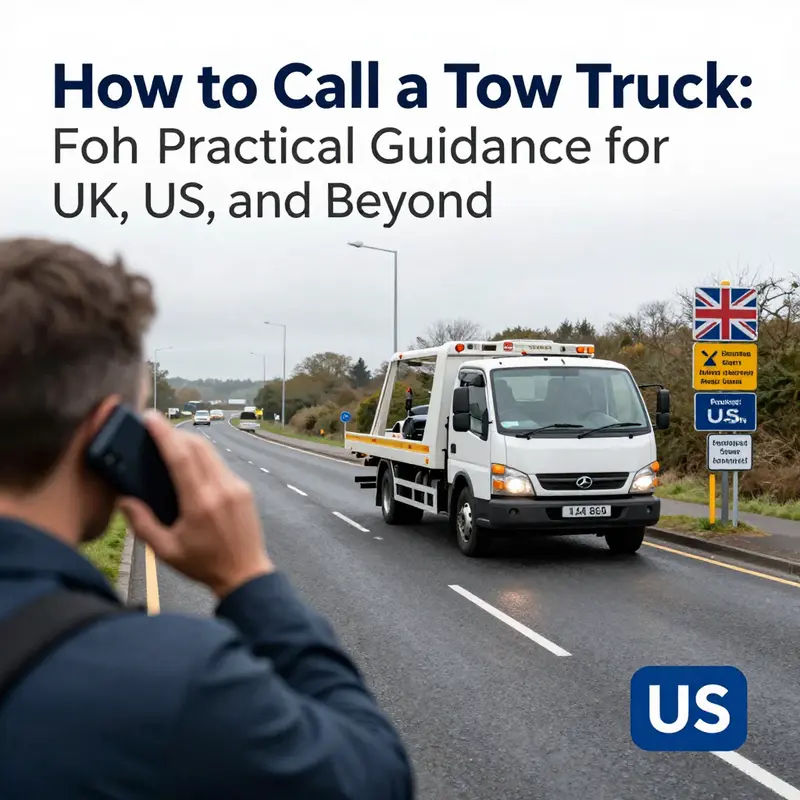
Tow trucks are more than a roadside service; they are critical logistics partners that keep daily life moving. Across the UK and US, the way you phrase a call, the dispatch path you choose, and the speed of response hinge on language, context, and channels. This guide aligns the realities of Everyday Drivers, Residents & Commuters, Truck Owners, Auto Repair Shops & Dealerships, and Property Managers with practical calling procedures. Chapter 1 clarifies language variants and practical calls in the UK and US. Chapter 2 outlines emergency procedures and rapid dispatch to minimize downtime. Chapter 3 explores non-emergency channels, insurer options, and actionable tips to optimize outcomes. A concise checklist helps you prepare before you call: know the vehicle’s make, model, and license plate; share your exact location; describe the problem succinctly. In emergencies, contact local emergency services when required; for non-emergencies, use roadside assistance or your insurer when appropriate. The goal is a holistic framework you can apply in the moment, with clear phrasing, verified contact details, and a dependable workflow when you need a tow.
How to call a tow truck—Chapter 1: Language variants and practical calls in the UK and US
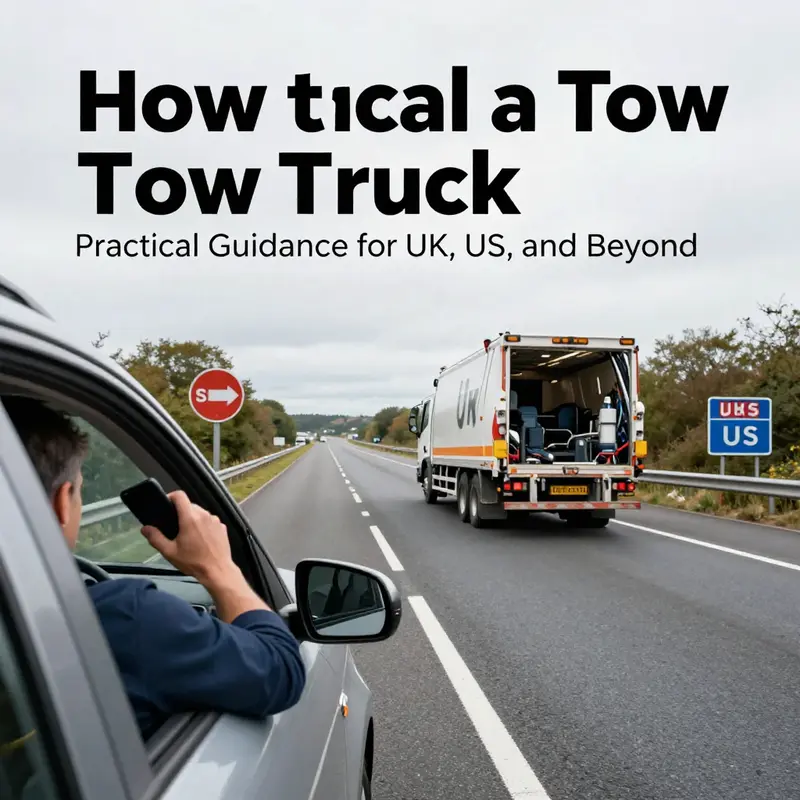
Stranded on the shoulder of a quiet road, you reach for your phone with a mix of irritation and relief, knowing help is on the way. The moment you call a tow truck is more than a request for a vehicle; it is a small act of communication under pressure. The language you use signals where you are, what you want, and how quickly you need rescue. In the United States the common term is tow truck; in the United Kingdom the same idea is typically described with breakdown truck or roadside assistance. These differences reflect regional practices and help the dispatcher respond quickly when you are precise about location and problem. Understanding them helps you prepare for the call and speeds the dispatch process.
If you are ready to call, decide whether you are dealing with an emergency. In the US, dial 911 and request the tow as part of the response. In the UK, dialing 999 or 112 connects you to emergency services, after which they can arrange roadside assistance or a tow if needed. For non emergency situations there are usually roadside plans from insurers, credit networks, or private memberships. These can offer complimentary towing within a set distance or arrange transport to a preferred shop. Knowing what your plan covers saves time and money when you call.
Before you pick up, gather the essentials: your exact location, the make and model of the vehicle, the license plate, and a concise description of the problem. If you are on a busy road, note nearby landmarks or mile markers. If a wheel is damaged or there is a leak, mention it. Clear details help the dispatcher assign the right equipment and estimate arrival times more accurately. While you wait, stay safe by turning on hazard lights and remaining in a well lit area if possible. Keep your phone close for updates and confirm any access details such as gates or parking restrictions so the driver can reach you without delay.
Tow Truck Coordination in Crisis: The Art and Science of Rapid Dispatch
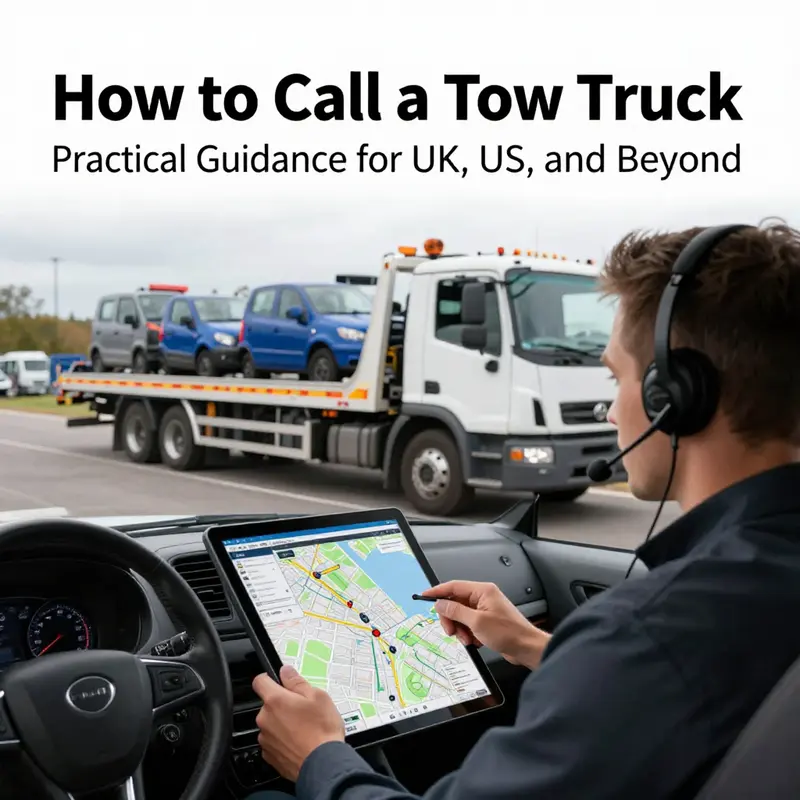
On a crowded stretch of highway, a breakdown or crash becomes a puzzle of time and space. The driver spots the problem, pulls to the shoulder, activates hazard lights, and reaches for the phone. What follows is not a simple request for help but the opening of a tightly choreographed sequence that links the motorist to a trained operator, a tow truck in motion, and a network of responders committed to clearing the scene safely and quickly.
In emergency situations, every second matters. The call you place initiates a cascade of decisions, each aimed at restoring normal traffic flow while safeguarding life and property. Dispatchers do not treat every call as identical. They triage based on location accuracy, vehicle type, required equipment, and the presence of hazards on the roadside. A disabled car on a straight highway with light traffic demands a different kind of reply than a multi-vehicle pileup on a busy interchange during rush hour. The former might require a single wrecker with basic stabilization tools; the latter could call for a coordinated strike team of tow units, police, and hazard responders with a plan to divert lanes and protect the crash site.
The core goal of rapid dispatch is simple in theory but complex in practice: get the right tow truck, with the right equipment, to the right place, at the right time, with the right safety measures in place. This is where the dispatch center blends algorithmic efficiency with human judgment. When a call comes in—via 911, roadside assistance, or a traffic-monitoring system—the dispatcher activates an automated workflow. The system locates the nearest qualified tow truck using GPS coordinates, checks the vehicle type and equipment needed, and confirms the unit’s availability. If the incident involves a high-risk route, recent weather hazards, or a corridor known for sudden congestion, the software can flag additional units to stand by nearby, ready to respond.
A pivotal element is the fleet’s readiness. Tow companies maintain a carefully pre-qualified pool of vehicles that are inspected regularly and stocked with essential recovery tools: robust winches, recovery chains, hydraulic lifts, lighting gear, traffic cones, reflective vests, and PPE. This is not a random selection at the roadside; it is a pre-arranged inventory that allows near-immediate deployment. In emergencies, the first message from the dispatcher to the driver is almost ritual in its brevity: confirm location, confirm incident type, confirm estimated arrival time, confirm access constraints. The driver responds with a precise route, anticipated travel time, and any on-scene hazards observed en route. The loop closes when the dispatcher marks the unit en route and continues to monitor progress, ready to reallocate resources as the situation evolves.
Modern emergency response is rarely a solo act. It relies on robust integration with police, fire departments, and highway patrol. In many regions, dispatch systems are wired into these agencies to ensure coordinated scene management. When a serious crash occurs, responders can direct traffic more efficiently, set up safety zones, and protect the recovery area from other vehicles entering the work zone. This coordination reduces the chance of secondary crashes, which are a leading threat to public safety around incidents. The objective is not merely to move a stalled car but to stabilize a potentially dangerous scene and restore movement on the corridor as soon as possible. In practice, this requires an exchange of timely information: location updates, scene assessments, and the type of tow equipment required, all relayed with precision so responders stay aligned and safe.
Behind the wheel, tow operators are more than drivers; they are on-scene professionals trained to navigate high-stress environments. They must understand how to approach a stalled vehicle safely, assess the need for immediate stabilization, and communicate clearly with the driver and with other responders. The operator’s training covers the risk factors at roadside recovery, from traffic speed differentials to the possibility of fuel leaks or unstable loads. A driver may encounter oncoming traffic, shifting shoulder widths, or rain-slick pavement. In those moments, the ability to adapt quickly—selecting a different rig, choosing a safer exit, or postponing a maneuver until conditions improve—can prevent harm.
What information should you provide when calling for a tow in an emergency? Start with exact location. If you can, share mile markers, exit numbers, or GPS coordinates. Add the vehicle’s make and model if possible, along with the license plate. Describe the problem with a concise phrase: is the car stuck in neutral, has it stalled with no power, or is there a crash with fluids on the roadway? Mention any hazards such as downed power lines, fuel spills, or obstructed lanes. If the vehicle blocks traffic, note the direction of travel and the best place for the tow to reach you without compromising other motorists. In non-emergency situations, you can still communicate the same details, but you may have slightly more time to arrange alternatives or insurance-assisted towing.
Pro tips matter in these moments. Have a plan to stay safe while you wait. If you can, activate hazard lights early, keep passengers away from traffic, and step away from the vehicle unless you are certain it is safe. If you’re on a busy highway, wait behind barriers or guardrails rather than standing directly near the roadway. If you must remain with the vehicle, keep clear of the traffic lane and follow the tow operator’s and emergency responders’ directions. A calm, factual description of the scene reduces back-and-forth and speeds up the response. The dispatcher’s first priority is to mobilize the closest, most suitable unit, but accuracy in your report is what keeps that unit from wasting precious minutes.
The technological backbone supporting rapid dispatch is increasingly sophisticated. Real-time GPS tracking shows the dispatcher the exact position of every unit in the fleet, not just the one designated to your call. Telematics provide status updates: en route, on scene, or delayed due to road conditions. These data streams give supervisors a live picture of resource distribution, enabling them to shift units before bottlenecks form. In large urban areas, fleets often deploy mobile apps and IoT-enabled devices that drivers use to confirm arrival times, communicate road conditions, and report changes in the scene. This level of transparency helps the entire system avoid duplication of effort and ensures a unit does not idle miles away while another squad is already on its way.
Artificial intelligence also plays a growing role. Dispatch software can predict high-risk zones—icy stretches, known accident hotspots, or congested bottlenecks—and position tow units in advance of suspected trouble. This proactive positioning is not guesswork; it is a data-driven practice built on historical incident patterns, weather data, and current traffic flows. In effect, AI helps shift the balance from reactive to proactive response, ensuring help can reach you faster even when the road looks chaotic.
All of this theory rests on the practical, on-the-ground reality that a tow driver must be able to operate safely in and around moving traffic. The best dispatch network is only as good as the person who carries out the recovery. Training emphasizes the safe setup of the work zone, the correct use of recovery equipment, and the discipline to stay within a defined safety perimeter while towing or winching. The driver learns to gauge tension on chains, to secure loads properly, and to communicate with the driver of the disabled vehicle so the recovery can proceed without causing additional risk. Safety gear—the high-visibility vests, the hard hat when required, the gloves and protective boots—becomes as essential as the tools in the truck bed.
Communication remains central throughout the process. The initial call triggers an ongoing exchange of information: location updates, scene size-up, and the evolving needs of the recovery. The dispatcher may request that the tow operator carry a particular accessory or equipment type based on the incident’s specifics, such as a flatbed for a car with a damaged undercarriage or a wheel-lift unit for a stubborn immobilization. The operator, in turn, feeds back information about arrival time, on-scene conditions, and any new hazards that surface during the approach. In complex scenes, communication with other responders is not a luxury but a necessity, enabling synchronized actions that minimize exposure to danger for everyone involved.
A key distinction in the field is the difference between emergency and non-emergency towing. In an emergency, the priority is rapid, coordinated action to reduce risk and restore safe travel. The dispatch system leans on its most immediate assets and may call for traffic control measures or the temporary closure of lanes to protect recovery teams. In non-emergency situations, time remains a factor, but the pace can be tempered to accommodate a more deliberate plan, which may include coordinating with the vehicle’s owner, arranging a preferred tow location, or aligning arrival with medical or insurance needs. Even in non-emergencies, the same disciplined approach to gathering information—location, problem description, vehicle details—shortens the eventual tow and reduces the chance of repeat visits.
The human dimension of the crisis chain is subtle but powerful. Dispatchers, drivers, police, and roadside personnel must trust each other to act with prudence, communicate clearly, and keep safety the top priority. This trust is built through training, repeated practice drills, and the routine sharing of lessons learned from near-misses and real incidents. In the most effective systems, these lessons are codified and disseminated across the network, ensuring that what works in one city can be adapted to another, with respect for local road layouts, weather patterns, and emergency response norms. The result is a pattern of behavior where rapid dispatch is not an accident of technology but the outcome of careful design, ongoing education, and relentless attention to safety.
The end-to-end flow—from the moment you dial a number to the moment you are reunited with your vehicle—rests on a delicate balance of speed and accuracy. The dispatcher must move with decisiveness, yet confirm details that matter. The tow operator must bring the right equipment, position the vehicle securely, and perform the recovery with minimal disruption to traffic. The road must be made safer for all who travel it, not just for the individual in distress. When this balance is achieved, the road becomes a shared space where efficiency and safety reinforce one another rather than compete for attention. The resulting improvement in response times, fewer secondary incidents, and smoother traffic flow is a measurable victory for public safety and for the people who rely on tow services to get back on the road as quickly as possible.
For readers who want a deeper dive into the technical backbone of these operations, a closer look at the integration of safety protocols and modern dispatch technology is available through the broader literature on tow-truck technology and safety. This evidence base highlights how GPS, telematics, and automated routing are not merely conveniences but essential components of a safer, faster, and more coordinated response to roadside emergencies. As you consider your own readiness—whether you are a driver, a dispatcher, or a policy planner—keep in mind that the efficiency of rapid dispatch is built on layered systems that support each link in the chain. When one link falters, the whole chain weakens; when every link is strong, the result is a quicker, safer, and more reliable recovery operation.
To envision how this plays out in real life, imagine a corridor where severe weather has just reduced visibility and traffic moves slowly. A call comes in about a disabled vehicle on the far shoulder. The dispatcher, using live traffic data and an up-to-the-minute inventory of available units, assigns a skid-equipped wrecker to the scene and reconfigures the queue to allow the nearest spare unit to prepare in parallel. The driver, notified of a potential change in the approach route due to an accident further down the lane, adjusts the plan, communicates back with the dispatcher, and proceeds with caution. The police officer at the scene, observing the hazard, tightens the safety perimeter and guides approaching vehicles away from the recovery. The owner of the disabled vehicle receives the information promptly, confirms the status, and understands the expected arrival time. In such a moment, the system’s resilience and the people who operate it become the unseen force that makes a crisis manageable rather than catastrophic.
From a broader perspective, rapid dispatch is a public-safety asset that extends beyond any single tow company. It depends on interoperable technologies, standardized procedures, and a shared culture of safety. It is this ecosystem that ultimately guards the flow of traffic, reduces the likelihood of additional injuries, and helps communities recover from disruptive incidents more quickly. For practitioners and readers who want to explore how these principles translate into practice, consider examining the linked resources that discuss the relationship between vehicle safety, emergency response, and organizational readiness. In particular, the visual and technical details behind how fleet managers position, monitor, and support their teams offer a concrete lens into how theory becomes action on busy streets.
As you move forward through this guide, you will gain a clearer sense of when to call for help, what to expect from the dispatch process, and how to interpret the signals you see along the way. You will also encounter practical advice about communicating with responders to minimize delays and maximize safety. The aim is not merely to speed up the arrival of a tow but to ensure that the moment of recovery unfolds with order, calm, and shared responsibility. For those who want to connect this chapter to a broader technical conversation, the field’s ongoing innovations—such as enhancements to vehicle-mounted safety systems and the continual refinement of dispatch algorithms—are captured in the accessible discussion of tow-truck technology and safety. This resource, linked here for further reading, complements the real-world strategies described above and helps readers appreciate how the pieces fit together.
Internal link reference for readers seeking a deeper technical context: Tow Truck Technology and Safety.
External resource for official guidance and best practices: NHTSA Emergency Vehicle Response Guidelines.
Call the Right Tow: Navigating Non-Emergency Options, Insurers, and Smart Preparation
When your vehicle stalls but the situation isn’t life threatening, the moment calls for a calm, deliberate workflow rather than a panic sprint to the nearest unknown roadside service. This chapter treats non-emergency tow needs as a planning problem with several reliable routes to consider. The goal is not merely to summon a tow truck, but to choose a path that minimizes cost, maximizes reliability, and protects your time and safety. A steady approach starts with recognizing that non-emergency tow needs often fall into one of a few lanes: insurance company coverage, manufacturer support programs, dedicated tow platforms or memberships, app based map and dispatch services, and regional non emergency lines. Each lane carries its own rules and potential advantages, and in many cases you can combine them to secure the best outcome without compromising safety. The first step is to shift from an emergency mindset to a decision framework. When you can describe your situation clearly—your location, the reason you think a tow is needed, and a repair destination—you give the dispatcher or service platform the information they need to choose the right truck and route. The more precise you are about your location, the better the driver can approximate arrival time and plan the route. Having the vehicle’s make, model, and a license plate number on hand can also streamline the process, especially if you are speaking with a service that needs to verify ownership or vehicle details before dispatch. In non emergency scenarios, many people prefer to use a trusted channel rather than calling a random number off a roadside sign. That trust often rests on a known relationship, whether with an insurance provider, a manufacturer program, or a reputable platform. The reliability of each option depends on how familiar you are with the terms and conditions that apply to your policy or service plan, and how transparent the price and coverage are before the tow begins. A practical, sometimes overlooked piece of preparation is knowing the repair destination you prefer. If you already have a preferred shop or dealership, confirming that location beforehand helps the dispatcher plan a tow that aligns with your repair timeline. If you lack a preferred destination, identify two or three nearby options that are compatible with your vehicle’s make and the type of service you anticipate. Your comfort with the chains of authorization matters too. Some insurers require that a tow be performed by a preferred network or that the vehicle be disabled in a way that makes safe transportation possible. Others allow freedom to choose any licensed operator. Reading your policy terms ahead of time, or having the policy number ready for a call, can prevent delays and misunderstandings, especially when you are in an unfamiliar part of town. In this light, the non emergency tow landscape reveals a spectrum of routes that can be navigated with a few careful steps, each path designed to balance speed, pricing, and reliability. Imagine a highway system where you can hop on a lane that feels most aligned with your current needs. One lane runs through insurance roadside assistance. If you carry auto coverage that includes 24/7 roadside support, you already have a built in plan for towing. The process typically starts with a quick verification of policy details and eligibility. A representative will confirm that towing is covered under your plan and will specify any distance limits, such as the maximum miles that a tow can cover at no extra charge. They may also verify whether the tow must be for a disabled vehicle or if the car cannot be driven safely to a repair facility. In practice, you call the number on your policy card or the policy app and describe the situation. If you are near your home or a familiar repair location, the cost can be minimal or free, and the process often includes a dispatch notification to a licensed tow operator who operates within the insurer’s network. It is crucial to confirm the actual towing distance and any caps before the tow is authorized. Some policies cover long tows from highway incidents to a dealership, while others might impose a per mile charge after a certain threshold. Checking these terms in advance saves you from surprises later. The second lane extends through the manufacturer’s rescue or assistance program. This route is especially relevant if your vehicle is recently purchased or still under some service terms tied to the manufacturer. In many cases, manufacturers offer 24/7 assistance with a tow to the nearest authorized service facility or dealer. This can be valuable because the manufacturer network is designed to preserve the integrity of the vehicle’s service history and to ensure compatibility with original parts and service standards. Access often comes through an in car emergency button, a brand app, or a dedicated helpline. The benefits can include consistency in service, potential cost reductions, and a smoother handoff to the dealer network. However, there can be limits. Depending on the plan, the tow might be restricted to certain geographic areas or to specific service centers. It may also require that the vehicle be within a certain warranty window or within a particular package tier. It helps to clarify whether the tow will be free, discounted, or subject to a cap, and whether the destination must be a dealership or an authorized repair facility. The third lane is built around dedicated tow platforms and memberships. These are dispatch networks that specialize in non emergency roadside assistance and telematics enabled dispatch. They often provide upfront pricing estimates, real time tracking of the tow vehicle, and ETA updates to your phone. Memberships vary in scope and price, but they frequently cover a certain number of miles without extra charges or at reduced rates, and they can offer predictable service across a wide geography. The advantage here is transparency and speed: you can see a quote, monitor the driver as they approach, and have a clear sense of the service you are paying for before the tow begins. The fourth lane is app based and map driven. With the growth of location aware services, you can search for tow providers near your position using a familiar map app. The results will display nearby tow trucks with estimated arrival times and user ratings. In some markets, ride sharing or task based apps have begun to incorporate towing tasks, offering a convenient, one stop solution for users who already rely on those ecosystems for other services. The caveat with this route is variability. Availability, price, and reliability can shift with location, time, and demand. It pays to cross check the provider’s credentials, verify the operator is licensed, and confirm the expected price up front if the platform supports upfront quotes. The final lane includes non emergency contact lines and regional guidance. Several regions maintain official non emergency numbers that you can call for a breakdown that is not an immediate hazard to life or property. The utility of these lines lies in their coordination with local authorities and highway services, and their capacity to deploy appropriate help without tying up emergency channels. If you happen to be in a country that preserves a non emergency contact path, that line can be a calm, well regulated route to arrange a tow. The content and availability of these numbers vary by region, and it helps to check your local government guidance or the highway authority website for the current procedure. Regardless of the lane you choose, there are universal considerations that govern the experience of non emergency towing. First, demand price transparency. Before any tow starts, you should obtain a clear, itemized estimate that states the base tow charge, any mileage costs, after hours fees, and destination charges if applicable. If you are using an app or platform, use the built in price quote feature when available. Second, destination planning matters. Decide in advance where you want the vehicle taken and ensure that the facility can accept your vehicle type and is equipped to perform the required repair or service. If shifting between networks, confirm whether the tow can be redirected to a different location mid course, and what the cost implications would be. Third, vehicle information. Have the vehicle’s make and model, color, license plate and any notable conditions ready. This reduces back and forth with dispatchers and helps avoid miscommunication that could cause delays. Fourth, location accuracy. Provide precise location details as clearly as possible. If you can give cross streets, landmarks, or GPS coordinates, you will help the tow truck find you faster and avoid parking tickets or unsafe spots. Fifth, enforcement and safety. Use licensed, legitimate operators. Unlicensed or unmarked operators are not just a potential legal risk but can create safety hazards for you, your passengers, and your vehicle. When in doubt, take a moment to verify license numbers or company details and ask for identification from the driver. The aim is to eliminate ambiguity while keeping you and your property safe. The story of choosing a tow option is less about finding the cheapest price and more about balancing price against reliability and speed. A low price that ends in a long wait or a driver with uncertain licensing does not serve your needs in a non emergency situation. The most effective approach is to think through your priorities: Is it critical to minimize out of pocket cost? Do you need a tow to a specific repair facility that can handle your vehicle today? Is time a factor because you are at work or waiting with a family member? Once you have answered these questions, you can select the lane that aligns with your priorities and proceed with confidence. A practical way to anchor this decision is to begin with a trusted starting point. In many cases, the simplest and most reliable starting point is the roadside assistance or service line provided by your insurer or by your vehicle manufacturer. These options are designed to be integrated with your policy or service terms, making them a natural first choice when you want to minimize friction and guarantee that the tow aligns with your vehicle’s service history and coverage. If you are curious about the typical costs involved in tow services, you can explore the general cost landscape through a dedicated cost guide that explains how pricing per mile, base dispatch fees, and destination charges interact. See how much is a tow truck for a sense of the typical ranges and to set expectations before you call. As you consider these options, remember that the most important outcome is getting you and your vehicle to a safe, professional repair environment with clarity on costs and timing. The process often unfolds more smoothly when you keep communications direct and precise, when you insist on written estimates or app based quotes, and when you confirm coverage and eligibility before the tow begins. In practice, this means asking: what is the estimated total price? what is the maximum distance covered by the policy or plan? what happens if I need to change the destination? and can you provide a confirmation in writing of the backup plan if a preferred shop cannot accept the vehicle? A few final considerations help keep the experience smooth. First, record the dispatcher’s name and the driver’s license plate or operator ID. These identifiers are useful for accountability if anything goes awry. Second, document the time of dispatch and the expected ETA. Third, keep any receipts and a summary of the services performed. If you used an app based platform, retain the invoice or digital receipt. Fourth, after the tow, assess the service quality. If you believe the price was unclear or the service did not meet expectations, you now have the information you need to file a review or request a clarification through the platform or provider. The non emergency towing landscape offers a flexible, multi lane approach that can adapt to nearly any location or scenario. The crucial factor is understanding the terms and aligning your choice with your needs, your budget, and your timeline. A calm, informed decision saves more than money; it preserves your time and your peace of mind. For those who want a quick point of reference while reading or planning, the following anchor can help you compare price expectations quickly: how much is a tow truck. This link points to a detailed resource that discusses typical costs and what factors influence them, helping you set realistic expectations before calling. how much is a tow truck. If you want a practical synthesis of where to start, consider beginning with your insurer’s roadside assistance or your vehicle manufacturer’s support line. These routes tend to be the most trusted and the most likely to align with your vehicle’s service plan, which can translate to smoother approvals and fewer disputes about coverage. The aim is not to lock you into a single method, but to empower you to choose deliberately and with confidence. In the end, the ideal non emergency tow experience blends transparency, reliability, and respect for your time. It means you are not left guessing about who is coming, how much it will cost, or where your vehicle will be taken. It means you can continue your day with a plan that keeps disruption to a minimum and safety as a top priority. If you would like, I can turn this into a concise decision guide or build a quick start checklist you can print or save on your device, tailored to whether you are insured, have a manufacturer plan, or prefer app based booking. External resource: for quick guidance on non-emergency roadside services that emphasizes safety and coordination with local authorities, you can consult trusted roadside information from a reputable UK resource here: https://www.theaa.com.
Final thoughts
Effective tow-truck calls combine precise language, clear procedures, and reliable channels. Chapter 1 equips readers with UK and US terminology, reducing miscommunication at the roadside. Chapter 2 demonstrates how to coordinate emergency dispatch, prioritize safety, and verify arrival times with operators. Chapter 3 outlines non-emergency routes, including insurer-backed towing, service provider selection, and practical tips to minimize downtime. Across Everyday Drivers, Residents & Commuters, Truck Owners, Auto Repair Shops & Dealerships, and Property Managers, the core practice is preparation: have the vehicle’s make, model, license plate, and your exact location ready; describe the problem concisely; and choose the most appropriate channel for the situation. A simple pre-call checklist and a calm, structured approach can dramatically shorten recovery time and reduce risk. Ready to take the next step in preparedness? Ready to elevate your ride? Summit Fairings delivers premium, custom-fit fairings that blend style and durability. Whether you’re chasing speed or turning heads, we’ve got your bike covered. Don’t wait—transform your machine today. Click, customize, and ride with confidence. Your perfect fairing is just a few clicks away. Act now!