
When your vehicle suddenly requires roadside assistance, a tow truck driver becomes your lifeline. However, the question of how much you should tip them often leaves drivers in a dilemma. Understanding when to tip and how much to offer can enhance the tow truck driver’s service experience and make a significant difference. This guide elaborates on essential factors, common practices, regional variations, customer expectations, and AAA’s guidelines that inform tipping models for tow truck drivers, empowering everyday drivers, property managers, and business owners to make informed decisions in dire moments.
null
null
Tipping with Purpose: Understanding How Much to Reward an AAA Tow Truck Driver for Good Service
Tipping a tow truck driver is rarely as straightforward as tipping a waiter or a courier, and that ambiguity can leave many roadside guests unsure what, if anything, to offer. When you’re stranded on a shoulder, options feel limited, and the next move—whether you’re dealing with a breakdown, a lockout, or a difficult tow from a busy highway ramp—hangs on the driver’s skill, safety, and the clarity of the message you convey about value. The common starting point in discussions of tipping is a practical range: many people consider around $20 to $50 as a baseline for a local tow, with higher stakes attached to more demanding jobs. The total tow cost can influence the tip, just as the level of effort and the time the driver spends on the scene can. In this moment of stress, a tip is not a legal obligation but a tangible signal of appreciation for service that met or exceeded your expectations. When a driver saves you time, avoids further risk, or helps you navigate a confusing process, that recognition can feel meaningful at a moment when every decision seems urgent.
Tipping, then, is best understood as a reflection of service quality and situational factors rather than a rigid rule. If the tow is quick, if the driver communicates clearly about what’s happening and what costs to expect, and if the vehicle is treated with care and safety is prioritized, a tip in the higher end of the range is reasonable. Conversely, a minimal interaction, a lack of explanation about costs, or a tow that feels routine and uneventful may justify a smaller gesture or even no tip at all. The core idea is to reward professionalism and usefulness without overthinking a moment that should be about staying safe and moving forward.
Within the broader conversation about tipping, the role of the towing service organization matters too. The American Automobile Association does not mandate a specific tip amount, and the official guidance often stresses service quality rather than dollar figures. In practice, many customers default to a guideline roughly equal to 15% to 20% of the tow cost, recognizing that this percentage-based approach scales with the job’s complexity, distance, and value of the vehicle involved. That said, the exact tip is always dependent on local norms, the driver’s conduct, and the particularities of the incident. If you’re unsure, leaning toward a modest percentage of the total bill or a targeted cash amount for a thoughtful intervention can bridge the gap between policy and personal judgment.
Beyond the price tag, several concrete realities shape when tipping makes sense and how much is appropriate. Tow truck work often requires specialized equipment and trained judgment. Vehicles like heavy-duty rigs are designed to handle recoveries that involve high-value assets or vehicles with drivetrain or suspension issues. The driver’s ability to deploy the right equipment safely, to navigate tricky road conditions, and to complete a tow without escalating risk for you, your passengers, or other motorists is a form of value that deserves recognition. In addition, the best practices promoted within the industry emphasize vehicle safety, clear communication, adherence to standard procedures, and a professional demeanor. These elements are not optional add-ons; they are the backbone of efficient, responsible roadside assistance. When a driver demonstrates them consistently, a tip can be understood as a concrete thanks for a job done well under pressure.
That connection between excellence and tipping becomes even clearer in scenarios that extend beyond a straightforward drop-off. A long-distance tow, a recovery that involves heavy equipment, or a tow that requires coordination with multiple stops or service centers can add hours to the driver’s work. In such cases, the value of the service increases, and a larger tip can be an appropriate acknowledgment of the extra effort and the extra time the driver has invested. Yet even in these circumstances, it is perfectly acceptable to base a tip on perceived value rather than the exact dollar amount of the invoice. The driver’s willingness to explain costs, to propose a reasonable timeline, and to provide practical advice for afterward—such as what to expect when your vehicle reaches the shop or how to handle paperwork—can elevate your sense of value and justify a higher tip.
The mechanics of tipping also deserve quick attention. Many roadside professionals, including AAA drivers, operate with the expectation that cash tips are common and easy to handle on the spot. Some drivers can accept card payments or digital tips, but cash remains the most straightforward option in a stressful moment. If you’re unsure of how much cash to offer, a quick mental calculation based on the total tow cost plus the described complexity can guide you toward a fair figure. It’s also wise to have small denominations on hand so you don’t end up shortchanging or visibly modest about the gesture. And while timing matters, tipping after the service, when you’re safely off the road, is a practical approach that allows you to reflect on the driver’s performance with a clear head and a calm sense of closure.
In talking about etiquette, it’s worth noting the practical realities that shape how people perceive tipping in a roadside context. Local customs can differ, and tips can feel more customary in some regions than in others. If a driver goes out of their way to offer helpful information—such as guidance on the most efficient route to a repair facility, or advice on preserving insurance documentation—the resulting sense of value often translates into a larger tip. The emphasis on clear communication—explaining timing, costs, and the steps of the tow—echoes the broader professional standard that many industry stakeholders advocate. When drivers embody this standard, tipping becomes a natural extension of recognition for service that protects people and property, not an abstract social obligation.
If you’d like a concise reference on tipping etiquette specific to tow services, you can explore a focused resource that discusses the practicalities of tipping drivers in this field. For more on the etiquette around tipping in tow operations, see the linked resource tip-tow-truck-driver. This discussion can help you calibrate expectations for future incidents without getting lost in conflicting anecdotes or overly prescriptive rules.
Ultimately, the decision to tip—and how much to tip—rests with the person receiving the service and with the person paying for it. It is a discretionary act rooted in gratitude for competence, safety, and courtesy under pressure. The core message is simple: a tip should mirror the value you perceived in the service. When a driver demonstrates safety-first thinking, thoughtful communication, and dependable problem-solving, recognizing that effort with a fair tip reinforces professional standards and reinforces the positive impact of good roadside assistance. As you reflect on the situation after the tow, you may find that your tip becomes less about the exact number and more about the message it carries: that skilled help at a stressful moment deserves thoughtful appreciation.
External reference: https://www.aaa.com/
Regional Variations in Tipping an AAA Tow Truck Driver: Policy, Practice, and Practical Guidance
Tipping practices for AAA tow truck drivers sit at an awkward crossroads of service culture, regulatory norms, and practical budgeting. Unlike ride-hailing or hospitality, where tipping has become a visible, sometimes expected custom, emergency roadside assistance operates under a different set of assumptions. In many regions, there is no universal standard for tipping a tow truck operator, and the norms shift with local laws, company policies, and the specific circumstances of the call. The service itself is inherently urgent, often dispatch-based, and designed to restore safety and mobility quickly. The price tag you see is usually designed to cover labor, equipment, fuel, and overhead for a job that can range from a straightforward jump-start to a complex, multi-vehicle tow. Because of that, tipping is not baked into the pricing model in the way it might be in another consumer service. The absence of a fixed tipping culture does not mean a driver cannot be recognized for exceptional effort; it simply means the recognition tends to take different forms and follows different rules depending on where you are and what happened on the ground. Regional variation emerges from a mix of local expectations and the way authorities regulate the interaction between customers, service providers, and the companies that organize roadside assistance.
When you cross state lines or travel between urban centers and rural stretches, the tipping conversation can feel as unsettled as the weather. In some locales, customers may still hand a driver a small cash sum as a gesture of gratitude for going beyond the call of duty—such as a navigation-assisted tow through a congested area, a particularly difficult disconnect and re-attachment, or when the driver helps with troubleshooting and safety checks beyond the immediate task. Yet the practical reality, as reflected in authoritative guidance, is that such gratuities are not uniformly endorsed. In fact, regulations and professional standards in several jurisdictions discourage or limit tipping for emergency responders and roadside technicians, at times citing potential conflicts of interest or the risk of shifting the perception of service quality toward a gratuity-driven metric rather than a fair, standardized price for service. This divergence between personal gratitude and formal policy is where regional variation becomes most evident. In some regions, drivers may explicitly decline tips, or company policies may channel any appreciation through formal feedback channels rather than cash or personal gratuities.
From a policy standpoint, the landscape is shaped by broader safety and consumer protection considerations. The field of roadside assistance is categorized as emergency response work, and the price structures are formulated around predictable labor, response times, and the resources required to secure a safe outcome for the motorist. In this context, tipping is not seen as a necessary incentive to meet service levels. Instead, the emphasis rests on consistency, transparency, and accountability—elements that ensure the customer receives reliable service regardless of local tipping norms. For customers, this means balancing personal gratitude with awareness of local customs and company guidelines. AAA, as a nationwide program, does not issue a universal tipping mandate, and the absence of a standardized tip amount is part of a larger framework that prioritizes uniform pricing and professional integrity across regions. The practical takeaway is that a fair tow should be judged by the service quality, the timeliness of the response, and the driver’s professionalism, rather than by the size of an extra gratuity.
Nevertheless, the conversation does not end with a one-size-fits-all rule. In regional practice, some callers may still feel compelled to offer a small tip when the service is unusually thorough or when the tow involves several hours of work, complex maneuvering, or additional safety-related tasks. The amount, if offered, tends to be modest and proportional to the overall scope of the job, often staying within a low single-digit to mid-range figure. It is important to recognize that even this gesture may not align with local norms or company policies in certain jurisdictions. The safest rule of thumb is to treat any gratuity as personal giving, not as a business requirement, and to be mindful of how it aligns with the accepted standards in your area.
For readers who want to navigate this terrain thoughtfully, consider how you express appreciation without complicating the transaction. If you believe a driver delivered exceptional service, the most reliable route is to document the experience through official feedback mechanisms—rating systems, service notes, or a formal commendation within the AAA member platform. Feedback not only reinforces positive outcomes but also supports continuous improvement in areas such as response time, on-scene safety practices, and customer communication. When in doubt about whether a tip is appropriate in a specific region, err on the side of caution and prioritize the documented channels for praise and recognition. If you still wish to learn about broader etiquette, you can explore resources focused on tipping norms in related contexts, such as the guidance on tow-truck etiquette available online.
For readers who want a concrete reference to etiquette without tipping, consider the following practical approach: ask the dispatcher or the driver if tipping is customary in the local area or if their company policy discourages it. If they invite no tip, or if you notice a sign or policy indicating that tipping is discouraged, respect that stance. If, after the job is done, you feel compelled to express gratitude in a tangible, non-monetary way, you can offer to provide a public positive rating or a detailed compliment that can be forwarded to the service management. This approach preserves the integrity of the transaction, minimizes potential conflicts of interest, and aligns with professional standards that govern emergency roadside assistance.
In regions where tipping is still a personal choice, the amount, when offered, should reflect the actual value of the service rendered, not a blanket expectation. Some drivers may perform above the basic requirements, such as staying in constant communication, offering extra safety checks, or providing practical advice for future incidents. In such cases, a modest token might seem appropriate to a courteous observer, but it remains a personal decision rather than a uniform practice. It is also important to recognize that the variability in tipping culture can extend to the type of tow. Long-distance runs, multi-vehicle recoveries, or situations requiring specialized equipment may place a greater time and effort burden on the driver. Even then, the localized norms and company policies will often guide whether a tip is appropriate and, if so, what amount would be considered reasonable rather than customary.
If you are curious about how tipping is perceived in professional towing contexts beyond personal experience, a helpful anchor is the broader policy landscape that governs roadside assistance. For a rigorous, evidence-based view of the safety and policy considerations that shape these interactions, see the guidelines issued by the national authority on road safety, which address how customers should engage with roadside services and why certain practices—such as tipping—are discouraged in official recommendations. This external reference helps frame the discussion within a standardized safety and ethics framework that transcends regional habit. In short, regional variations exist, but the prevailing emphasis from safety authorities and policy guidelines is to price services fairly and avoid tipping as a routine incentive.
If you want a quick practical takeaway, remember this: tipping is not a universal proxy for service quality. Your experience with an AAA tow could be excellent without any gratuity, or it could be the kind of job that makes you consider a small token in a region where it is personally customary—and where the company policy permits it. The safer path is to anchor your actions in official channels, provide clear, constructive feedback, and reserve monetary gratitude for situations where it is explicitly welcomed or permitted by policy. For those who wish to read more about how tipping practices are framed in relation to tow-truck drivers, see the resource linked below. And if you are preparing for future incidents, you may also find value in resources that discuss the broader evolution of emergency response and the role of training and standards in ensuring high-quality service.
External resource: https://www.nhtsa.gov/roadside-assistance-guidelines
Internal reference for further etiquette guidance: tip tow truck driver etiquette
Gratitude on the Road: Reading Customer Expectations When Tipping AAA Tow Truck Drivers
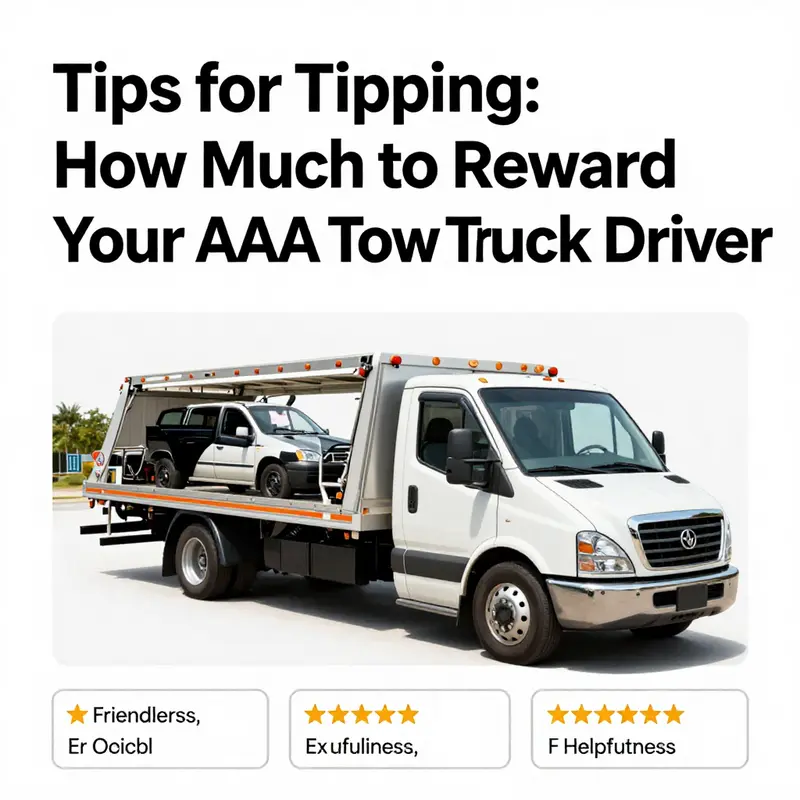
Stranded on the shoulder with the engine sighing and the heat rising, you watch the flashing lights approach. The tow truck driver steps out, checks the scene, and begins to secure your vehicle. In that moment you feel a complicated mix of relief, embarrassment, and practical anxiety about whether a tip is expected, and if so, how much. The question looms not as a demand, but as a social practice that helps acknowledge good service. When you are dealing with AAA roadside assistance, tipping becomes even more nuanced. AAA is a membership organization; their primary aim is to provide reliable help as part of your plan, not to monetize every interaction. Yet the people who work the roadside sometimes rise above routine expectations. That is when a tip feels most appropriate.
Regional norms shape what feels right. A driver may switch masks of language and tone from one state to another, reflecting the local hospitality that many Americans associate with the road. In a region with a strong tipping culture, a driver who stays calm under pressure, explains options clearly, and moves quickly to secure a stubborn tow may receive a larger thank you. In other parts of the country, a modest tip is more common, or the act of tipping itself is less habitual. These regional grooves are not rules, but they help set expectations. Your tipping choice should take into account where you are, not just who you are.
The nature of the service matters as well. A routine tow after a minor breakdown is different from a demanding rescue on a remote highway, during rain, snow, or darkness, where the driver may face hazards and constraints that are beyond the ordinary. If the driver arranges a complicated maneuver, such as navigating tight access to a hill, or coordinating with a second vehicle to secure your load, many customers view this as an extra effort worthy of a higher tip. If the driver offers something extra, like safety tips for a tricky stretch of road, a quick recap of what to watch for in the following days, or help with jump starting a dead battery in subzero wind, those little additions can feel priceless.
Personal discretion plays a large role. Tipping is never a legal requirement, and it is not a contract obligation. It is a voluntary expression of gratitude for service that went beyond the baseline. AAA does not set a tipping policy that binds every member, and many customers interpret that stance as leaving room for judgment. The common practice, however, is to consider the value of the service against the cost or the inconvenience. As a rough guide, many people weigh a tip on the basis of the total tow cost or the perceived quality of the assistance. Yet the reality remains that a good captain of the road can earn a small tip for a quick pull if the outcome is favorable, or a larger tip if the driver has to put in extra effort or stay longer than expected.
When the driver demonstrates professional care—careful handling of your vehicle, clear communication about the tow plan, and respect for your time—the tipping impulse often grows. A typical tip you will see in the wild ranges from modest to generous: many people are comfortable with ten to twenty dollars for a straightforward tow, while others might tip twenty to fifty dollars for a longer haul, a difficult extraction, or a situation that required significant problem solving. A rule of thumb frequently circulated in forums is fifteen to twenty percent of the tow cost, but the exact dollar amount can swing widely depending on circumstances and locale. The important thing is to anchor the gesture in the service you received rather than a fixed plate of norms.
The driver’s demeanor can tilt tipping decisions as well. A calm, patient, and informative interaction can soften the sting of the moment when you were late for an appointment, the clock was ticking, or the weather was turning nasty. Conversely, a driver who rushes, seems indifferent, or fails to explain what is happening may diminish the sense that additional compensation is deserved. People want to reward competence and courtesy, not to exploit the situation. In that sense, tipping becomes a language that aligns expectations with outcomes. It communicates that you respect the time and skill it takes to bring a stubborn problem to a safe conclusion.
AAA’s stance on tipping reflects a practical balance. As a membership organization focused on value for subscribers, AAA does not require tipping and does not promise a standard gratuity. Yet the same stance does not preclude spontaneous appreciation for service. If a driver goes above and beyond—helping with an especially heavy load, offering immediate safety guidance, or staying late to ensure you are safe—that appreciation can be expressed through a tip. In that sense, tipping can reinforce the kind of service people want to see repeated: a combination of reliability, competence, and thoughtful attention.
For those wondering how to calibrate a tip, it is useful to consider both service quality and local customs. A prominent factor is whether the tow was straightforward or involved extra tasks. A heavy or awkward load, a tow across a long distance, or a tow in severe weather all justify higher recognition. A simple, no-friction tow at an ordinary hour may justify a more modest gesture. The aim is to reflect the effort the driver invested, not to follow a single universal number. If you are uncertain, a practical approach is to recall the time and stress that accompanied the service and translate that into a tip that feels fair.
The mode of delivering the tip matters too. Cash remains the most direct form of appreciation, but some drivers appreciate a tip in the method you used to pay for the service, or simply a small cash gesture tucked into a glove compartment. If cash feels awkward in the moment, asking politely whether a tip is appropriate or whether the driver would prefer cash or card can ease the moment. If the driver completes the service and then leaves, you have a window of a few minutes to offer a tip, say thank you, and acknowledge the work done. If another driver arrives—perhaps a second unit is needed—they may have helped with a different aspect of the job, in which case you can decide whether to tip separately to reflect that individual effort.
The question of whether to tip can also invite broader reflection on how customers perceive membership-based roadside assistance. Some people feel that the service should be included as part of the plan or covered by membership dues. Others see tipping as a natural extension of good service, a way to reinforce positive patterns for future calls. In online communities, people often compare notes about what is customary in their locale, and these conversations can be instructive. They may reveal that tipping norms vary with the moment, the call, and the relationship you have with the roadside crew. In many ways, tipping is less about a fixed price than about a moment of shared recognition between driver and passenger.
As you move through your week, you may not encounter a tow truck every day, but the pattern of thought about tipping can become a routine in its own right. If you want a quick reference for practical tips, you can explore concise guidance on tipping a tow truck driver using the internal resource that covers etiquette and practical considerations. For practical guidance on tipping etiquette, you can refer to the guide on tip-tow-truck-driver. The point is not to rigidly chase a number but to align your gesture with the service you received.
Ultimately, the decision rests with you. If you feel confident that the driver helped you reach safety, you are within your rights to express that gratitude with a tip that feels fair. If the service was less satisfactory, a lower amount or no tip may be appropriate, and you can still offer thanks and constructive feedback to the company. The aim is to preserve trust and respect in an experience that can be stressful for everyone involved. When you keep this mindset, tipping becomes less about adhering to a universal standard and more about acknowledging the human effort that goes into keeping people mobile when they are stranded by the side of the road.
For readers curious about the broader economics of towing, including what determines tow rates and how drivers are compensated, there are resources that explain how pricing and earnings come together in this industry. A basic takeaway is that tipping is a personal and discretionary supplement to the service, not a mandated charge. The majority of people who find themselves in need of roadside assistance are not looking to make a political statement with a tip; they are looking to restore normalcy and safety as quickly as possible. In the end, tipping is a small gesture that can reaffirm humane care in a precarious moment. It is a personal choice shaped by circumstances, not a universal rule.
External resource: AAA policies provide context on how customers view their own obligations and expectations when seeking roadside help, and can be consulted for a deeper sense of the official stance. For more information, see AAA’s guidelines and policy pages at https://www.aaa.com
Reading the Road: Decoding AAA’s Tipping Guidelines for Tow Truck Drivers
When you’re stranded on the side of the road, a tow truck can be more than a vehicle recovery service. It’s a lifeline that moves you from danger to safety, from uncertainty to a plan. In that moment, tipping becomes a quiet, human gesture—a way to acknowledge effort, professionalism, and the extra miles a driver may travel to get you home or to a shop with minimal hassle. The topic is not simply a fixed number, but a blend of policy, circumstance, and local customs. The American Automobile Association, widely consulted in such moments, treats tipping as a voluntary expression of thanks rather than a mandatory fee. What that means in practice is that you have room to calibrate your response to the quality of the service, the conditions under which the driver worked, and the financial value of the tow itself. The result is a flexible guideline rather than a rulebook, one that helps you balance fairness with practicality when the road is still fresh in your memory and your options feel a little uncertain.
AAA’s official stance offers a baseline that tilts toward generosity without insisting on a fixed amount. In many discussions and user interpretations, a tip of about 10% to 15% of the tow cost is proposed as a reasonable starting point. This range accounts for the complexity of the job—whether the driver had to navigate slick roads, extract a vehicle from a tricky position, or secure a load in challenging weather. When the job stretches into longer distances or involves extra help, an uptick in the tip is sensible and appreciated. Conversely, if the tow is straightforward, brief, or performed with clear efficiency, a smaller tip may be appropriate. It’s important to evaluate the service against the effort, not just the duration. If the driver goes above and beyond—offering practical advice about what to do next, helping you coordinate add-on services, or staying with you until your vehicle is safely on a tow bed and the situation is stabilized—consider adjusting the tip upward. In this kind of moment, tipping communicates recognition and encouragement for a job done well under pressure.
One point that often surfaces in conversations about tipping is the method of payment. AAA guidance and common practice emphasize cash as the preferred medium for tips, given its immediacy and direct acknowledgment of the driver’s labor. A hand-to-hand exchange at the end of service carries a personal element that many customers value, especially in urgent or emotionally charged situations. The immediacy matters too, because it reinforces the connection between the effort and the reward. If cash is not feasible and the tow company supports electronic tipping, some drivers may accept a card-based tip, but you should confirm this option with the dispatcher or the driver before the payment is processed. At times, a printed receipt or a company policy may include guidelines or restrictions about tipping. If the company has a stated policy of not accepting tips or if a service charge is already included in the fare, that is your cue to refrain. Respecting those boundaries is part of a fair and professional interaction and helps maintain trust between customers and service providers.
Locational variation also shapes tipping expectations. In some regions, a larger tip may be customary because of higher living costs or longer travel distances tied to the job. In others, the norm might be more modest, reflecting local standards and the typical scope of emergency services. The driver’s role can differ as well. A simple roadside pickup in mild conditions is not the same as an extraction from a remote location in heavy rain or snow, where the driver’s extra care, time, and risk should be reflected in the tip. The overarching principle remains consistent: the tip should align with the quality of service and the level of effort you observed, while staying within your means. This is not about pressuring anyone into a higher amount but about acknowledging a job done with skill, safety, and courtesy, especially when the situation is stressful for you as a customer.
From a customer’s perspective, the tipping decision often comes down to a quick, practical assessment. Did the driver arrive promptly? Did they communicate clearly about the process, potential delays, and what to expect next? Was the vehicle handled with care, secured properly on the tow bed, and placed in a safe location upon arrival at your destination or shop? If the answers lean toward yes, a tip toward the upper end of the guideline is a reasonable reflection of that positive experience. If answers tilt toward no—if the driver seemed rushed, uncertain, or dismissive, or if the service felt unnecessary or poorly organized—then a reduced amount or no tip is justifiable. The key is to honor the service relative to its value and to avoid penalties of any kind for what you perceive as subpar performance. Even in cases of disappointment, you can offer courtesy in other ways, such as a polite note to the company about your experience or a measured online review that describes the facts without venturing into personal judgments.
To help anchor this discussion in a shared reference, it’s useful to connect with a broader sense of etiquette that many drivers and customers recognize. Tipping is independent of a driver’s pay grade or union status; it is a form of gratitude for a job well done under tough conditions. If you want a straightforward reminder of the etiquette, there are practical cues worth noting, such as keeping the tip in a ready envelope or pocket so you can hand it directly to the driver as the service concludes, rather than fumbling through a wallet once the situation has moved on. The conversation about tipping is not a debate about subsidies or wages but about courtesy and responsibility, and it should always reflect your assessment of the service delivered in the moment you needed it most. For readers who want a concise guide to etiquette, a quick reference such as tip-tow-truck-drivers-etiquette can offer a practical reminder of timing, method, and tone, while still respecting any company policy on tipping.
In framing your decision, remember that tipping is highly situational. A long tow, a demanding recovery, or an emergency condition can justify a higher tip. On the other hand, if the cost of the service is substantial, a proportional increase makes sense, but you should still balance it against your overall cost and the value you perceived. The idea is to keep the gesture reasonable, transparent, and tied to the service’s impact on your safety and peace of mind. The guidance provided by AAA, along with the consensus of many customers, is to treat tipping as a meaningful expression of appreciation where it’s earned, and to avoid tipping in situations where it isn’t appropriate or permitted by policy. In this sense, your tip becomes a personal signal of how much you valued the driver’s guidance, safety orientation, and practical assistance during a moment of vulnerability. For those seeking a broader basis of information directly from a national perspective, official resources offer detailed explanations and can help you calibrate your approach to tipping across different scenarios. External resource: https://www.aaa.com
Final thoughts
Determining how much to tip a AAA tow truck driver involves considering several factors like the type of service provided, regional expectations, and personal satisfaction. While tipping is not obligatory, a thoughtful gesture can demonstrate appreciation for their hard work, especially in stressful situations. Aim to use the insights shared here to navigate your tipping decisions thoughtfully and support the individuals that keep you moving on the road.