
The world of roadside assistance carries many questions, one of which revolves around the practice of tipping tow truck drivers, particularly those from AAA. As everyday drivers, truck owners, and property managers frequently encounter situations requiring towing services, understanding the social dynamics around tipping can be enlightening. This article will delve into custom practices regarding tipping within this context, explore AAA’s own policies, signal moments when exceptional service might merit a tip, and provide a comparative analysis with tipping traditions observed among other service professionals. Each chapter aims to build a comprehensive view of when and why you might consider tipping a tow truck driver beyond mere obligation.
Clear-Cut Courtesy on the Road: Understanding Tipping Norms for AAA Tow Truck Drivers
When the headlights flicker and the road suddenly narrows to a shoulder, you don’t just want your car back on track—you want reassurance. You dial roadside assistance, you wait for the tow truck, and you wonder about gratitude in the moment: should you tip the driver who arrives from AAA? The simplest and most widely held answer is straightforward: tipping AAA tow truck drivers is not expected and is not part of the standard practice. AAA operates as a membership-based, professional service organization, and their tow truck drivers are employees paid to perform a defined set of duties. In this framework, tipping is not a required gesture of thanks and is not considered a norm in the way it might be with independent operators or more informal roadside services. Yet the human moment can still feel emotionally charged: you’ve just faced a stressful setback, and you want to acknowledge a job well done. So where does gratitude become appropriate, and how can it be expressed without complicating the professional relationship or the policy that governs it?
The durability of AAA’s model helps answer that question. Tow truck drivers dispatched by AAA are part of a larger system designed to deliver reliable, predictable service as part of a membership benefit. They are paid employees who are trained to handle a spectrum of roadside needs, from jump-starts to vehicle recoveries to basic guidance about next steps after a breakdown. In contrast to independent tow operators—where tipping can sometimes be a customary practice—AAA positions tipping as optional rather than expected. In most scenarios, the financial transaction ends with the service as described within the membership plan, and no extra monetary gesture is anticipated as part of the encounter. In short, tipping is not a required component of the service and is generally not customary within this specific framework.
That said, there is room for discretion in unusual situations. If a driver truly goes above and beyond in a way that markedly improves your safety or saves time in a hazardous moment, many people still want to express appreciation. This is where the conversation becomes nuanced. An exceptional example might be a driver who not only retrieves a vehicle but also patiently explains what went wrong, offers practical safety tips for the moment, helps you navigate the next steps for repair or rental, or coordinates a safe handoff when conditions are tight. In such cases, a small token of appreciation may be considered, but it is entirely optional and not a formal expectation.
The healthy approach—whether or not you choose to tip—focuses on honoring the driver’s professionalism and the service’s role within the membership. A genuine, specific expression of thanks can be meaningful in its own right. A calm, respectful conversation during the moment, a clear acknowledgment of the driver’s assistance, and a concise note that you appreciate the guidance can reinforce trust in the service and leave the encounter on a positive footing. Beyond words, some people opt for a few practical gestures that are unobtrusive and non-monetary, such as offering a bottle of water, a snack, or a comfortable place to sit if the weather is harsh and you have the means to do so without encroaching on the driver’s time or responsibilities. These actions convey gratitude without altering the professional dynamic or creating policy concerns.
The question of how to navigate this moment often returns to policy and culture, and the safest guidance is to proceed with caution. If you are inclined to consider a tip, first verify the local guidelines or the employer’s policy where you are receiving service. Some organizations discourage or restrict cash tips for their employees due to contract or insurance constraints, while others may accept them but prefer non-monetary acknowledgments. In practice, most AAA services emphasize the value of feedback over financial gestures when the service has been completed. A positive review, a note to the AAA customer service channel praising the driver’s conduct, or completing a detailed service feedback form can be uplifting for the individual and the organization alike. Such feedback helps the provider recognize outstanding performance in a way that aligns with the company’s policies and performance standards.
If you’ve found the situation particularly trying—stuck on a remote road, weather turning worse, or a vehicle that presents additional safety concerns—the moment may deserve more than a simple thank-you. You can still avoid tipping while showing meaningful appreciation. Verbal acknowledgment matters: concise, specific praise about what the driver did and how it helped you can leave a lasting impression. After the encounter, consider submitting a detailed review or a message to the AAA support channel that describes the driver’s professionalism, safety awareness, and clear communication. When another driver later reads that feedback, it can reinforce the behaviors that contribute to high-quality roadside assistance and help maintain a standard of service that benefits all members.
It is also helpful to understand how this topic differs from other towing contexts. Independent tow operators or local towing services often operate under different commercial norms, where tips may be more commonly accepted or expected as a sign of appreciation for harder-to-perform tasks or after-hours service. AAA’s centralized, salaried workforce and the structured service framework they operate within create a distinct environment where gratitude is framed more by routine, reliability, and professional conduct than by the traditional tipping culture that sometimes surrounds road-side tasks. Recognizing this distinction is not just about following a rule; it’s about aligning expectations with the business model that governs the service you are receiving. In this sense, the question of tipping becomes less about propriety in any single moment and more about the broader relationship between a member, a provider, and the standards that guide the service.
For readers seeking practical guidance that mirrors this nuanced stance, it helps to review a concise explainer that discusses tipping in the context of tow-truck services. In particular, some readers turn to resources that address whether tipping is appropriate or expected in various towing scenarios. This kind of resource can offer a clear, contextualized view of when a tip might be appropriate and when it would be superfluous, depending on the service arrangement and the policy framework. You can explore guidance on this topic at the linked explainer do-u-tip-tow-truck-drivers as you weigh your own choice in a stressful moment. The nuance remains the same: tipping is optional, not required, and the most meaningful act of gratitude is typically timely, specific, and aligns with the service framework you are using.
Beyond the question of whether to tip in a given moment, it is worth noting that appreciation can be conveyed in durable ways that support a positive cycle of service. A clear, respectful expression during the encounter can set a tone of gratitude and cooperation that makes a stressful situation a little easier to bear. Following up with constructive feedback after the fact, highlighting the driver’s communication skills, safety-minded approach, and thoroughness, reinforces good performance and helps others understand what constitutes excellent service. And if you simply want to acknowledge the value of the membership itself, a review that speaks to how AAA’s roadside assistance helped you regain momentum after a breakdown can be one of the most impactful forms of appreciation, benefiting future members as well as the drivers who participate in the program.
In the end, the decision to tip or not tips into personal preference, policy, and the specifics of the moment. The overarching norm for AAA tow truck drivers hinges on the professional, paid, employee-based model of the organization, which makes tipping less customary than in other towing contexts. If you opt to show gratitude, keep it modest, be mindful of policy, and consider non-monetary expressions that reflect genuine appreciation. And if you want to dig deeper into how tipping debates play out in the broader towing ecosystem, you can always consult trusted sources that discuss the topic and provide a spectrum of perspectives. The most reliable guide remains the service policy of the provider you’re calling, followed by your own sense of gratitude for a job well done on the stretch of road where you found yourself.
External resource: https://www.aaa.com
null
null
Beyond the Tow: When Exceptional Service Meets Etiquette with AAA Tow Truck Drivers
When the moment of crisis arrives on the side of the road, the arrival of a tow truck can feel like a lifeline. The engine’s hum fades into the background as the driver steps out, a calm presence amid flashing hazards and the tremor of fatigue. In those moments, you notice not just the mechanical skill but the way the driver moves through the situation: with focus, clear instructions, and a readiness to calm a stressed passenger. That blend of competence and courtesy shapes your impression of the service you received, and it inevitably leads to questions about tipping. The short answer, grounded in standard industry practice and reinforced by professional guidelines, is that tipping a tow truck driver from a national roadside assistance program is not expected. These drivers are employees paid to perform the service as part of their job. Yet human moments aren’t reduced to pay grades, and when service goes beyond the ordinary, a gesture of appreciation can feel natural and appropriate. The challenge is to balance courtesy with policy, state-by-state norms, and the reality that a simple thank-you can carry as much weight as any wallet gift.
The reluctance to treat tipping as a standard part of roadside assistance rests on several practical considerations. First, the drivers are typically dispatched through a program that covers the cost of the service, whether or not you belong to a specific membership tier. Their work is a paid profession, and their compensation is designed to reflect that. In that sense, tipping isn’t a transactional expectation. Second, the dynamics of an emergency scene complicate the act of tipping. The priority is safety, a swift resolution, and clear communication about next steps. In the middle of a roadside incident, the focus is on getting you back on the road, not on tipping etiquette. The result can feel like a policy-driven norm, even if your instincts tug you toward a gesture of thanks after you’ve reached a safe destination.
That said, exceptional service remains a human, not a machine, standard. When a driver goes above and beyond—when they stay with you through a tense moment, provide practical guidance that helps you avoid further hazards, or take extra care to ensure you understand the options for repair or transport—the impulse to acknowledge that effort is understandable. The advice here, then, is practical and flexible. There is no required amount, and the act is entirely voluntary. If you choose to offer a gratuity, a typical range is modest enough to reflect appreciation without creating a sense of obligation or pressure for future encounters. A tip in the vicinity of ten to twenty dollars is commonly cited in conversations about roadside service etiquette. It signals gratitude for genuinely notable effort without transforming the encounter into a commercial exchange. The emphasis is on personal experience rather than a formulaic ritual.
Even when a tip isn’t given, there are meaningful ways to convey your appreciation that can impact a driver’s day and, by extension, their sense of how they were valued. A sincere, specific compliment about the driver’s behavior can be powerful. Mention how they communicated clearly, what they did to assist you beyond the basic service, or how their demeanor affected your state of mind during a stressful moment. In an organization where customer feedback feeds performance reviews and recognition, such comments can carry weight. If you have time, taking a moment to leave a positive review through the service provider’s platform, or to note the driver’s name if you were able to catch it, can be a practical form of recognition. This kind of feedback often travels through the system in a way a cash tip cannot, reinforcing the behaviors that elevate the overall customer experience. For those who want a quick synthesis of tipping etiquette, guidance resources exist to help align personal acts of gratitude with professional norms. See the discussion in tip-tow-truck-drivers-etiquette for a concise perspective on when and how to consider tipping in these situations.
If you decide to tip, consider the context as much as the amount. A moment’s reflection on the situation—was the wait time reasonable, did the driver stay with you to reassure you, did they offer additional advice about your next steps—will help you decide not only whether to tip but how much. The local cost of living and the duration of the interaction can influence the magnitude of your gesture, but the core principle remains: tipping should reflect the quality of service rather than the mere fact of receiving a tow. In a crisis, a tip can feel like a personal badge of gratitude, a signal that the driver’s extra care has not gone unnoticed. It is equally acceptable to decline a tip if you feel the service was routine or if you’re uncomfortable with the act—there is no moral obligation in these circumstances—and to redirect your gratitude through a written note or a constructive compliment instead.
The practicalities of tipping also deserve attention. Cash remains the simplest and most immediate method, but a card-based gratuity, if offered by the provider, is a reasonable alternative. Some drivers may quickly set a policy that they cannot accept tips while on duty, or they may defer gratuities for a recovery plan that is yet to be finalized. In such cases, follow the driver’s lead. If you’re uncertain about the policy, a respectful inquiry after the service is complete can clarify what is appropriate. Regardless of whether you tip, the moment matters: the way a driver handles your concern, explains the options, and ensures your safety will linger in your memory longer than the exact dollar amount.
A broader, more enduring form of appreciation can also be a constructive part of the experience. If the interaction left you with a positive impression of the service overall, consider sharing that sentiment with the company through a written commendation or review. Recognize the driver’s professionalism, promptness, or adherence to safety practices. Positive visibility has real consequences for employees who rely on performance feedback to guide their careers, particularly in high-stress lines of work like roadside assistance. Beyond individual recognition, constructive feedback helps the company refine its practices, improve driver training, and elevate the standard of care offered to customers in distress. Even a short note that highlights specific actions—such as the driver’s careful load handling, safe vehicle positioning in traffic, or the way they explained the repair options—becomes part of a larger record that supports continuous improvement.
For those seeking additional guidance, it is worth consulting official customer service guidelines published by the service provider’s corporate resources. While the specifics can vary by region or program, the general principle remains consistent: tipping is optional and should reflect personal experience, not obligation. The emphasis is on respectful, informed choices that honor the driver’s efforts while aligning with professional norms. As with many facets of service etiquette, the most prudent approach is to focus on the outcome: safety, clarity, and relief after a complicated moment. When these elements align, a small token of appreciation can feel momentous; when they don’t, a thoughtful note or simply a sincere thank-you can still convey heartfelt gratitude without complicating the interaction.
In short, tipping a tow truck driver from a national roadside assistance program is not a default expectation. It is a voluntary gesture that may be appropriate in exceptional cases. The depth of the driver’s service—whether they offer extra care, clear communication, and immediate reassurance—often determines whether a tip feels fitting. A modest amount, typically in the ten-to-twenty-dollar range, can be a reasonable expression of thanks for above-and-beyond performance. But if that moment passes without a tip, or if the driver declines one, there are meaningful alternatives—specific praise, a positive review, or a note to the company—that preserve the integrity of the encounter while acknowledging the driver’s contribution. In this space, the human dimension matters most: the driver’s competence, their calm presence, and the sense of safety they help restore when you are most vulnerable.
For those who want to explore these ideas further, practical discussions about tipping etiquette for tow truck drivers offer additional nuance and context. See the referenced resource on tipping etiquette for more comprehensive guidance. And for a deeper understanding of the official stance and policies related to roadside assistance, you can review the external guidance provided by the service’s policy framework: https://www.aaa.com/roadside-assistance
When Generosity Meets Protocol: Understanding Tipping Tow Truck Services from AAA in the Modern Service Economy
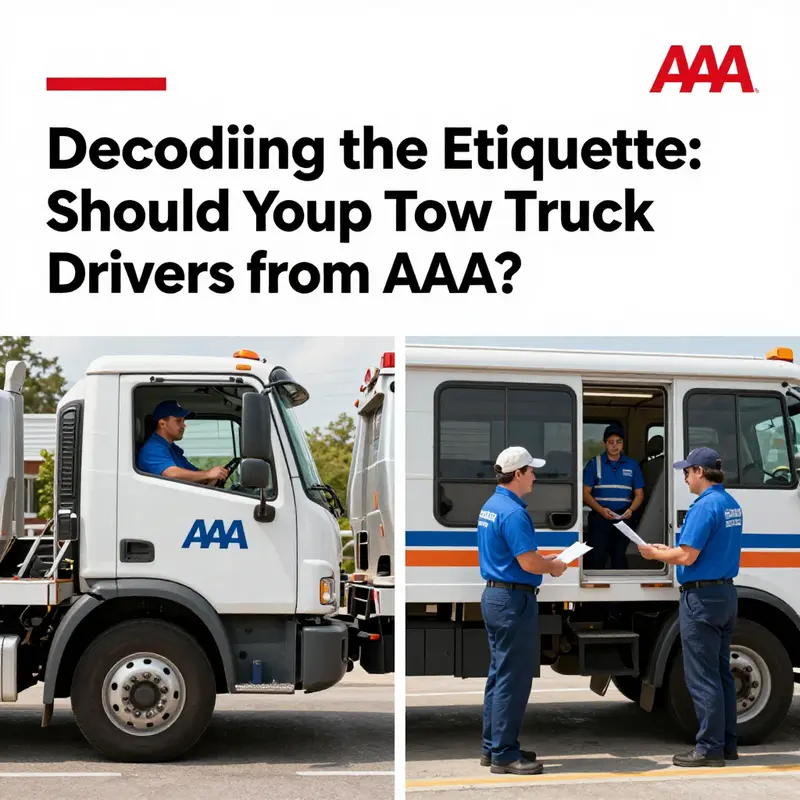
Tipping is a cultural compass that points in different directions depending on the service, the setting, and the economic model behind the work. In the realm of roadside assistance—especially when the provider is part of a national club like AAA—the question of whether to tip a tow truck driver rarely has a universal answer. The practical texture of the situation rests on how the service is structured to compensate workers, how the transaction is priced through contracts or insurance claims, and what the driver’s role is supposed to be in an emergency. In this context, tipping tow truck drivers from AAA is not considered standard or expected by most consumers. Yet the human impulse to show appreciation—when a driver goes beyond the call of duty—persists, creating a nuanced, if occasional, practice of small tokens or gestures that sit outside the formal payroll or contract arrangements. This nuance sits at the heart of the AAA stance: tipping is optional, not required, and not a substitute for proper compensation through official channels. To understand what this means in real-world terms, it helps to look at the data and the logic behind it, while keeping in view the bigger ecosystem of service compensation in America today.
AAA’s 2025 Consumer Survey on Automotive Services provides a clear snapshot of tipping norms across related services. In the survey, a striking divergence appears between tow truck assistance and other everyday acts of service. Only about 14% of respondents reported ever tipping a tow truck driver. By contrast, tipping is far more ingrained elsewhere: roughly 78% regularly tip rideshare drivers, and about 69% tip restaurant servers. Those figures do not merely reflect personal generosity; they underscore how income streams are structured in different fields. Rideshare drivers and restaurant staff frequently rely on tips as a meaningful portion of take-home pay, whereas tow truck drivers are typically paid through wages or contracts negotiated by the towing company and, in some cases, by insurance providers. This economic reality means the incentive to tip as a routine form of compensation is absent in the tow-truck segment, even as gratitude remains possible in moments when a driver delivers exceptional, go‑the‑extra-mile service.
The underpinnings of this distinction are practical as well as cultural. Tow truck operators who respond through AAA are usually employees of the towing network or independent contractors paid by the company or under an insurance claim. The compensation model is designed to cover the vehicle’s recovery, the technician’s time, and the safety standards that guide a roadside assist operation. In other words, the job is framed as emergency response work with a predictable pay structure rather than a customer-service encounter shaped by tip-based income. This is not to say the system is rigid or unchangeable, but it does explain why tipping is not embedded as a routine expectation. AAA explicitly positions towing services as part of a professional emergency response system, where payment is negotiated through contracts or insurance claims—rather than through discretionary customer tips. This framing helps to set reasonable expectations for motorists who call for help on the highway or at the roadside.
Despite the general norm, a note on nuance is important. When a driver goes above and beyond in a way that clearly improves safety, efficiency, or the overall experience—such as navigating hazardous conditions, coordinating with insurance representatives, or providing precise, practical guidance under stress—some people choose to offer a small token of appreciation. The gesture remains entirely optional and should never be viewed as a performance metric that changes a driver’s compensation. It is a personal sign of gratitude, not a mechanism for shifting the driver’s pay from the employer to the customer. In discussing etiquette, many readers find it useful to consult practical guidance that translates politely into a real-life moment: a brief, sincere thank-you, a note of praise to the company, or a modest tip if the driver explicitly indicates that tipping is acceptable or permissible in the firm’s policy. For readers curious about the finer points of etiquette, a concise reference exists that frames tipping with a clear emphasis on respect and appropriateness in these specific situations. tip-tow-truck-drivers-etiquette.
Regional variations can also color the picture, even within the same country. Some urban contexts have seen informal tipping practices emerge for roadside assistance in certain events or through newer apps that pair emergency response with a broader tipping culture. AAA, however, cautions against treating these exceptions as the standard path. The organization’s guidance remains explicit: if you are unsure whether to tip, do not tip; the primary obligation for fair compensation lies with the company, not the customer. This stance aligns with the broader reality that tipping in the tow-truck sector is not a lever to improve service quality in the same way it can be for other, more tip-dependent industries. The emphasis is on reliable service, trained personnel, and clear insurance workflows that ensure the driver is compensated regardless of any discretionary gratuity. In this framework, the customer’s responsible course of action is to verify coverage, confirm costs, and ensure the service agreement is sound, rather than to gamble on a tip to unlock better service in a high-stress scenario.
Of course, emotion and memory can complicate the simple arithmetic of tipping. A driver who treats a stranded motorist with calm authority, who explains the next steps in plain language, who coordinates with a dispatcher to minimize waiting time, or who provides critical safety insights while a vehicle is being recovered may become the subject of a long, thankful memory. In those moments, a tipping instinct may arise. Yet the prudent approach remains anchored in the policy and the practicalities of the job: tipping is optional, not expected, and not a substitute for properly negotiated wages and insurance-based payment. If a motorist wants to express appreciation, there are avenues that align with the professional structure: a direct word of thanks, a positive review to the company, or a formal commendation that recognizes outstanding service. These channels contribute to morale and recognition without altering the baseline compensation or the integrity of the service arrangement.
The overarching message for drivers, customers, and policy-makers is simple: the tipping economy has not reshaped the compensation architecture for AAA tow truck services. Rideshares and dining have evolved around tip-driven models, but roadside emergency services retain a different calculus, focused on reliability, safety, and contractual clarity. For readers who want to navigate these waters with confidence, a practical framework emerges. If you are in a position to show thanks for unusually helpful service, do so in a way that respects the professional context. Verbally acknowledge the driver’s skill and composure. If you choose a physical token, keep it small and optional, and consider whether the company has a policy about tips or whether a written note of appreciation feels equally meaningful. And when in doubt, lean on the official channels: confirm coverage, review the service, and communicate through the company’s feedback mechanism. This approach preserves the integrity of the emergency response system while honoring the human effort that makes a stressful moment a little easier to bear.
For readers who want a concise summary of what this means in the real world, the guidance is clear. Tipping tow truck drivers from AAA is not a standard practice, but gratitude is not off-limits. The key is to respect the compensation structure, follow the company’s policies, and recognize when exceptional effort deserves recognition in a way that complements the existing payment framework rather than replaces it. In the broader conversation about tipping across service sectors, AAA’s stance anchors the discussion in a principles-based approach: the customer should focus on fair, transparent pricing and dependable service, while appreciation should be expressed through appropriate channels rather than through an altered paycheck. This aligns with the goal of a trustworthy roadside assistance system that remains responsive, consistent, and fair to both customers and workers.
External resource: AAA’s 2025 Consumer Survey on Automotive Services offers a broader view of how tipping differs across service sectors and why those differences matter for both customers and providers. See: https://www.aaa.com/automotive-services/consumer-survey-2025
Final thoughts
Navigating the world of roadside assistance can be fraught with uncertainty, especially when it comes to etiquette around tipping tow truck drivers from AAA. While the general consensus leans towards not tipping due to the professional nature of the service, moments of exceptional assistance might inspire a gesture of gratitude. Understanding the expectation-free culture upheld by AAA can help you make informed choices when you find yourself needing help on the road. Whether you choose to tip or not should be based on the level of service received and your comfort level with the practice.