
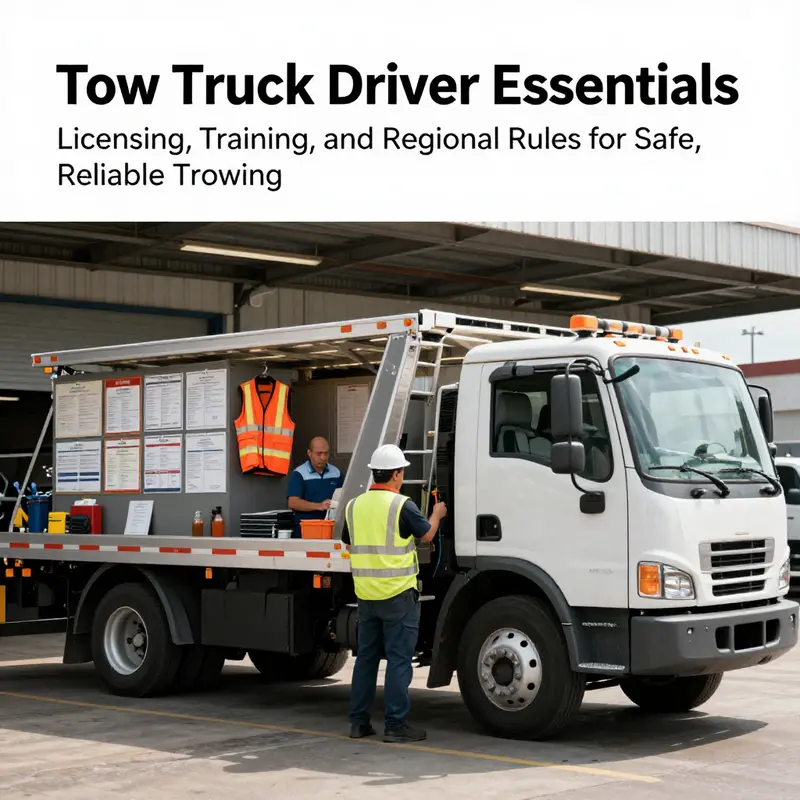
Tow truck service keeps roads moving by quickly removing disabled vehicles, recovering stuck cars, and supporting responders after incidents. For everyday drivers, residents, and fleet owners, understanding what it takes to become a tow truck driver helps you evaluate candidates, partner with capable operators, and plan safer, more reliable service. Licensing, certification, and training establish a baseline of competence; age, driving history, and medical fitness ensure operators are dependable and safe; specialized training and regional certifications expand capability for challenging recoveries; and regional regulations shape the economics and logistics behind each job. This four-chapter framework speaks directly to Everyday Drivers, Residents & Commuters, Truck Owners, Auto Repair Shops & Dealerships, and Property Managers, showing how the elements of qualification fit into real-world tasks—from roadside pulls on a busy beltline to nightly lot holds at apartment complexes. As you move through the chapters, you’ll see how the baseline credentials translate into operational readiness, how ongoing training keeps operators current with safety standards, and how local rules influence when and how tow services are engaged. The result is a practical map: you can assess a person’s readiness, plan workforce needs, or select a partner who can deliver consistent, compliant, and courteous service in a wide range of settings.
Licensing, Certification, and Training: Building the Foundation to Tow with Confidence
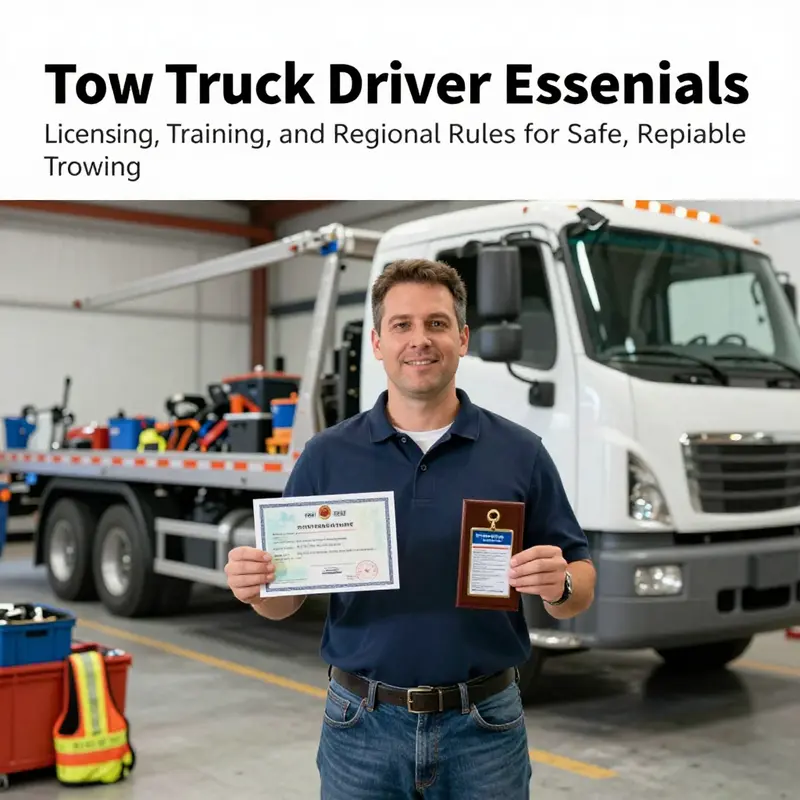
A tow truck driver operates at the intersection of technical skill, legal responsibility, and quick decision‑making under pressure. The chapter you’re reading is about the entryway into this field—the licensing, certification, and training that set the baseline for every other qualification that follows. The specifics shift from place to place, but the throughline remains consistent: you must prove you can operate a vehicle safely, understand the rules of the road and roadside work, and demonstrate the ability to respond effectively when situations demand immediate action. This is not merely a test of driving ability; it is a judgment of temperament, responsibility, and readiness to handle complicated, sometimes hazardous, towing scenarios with composure and precision. In many jurisdictions, the path begins with the right license and ends with targeted certification that aligns with the kind of towing you intend to do—whether that means light roadside recovery, heavy equipment transport, or specialized recovery of damaged vehicles on busy highways. The arc from license to training to certification is designed to ensure that every operator present on public roads can manage risk, protect the public, and safeguard the vehicles and people involved in an breakdown or collision scene. Although the precise requirements vary, several consistent pillars emerge across regions: the right class of license, a clean driving record, medical fitness, and a structured program of instruction that covers safety, practical handling, and situational responsiveness. These pillars are not abstract ideals; they translate into concrete steps you can take, and they shape how you plan your entry into the profession and how you grow within it. To begin, you must secure a license that authorizes you to drive the kind of tow truck you intend to operate. In the United States, this typically means obtaining a Commercial Driver’s License with the appropriate class and endorsements for towing or recovery operations. The precise class depends on vehicle weight and configuration, with many operators needing a Class B CDL and a special tow endorsement, and in some states or for heavier configurations, a Class A CDL may be required. The emphasis here is not merely on moving a vehicle from point A to point B; it is on moving it safely while coordinating with other drivers, pedestrians, and sometimes emergency responders. The licensing step sets the legal stage for the practical work that follows and ensures you can meet the gross vehicle weight and towing capacity limits that your duties will demand. The licensing story also invites an important caveat: consult your local transportation authority for the exact requirements in your area. A wide constellation of regional rules governs the specifics—age, medical standards, background checks, and the exact endorsements you need. The core idea is clear: begin with the right license, stay within the parameters it establishes, and build from there with formal training and certification that deepen your capability and credibility on the road. As you navigate this path, you will encounter a mosaic of additional prerequisites, each designed to keep roadside work safe and efficient. Training courses in road safety translate theory into practice, teaching you to assess hazards, secure loads, and work with other responders during incidents. Emergency response training adds another layer of readiness, equipping you to handle accident scenes, manage traffic flow, and communicate clearly under stress. Vehicle handling courses, meanwhile, provide hands‑on experience with the dynamics of towing different configurations, including wheel lifts, flatbeds, and hook‑and‑chain setups, all while accounting for vehicle weight distribution, braking performance, and road conditions. In many systems, you must complete these trainings and then pass formal examinations to obtain a professional certificate or license specific to tow operations. Some regions require a formal road transport qualification certificate in addition to a tow‑truck operator license, a distinction that underscores the specialized nature of the work. The training ecosystem often divides into foundational content and job‑specific tracks. Foundational training covers general roadway safety, defensive driving, load securing, and the ethics and professionalism expected of roadside workers. Job‑specific tracks tailor instruction to the vehicle types you will encounter. For example, someone focused on heavy‑duty towing will engage with heavier vehicle dynamics, brake management for large trailers, and the particular safety checks that diminished risk on long highway runs. Those pursuing hazardous materials towing or recovery must pursue additional certifications that address dangerous goods properties, packaging considerations, and emergency response procedures. The structure of this training ecosystem matters because it translates into consistent performance on the job. Employers rely on this consistency; insurers factor it into risk assessments; and regulators use it to set the standards that separate everyday tow operators from those entrusted with critical emergency response roles. When you start to assemble your roadmap, the practical steps become quite clear. You will need to obtain your driver’s license with the appropriate class and endorsements, then commit to medical and physical fitness standards that reflect the physical demands of towing work. The medical portion often includes a vision assessment with minimum acuity levels, color‑vision screening, and hearing tests, along with a general health check to identify any conditions that could impair safe operation. Some jurisdictions may specify a particular vision standard or color‑vision requirement, while others accept broader measures of visual capability as long as the driver can meet the demands of routine and emergency driving. The physical and medical standards are not merely bureaucratic hurdles; they act as a safety net for you and for the people sharing the road with you. A robust medical exam, together with the regular fitness checks that many employers require, helps ensure that you remain capable of handling prolonged shifts, inclement weather, and the physical rigors of assisting stranded motorists, securing loads, and maneuvering within tight spaces. As part of the training and certification arc, you will likely encounter background checks and mandatory drug screening. These checks are not simply formalities; they reflect the critical need to verify a driver’s history of safe operation and to mitigate the risk of impairment at work. A clean driving record is a core asset in the towing world because insurers and employers weigh your past performance heavily when deciding coverage and employment prospects. Some violations, especially those related to reckless driving, DUIs, or other serious offenses, can disqualify applicants or trigger stricter requirements, such as longer periods of supervision or probationary labor terms. The interplay between licensing, medical readiness, and background screening underscores the broader philosophy of tow work: readiness, responsibility, and reliability are non‑negotiable. The licensing step gives you the right to operate; the medical and physical checks confirm you can operate safely; and the training and certification establish your skill set and professional mindset. This trio creates a framework that supports not only your own safety but also the safety of other road users, the integrity of the towing operation, and the efficient resolution of emergencies where every second counts. For those navigating this landscape, there is value in turning to official checklists and resources that lay out the exact steps you must complete. The Tow Truck Driver License Application Checklist from the New York City Department of Consumer and Worker Protection, for example, provides a detailed map of the qualifications and procedures that applicants must follow in that jurisdiction. This resource can be a useful reference point as you compare requirements across regions and plan your path. Tow Truck Driver License Application Checklist. In addition to local resources, prospective drivers should remember that the licensing and training picture in the United States—much like in other countries—rests on a combination of state or provincial rules, federal guidelines where applicable, and employer expectations. If you are planning your path in a specific city, county, or state, always align your steps with the authority that issues the license in that area, and use the official guidelines to verify you are meeting all prerequisites before scheduling tests or enrolling in courses. A broad, practical overview of CDL requirements and tow‑specific licensing in the United States can be found at DMV.org, which compiles eligibility, testing, medical standards, and licensing procedures. External resource: https://www.dmv.org/
The Gatekeepers of the Road: Age, Driving Record, and Medical Fitness on the Tow-Truck Path
Becoming a tow truck driver is more than learning how to hook a vehicle and clear a roadside accident. It is a career that hinges on three fundamental gates: age, driving record, and medical fitness. Each gate serves as a safeguard for the people you’ll encounter on the road and for the drivers who will share the highways with you. The way these gates are set can vary by country, by state, and by employer, but the underlying logic is consistent: you must meet a baseline standard of responsibility, reliability, and physical capability before you are trusted to operate a commercial tow truck. Understanding these requirements deeply helps you plan your path with clarity, rather than chasing a moving target. The following exploration weaves together the general norms, practical implications, and the steps you can take to align yourself with what authorities and employers expect.
Age is often the first question people ask. It is framed not merely by legality, but by the lived realities of operating heavy vehicles, managing emergency situations, and balancing responsibility with the ability to perform under pressure. In the United States, the universal minimum age to operate a tow truck is 18. This is the baseline that acknowledges the maturity and judgment needed to respond to roadside scenarios. However, age expectations are not uniform across the globe or even across all states. Some jurisdictions or employers may prefer or require a higher floor, especially for shorter-haul operations or roles that carry additional risk. The broad reality you’ll encounter is a spectrum: in some places, the industry looks for applicants who are at least 20, or even older in certain regions where working hours, shift patterns, or the physical demands of specific tow configurations are considered. In other parts of the world, especially where regulated commercial driving is tightly codified, a higher starting age may be the norm. You may also see scheduling and job-sizing practices that cap the upper age limit in some organizations, typically around the early to mid-50s or even 60s, depending on the jurisdiction and the employer’s risk calculus. The point is simple: age matters, but it’s not a single gate you must sprint through without context. It’s a gate that opens with a ratio of factors—the type of towing you plan to do, the vehicle you’ll drive, and the environment in which you’ll work.
That context is reflected in the broader discussion about age and eligibility. For example, while general guidance may point to entry-level drivers being older than 18, the more nuanced picture appears when you look at the kind of tow work you pursue. Heavy-duty towing with large wreckers, or operations that include on-scene recovery and accident management, may tend to favor a workforce with a few more years behind the wheel. This nuance does not erase the 18-year baseline; it simply places it within a spectrum of expectations that vary by employer and by local regulation. The practical upshot is: if you are younger than the typical target range in a given area, you can still pursue the role, but you should be prepared to demonstrate more comprehensive training, a spotless driving record, and a robust plan for medical fitness. If you are older than the typical range, you’ll want to emphasize ongoing physical fitness, adaptability, and a demonstrable track record of safe driving to reassure potential employers that you can maintain the high safety standards required on the road.
Beyond age, the second gate is the driving record. A clean record is not merely a preference; it is a prerequisite for securing licensure and employment as a tow-truck operator. The logic is straightforward: tow-truck driving places you in environments where delays, errors, or impulsive decisions can escalate into harm for your crew, your clients, and the public. A valid, state-issued driver’s license is a given, and in many states, the license class that qualifies you to operate a tow truck aligns with the weight and configuration of the vehicle you will drive. In the United States, this often means a Class C license for standard operations and a Class B or higher CDL for heavier or more specialized equipment. But the real test is not the letter on the license; it is the driving history behind it. Employers and licensing authorities commonly require a license with no history of major traffic violations such as DUIs, reckless driving, or hit-and-run incidents. Some states go further, requiring that a driver has held the license for at least a year with no points in the previous 12 months, and that background checks corroborate a pattern of safe, responsible behavior behind the wheel.
The emphasis on driving records is not only punitive. It is preventive: it signals to you, the prospective tow-truck driver, that the job demands a degree of foresight, restraint, and discipline. Tow-truck operators must navigate congested streets, work in uncontrolled environments, and often make quick, high-stakes decisions about vehicle recovery and hazard mitigation. A clean record does not merely reduce immediate risk; it also reflects a sustained commitment to safe driving practices, adherence to traffic laws, and the capacity to represent a service with professionalism even in stressful moments. If your record has blemishes, it does not spell the end of your tow-truck ambitions. It does mean you’ll need to address underlying issues, demonstrate accountability, and potentially engage in remedial driving programs or additional training to reassure employers that you can meet the safety bar.
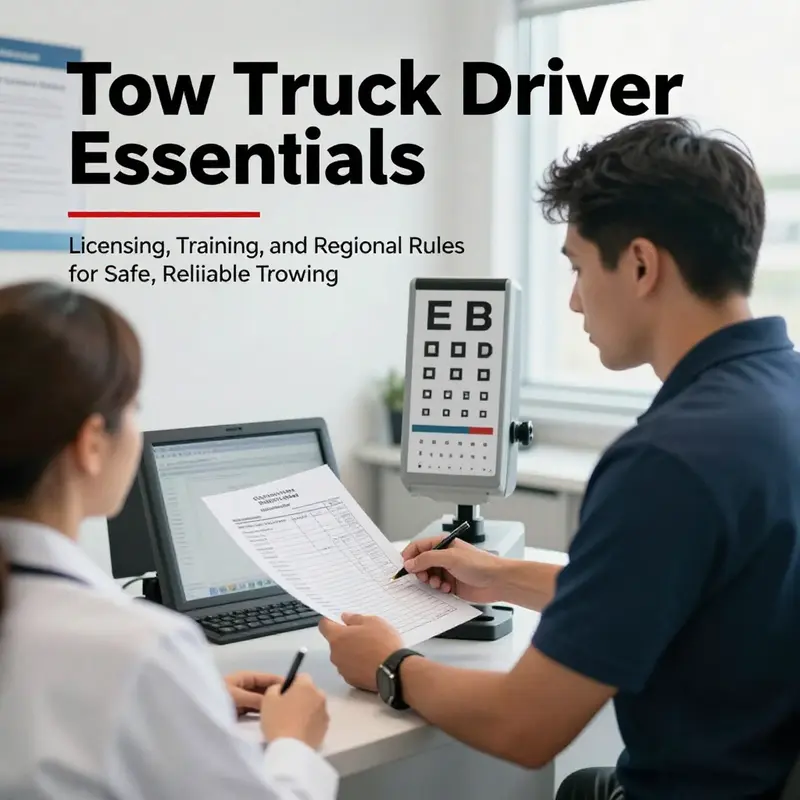
Medical fitness forms the third gate, and in many jurisdictions it is the most technically defined. The commercial driving ecosystem places a premium on consistent, reliable physical and cognitive functioning because tow-truck work often involves lifting, operating hydraulic controls, and managing complex scenes under time pressure. In the United States, the Department of Transportation (DOT) governs medical certification for commercial drivers, including tow-truck operators. According to DOT guidelines, you must undergo a medical examination by a certified medical examiner. The physical criteria are explicit: vision must be at least 5.0 on the logMAR scale, corrected or uncorrected; color vision must exclude red-green color blindness; hearing must be adequate to detect distant sounds; and there must be no physical impairments that would compromise safe operation—such as significant limb limitations, neurological conditions, or chronic illnesses that could impede driving. Additional safeguards include drug and alcohol testing, with regular screenings mandated by federal rules, including annual tests and randomized checks. One formal requirement that often appears in the paperwork is the submission of the DOT Medical Examiner’s Certificate, commonly referred to by its form designation in the materials you encounter: Form MCSA-5871. This certificate is your official affirmation that you meet the medical standards to operate a commercial vehicle. Without it, the door to a tow-truck role remains closed.
The medical fitness gate also encompasses ongoing responsibilities. Even after you secure certification, you will need to maintain your health status. Recertification occurs on a cadence set by the medical examiner’s certificate, with periodic re-evaluations to confirm that your vision, hearing, and physical health remain within safe limits. The DOT framework also includes drug and alcohol testing, designed not just to comply with regulation but to preserve the integrity of the driving workforce. The routine may feel onerous, but it is part of a broader societal commitment to road safety. Your willingness to adhere to testing schedules, maintain medical documentation, and address any health concerns proactively is a strong signal to employers that you are serious about safety and reliability.
All three gates—age, driving record, and medical fitness—do not exist in isolation. They intersect with training, licensing, and practical readiness to perform the job. In practice, a prospective tow-truck driver begins by ensuring eligibility at the legal level: understanding the minimum age and license class requirements in their jurisdiction, then verifying their driving history is as clean as possible through disciplined driving habits and adherence to traffic laws. Next, they pursue the medical clearance step, arranging an exam with a DOT-certified medical examiner and compiling the certificate that confirms fitness to operate a vehicle carrying passengers or cargo. Alongside these steps, it is wise to consider the broader scope of specialized training that supports safe operation. Road safety principles, emergency response readiness, and precise vehicle handling are foundational competencies that empower a driver to manage the unexpected. If your interest includes hazardous material towing, additional certifications will be necessary, reflecting the elevated stakes when dangerous goods are involved.
The practical path forward is straightforward but exacting. Start by clarifying the specific requirements for your state or country, because local rules influence the precise license class you will need and the thresholds for background checks. If you are unsure where to begin, a concise, step-by-step guide can be a helpful companion as you map your journey. For a streamlined overview of the process that many aspiring tow-truck drivers find helpful, you can consult a focused guide on how to become a tow-truck driver. This resource distills the essential steps—from understanding age and licensing to pursuing the medical exam and obtaining the required certificate—and can serve as a practical checkpoint as you assemble the prerequisites you will need before stepping into the job market, speaking with potential employers, and entering training programs. How to become a tow-truck driver
As you frame your preparation, it is important to connect this chapter to the broader conversation about what it takes to be a tow-truck professional. The gatekeeping trio of age, driving record, and medical fitness does not merely screen candidates; it also sets the baseline standard upon which all other competencies are built. Once you clear these gates, the path expands into the practicalities of becoming a skilled tow-truck operator: learning winching techniques, mastering safety protocols, gaining familiarity with local regulations, and developing the judgment that comes from real-world callouts and steady, methodical practice. In this sense, you are not simply chasing a credential but cultivating a professional identity anchored in responsibility, reliability, and service to the community.
To reinforce the bigger picture, it is valuable to remain mindful of the fact that the details of these requirements are not static. They evolve with policy shifts, changes in traffic safety priorities, and variations in regulatory enforcement. The best approach is to stay connected with the official guidelines in your jurisdiction, and to seek guidance from reputable resource centers that summarize current rules in a practical format. A reliable starting point is the official guidance provided by the U.S. Department of Transportation, which outlines the medical certification framework and the related testing requirements for commercial drivers. Access to this information helps you plan your preparation with confidence and ensures you aren’t pursuing outdated or inaccurate assumptions about what it takes to become a tow-truck driver.
In the midst of planning, you may be wondering how to balance the different gates while still moving forward efficiently. The answer lies in a disciplined, proactive approach: maintain a clean driving record by avoiding violations, commit to regular vehicle maintenance and safe driving practices, and cultivate a routine around health and wellness so you can pass the medical examination with ease. This means regular checkups, attention to vision and hearing health, and a commitment to abstaining from substances that could jeopardize your certification. It also means investing in training that reinforces the basics of safe operation, proper hitching techniques, scene safety, and the ability to adapt quickly to changing circumstances on the roadside. When you combine these elements with a clear understanding of the licensing pathway and the regulatory expectations in your area, you assemble a robust foundation for a tow-truck career that can withstand the scrutiny of employers and regulatory bodies alike.
As you reflect on these gates, keep in mind that the doors you’re opening are not merely about getting a job. They are about entering a profession that is essential to community safety and mobility. Tow-truck drivers often work in demanding environments, from night-time emergencies to high-traffic interstate incidents. The gates you clear—age, driving record, and medical fitness—signal your readiness to shoulder responsibility and represent the service with professionalism when you arrive on scene. If you want a concise map of the steps you’ll take, the resource linked above offers a practical overview, while the official DOT guidelines provide the technical specifics you will need for medical certification and compliance. With this combination of guidance, preparation, and dedication, you can approach the tow-truck doorway with clarity, knowing what each gate requires and how to meet those requirements with confidence. For more official guidance on medical certification and licensing, refer to the U.S. Department of Transportation’s resources at https://www.transportation.gov/dot.
Chapter 3 — Specialized Training and Regional Certifications: The Skills Gateways That Turn Licenses into Competent Tow Operators
Specialized training acts as the bridge between a license and reliable performance on roads and highways. Tow work is not merely about driving from point A to point B; it combines mechanical know-how, situational awareness, and a steady hand under pressure. In the field, seconds matter, edges are soft, and the line between a safe recovery and a new hazard can be razor-thin. That reality makes specialized training essential. It ties together the rules that govern the road, the equipment that moves a disabled vehicle, and the communication skills needed when a motorist is anxious and a busy highway demands calm efficiency. The journey from beginner to capable operator begins with core prerequisites, but it continues through a structured progression of training that is shaped by where you work and what you handle.
Foundational prerequisites are the gatekeepers that separate hobbyists from professionals. You generally must be old enough to hold a driver’s license and to legally operate a heavy vehicle, and you must hold a license class that matches the weight and configuration of the tow equipment you’ll use. In many regions this means a commercially endorsed license. The exact class varies with the jurisdiction and the vehicle, but the underlying idea is universal: the operator must have demonstrated competence to drive big equipment on public roads. Employers look for a clean driving record, with no major crashes or reckless violations in the past several years, and many require a background check that screens for criminal behavior relevant to safety and on-road responsibilities. Drug screening is commonly part of the process, ensuring that a driver’s decision-making and reaction times won’t be compromised on the roadside. These gatekeepers aren’t barriers; they are protections for the driver, the public, and the people awaiting help on busy corridors.
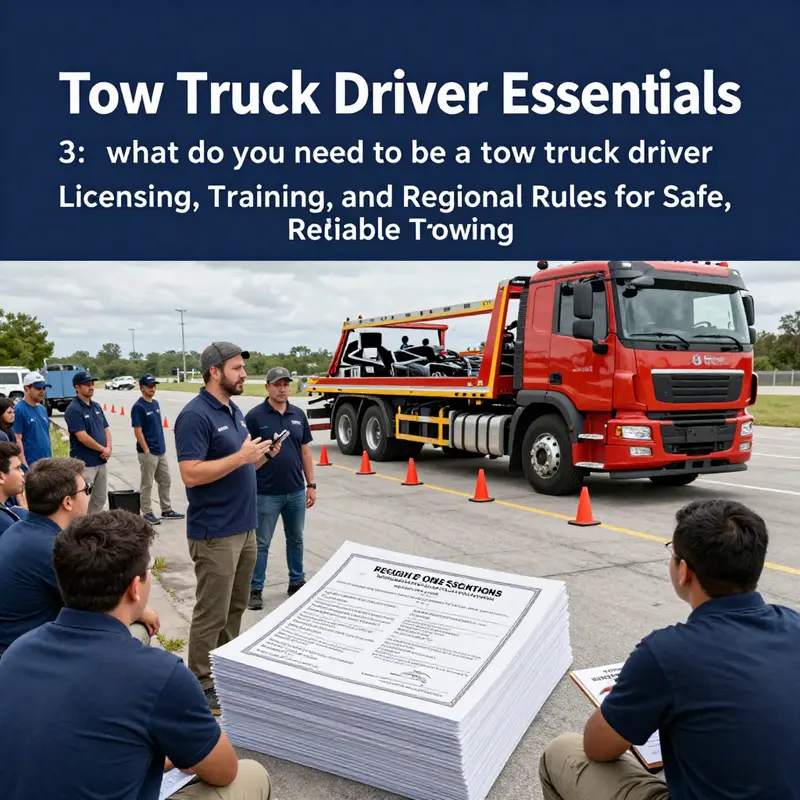
With those basics cleared, the real learning begins. Vocational programs and technical schools that focus on heavy duty trucking, fleet maintenance, and recovery operations offer immersive curricula. Students learn a spectrum of recovery techniques for different vehicle types, including light cars, heavy trucks, and specialty equipment. They gain hands-on experience with winches of various capacities, hydraulic lifting systems, and flatbed configurations. They practice rigging techniques to secure loads, choosing the right straps, chains, and anchors to prevent movement during transport. Safety protocols become second nature—pre-job briefings, buddy systems on the scene, PPE usage, and an awareness of potential pinch points, chemical exposures, and vehicle fluids. In the shop and on the lot, instructors simulate scenarios—sloped terrains, tight spaces, and multi-vehicle recoveries—so that students can apply theory under controlled risk before facing real emergencies.
Classroom modules mirror the real world by covering legal and logistical realities. Trainees study local towing laws, state regulations, and the responsibilities that come with towing and storage. They learn how insurance processes unfold after a claim, how to document incidents accurately, and the paperwork that accompanies every call—from writtendown notes to wire transfers for payment, if applicable. Contact with customers is coached through role-play, teaching drivers how to explain what happened, what options exist, and what the driver will do next to resolve the situation. This combination of legal literacy, procedural knowledge, and interpersonal skill helps reduce miscommunication, ensure transparency with clients, and protect the operator from liability during a stressful roadside recovery.
Beyond school, professional associations and regional training networks provide continuing education and standardized credentialing. NATTO and similar bodies curate certification programs that address a broad range of towing challenges, from routine roadside assistance to complex recoveries in restricted or hazardous environments. These programs emphasize best practices, equipment handling, safety drills, and decision-making frameworks that play out in the field. They also offer ongoing education opportunities that keep drivers current as laws, equipment, and rescue techniques evolve. Participation in such programs signals a commitment to professional standards, which can translate into higher trust with employers and with the motorists who depend on tow services at difficult moments. You can explore NATTO’s framework and resources at the organization’s official site to understand what certifications might suit your path and how to prepare for them.
Regional certifications form the local layer that makes an operator legally eligible on streets, highways, and private property where public safety rules apply. Some states or municipalities require a separate tow operator permit or registration with the local transportation authority. Others impose periodic renewal requirements, with additional modules for emergency response, incident management, or specialized equipment handling such as heavy-duty rotators or winch systems. In certain jurisdictions, operators who routinely respond to highway emergencies must complete specialized training for incident command, road safety barriers, or traffic management. Because these rules vary widely, the effective approach is to consult the local DMV or your equivalent agency early in the process to map out the exact certifications, endorsements, and renewals you’ll need. This regional layer ensures that even as every fleet has its own standards, every operator contributes to a shared baseline of safety and accountability on the road.
A practical pathway blends national or state licensing with the specialized training described above. For many aspiring tow truck operators, starting with a CDL pathway provides a recognized baseline that opens doors in fleets curious about reliability and safety records. Then they pursue targeted training and regional certifications that tailor the license to the job. A useful step is to consult the CDL tow-truck guide to map out the sequence of steps, from eligibility and testing to endorsements, and then layering on the regional permits. CDL tow-truck guide. This roadmap helps avoid wasted time and ensures you’re building the right competencies in the right order, so you can handle the first critical calls with confidence and competence.
Experience remains a critical multiplier. Time behind the wheel, in combination with structured training, translates into faster, safer, and more predictable responses on the scene. Entry-level roles in fleets, apprenticeships, or shadowing programs let new drivers observe how others assess a scene, select equipment, and communicate with the motorist and dispatcher. As trainees gain wheel time and complete certifications, they accumulate a portfolio of demonstrated competencies. The most effective learners document their progress, seek feedback from mentors, and deliberately tackle more challenging environments—night operations, winter conditions, or congested corridors—under supervision. This steady progression reduces risk for everyone involved and increases opportunities for advancement into more responsible assignments, such as fleet supervision, training others, or leading complex recoveries.
Specialized services add another rung to the ladder. If the work involves hazardous materials, oversized vehicles, or recovery at accident scenes where multiple units converge, the training required expands beyond the mechanical and into hazard recognition, spill response, and coordination with emergency responders. Even without pursuing every niche credential, exposing oneself to modules on dangerous goods properties, packaging practices, and incident command builds transferable judgment and situational awareness. Employers value this breadth because it signals a driver who can adapt to different jobs and maintain safety margins even under stress.
Beyond compliance, specialized training informs every moment of a tow operation. A driver chooses the right towing attachment, assesses the stability of a vehicle on uneven ground, identifies when to call for additional support, and negotiates with bystanders and authorities. It fosters a professional identity that balances firmness with courtesy, speed with caution, and efficiency with care for property. In a field where a single misstep can escalate risk, having a well-structured training background becomes a practical compass, guiding judgment when conditions change faster than a plan might allow.
Looking ahead, the learning curve never ends. Regulators revise rules, fleets update equipment, and new technologies—from electric powertrains to advanced stabilization systems—change how recoveries are performed. Staying current requires ongoing education, routine practice, and engagement with the networks that define industry norms. The strongest operators treat training as an investment rather than a formality, a mindset that keeps them adaptable, compliant, and ready for whatever roadside challenges arise. Local employers may also have internal certification programs and standard operating procedures that build on the general framework, creating a cohesive culture of safety and service within a given company.
Taken together, specialized training and regional certifications are the leverage that turns a license into a capable, safe, and trusted tow operator. The landscape is diverse, but the core aim is consistent: to protect lives, safeguard property, and restore mobility when trouble strikes. The right training sharpens judgment, reinforces discipline, and signals reliability to clients, dispatchers, and the public. It is this blend of technical skill and professional stewardship that enables tow operators to perform at their best when every second counts and every decision matters.
To begin mapping your path, connect with local training providers, reach out to fleets that hire drivers, and review the official requirements in your area. Build a plan that integrates licensing, hands-on recovery practice, and the regional endorsements you’ll need. With deliberate stepwise progress, you can move from the basics into a career defined by competence, responsibility, and the confidence that you can handle whatever the road throws your way.
External resources and ongoing reading: for formal, nationwide standards and training materials, consider professional resources such as NATTO’s training framework at https://www.natto.org.
Becoming a Tow Truck Driver: Licenses, Laws, and the Market
Becoming a tow truck driver starts with understanding the licensing ladder. In many regions you need a driver’s license that matches the vehicle class you will operate, with heavy vehicle or commercial licenses typical for heavier tows. The exact category and tests vary, but the principle is clear: you must prove you can control and recover a tow vehicle safely. Age limits, medical checks, and a clean driving record are common eligibility gates that reflect the safety role you will play on public roads.
Beyond these basics, most jurisdictions require training in road safety, incident scene management, and proper towing techniques. Certifications may cover hazardous materials handling when relevant, and a formal exam or credentialing process often seals the license to tow. Employers may seek experience, but many regions allow entry through structured programs that pair training with supervised practice.
The regulatory landscape also shapes the market: licensing, inspections, and standard operating rules aim to protect consumers, reduce disputes, and promote reliable service. Official guidelines or licensing portals are the best starting points for region-specific steps, tests, fees, and timelines.
In short, the path to becoming a tow truck driver balances credentials with practical training, and the exact mix depends on where you work. Planning ahead with the official requirements helps you move from learner to licensed operator with confidence.
Final thoughts
Becoming a tow truck driver is a structured path that blends personal responsibility with legal and technical knowledge. Licensing and training establish the foundation, while age, driving history, and medical fitness ensure a dependable, safe operator. Specialized training and regional certifications extend capabilities to handle complex recoveries and hazardous scenarios. Regional regulations then shape the economics, scheduling, and compliance realities that affect service delivery. For Everyday Drivers and Property Managers, this framework helps you evaluate candidates and partner with operators who meet high standards of safety and reliability; for Truck Owners and Auto Shops, it provides a clear roadmap for workforce development and vendor selection. The overarching takeaway is simple: a qualified tow operator isn’t just someone who can move a vehicle—it’s someone who can do so safely, legally, and with predictable performance across the jurisdictions you rely on.