
Tow truck service plays a critical role for everyday drivers, residents, commuters, and fleet operations alike. Pricing for towing is typically presented as a set rate, which covers labor, fuel, and equipment use, yet a common question remains: should you tip the driver? The answer isn’t one-size-fits-all. Tipping is generally not expected, and many professional outfits discourage tips to avoid conflicts of interest. However, exceptional service—such as rapid arrival in emergencies, helpful driver guidance, or additional assistance beyond the basic tow—can merit a small gesture. Regional customs, company policies, and individual circumstances all shape whether tipping is appropriate. This article examines tipping from four angles: (1) the economics and pricing behind towing services, (2) scenarios where tipping is appreciated versus not expected, (3) regional and cultural etiquette considerations, and (4) practical guidance for companies and customers. By aligning pricing realism with etiquette awareness and policy guidance, Everyday Drivers, Residents & Commuters, Truck Owners, Auto Repair Shops & Dealerships, and Property Managers can approach tipping decisions with clarity and confidence.
Tow Trucks, Tipping, and Transparent Costs: How to Navigate Fees, Policies, and Courtesy
Breaking down on a highway or side street is rarely convenient, and the arrival of a tow truck often feels like a pause in a tense situation. In that moment, the questions pile up: who covers the cost, what is a fair charge, and should I tip the driver who has just helped me move from one stressful predicament to the next? The short answer is nuanced. Tipping tow truck drivers is generally not expected or required for standard towing services. Most reputable towing companies price their work with a clear, published rate that covers the driver’s labor, the vehicle’s operation, and the costs of running a dispatch system. Yet like many service interactions, tipping can come into play when the service goes beyond the ordinary. If the driver arrives quickly in an emergency, offers practical assistance beyond simply loading a vehicle, or handles a difficult situation with courtesy and competence, a small gratuity may feel appropriate. The key is to view tipping as a voluntary acknowledgment of outstanding effort rather than a supplement to an already agreed price. In practice, many drivers and companies welcome appreciation in the form of a tip only when it is truly earned, and some organizations even discourage tips to avoid conflicts of interest or pressure on customers who are already stressed by a loss of mobility or a roadside emergency. The right approach is to focus first on paying the agreed-upon rate and to consider tipping only if the service clearly warrants extra thanks.
The broader context of pricing and tipping rests on how towing services are structured and regulated in a given region. In places with a robust consumer protection framework, the emphasis is on transparency: customers should know the total cost up front, understand what is included in the charge, and be informed about any storage fees or additional costs that could arise if the vehicle must be held for inspection, repair, or insurer assessment. The question of tipping then becomes a separate, optional gesture of appreciation rather than a required part of the transaction. Within this framework, it is prudent to resist the impulse to compare a single tow incident to everyday consumer services where tipping is customary. Towing often involves a fixed dispatch fee, mileage charges, and sometimes a per-hour labor rate. Those components can vary widely based on distance, time of day, urgency, weather, regional demand, and the driver’s assessment of the work involved.
To navigate these waters with greater clarity, it helps to understand the practical pricing context that frames any roadside tow. In Western Australia, for example, there is explicit guidance about managing costs and claims that emphasizes empowerment and choice. Transport WA advises consumers to save their insurance company’s contact details in their phone and to carry a copy of their policy in the car. This practice streamlines the claims process and can prevent delays or misunderstandings when arranging a tow through an insurer or a third-party administrator. Importantly, you typically retain the right to decide where your vehicle is towed. You can instruct the driver to take the vehicle to a repairer, to your home, to a storage yard, or to another location as directed by your insurer. In some scenarios, towing to your home can give you a little breathing room to evaluate options, consult your insurer, and review repair quotes without feeling pressured in a busy or stressful moment. The ability to designate the destination is not merely a convenience; it is a strategic element in managing costs and ensuring that the eventual repair or claim process unfolds smoothly.
Transparency is the watchword in these interactions. Before you authorize any towing service, make sure you have a clear understanding of the total cost and any potential storage fees. Some drivers and private tow operators bill by distance, while others apply a time-based rate or a combination of both. In high-demand situations—such as after-hours calls, incidents that obstruct traffic, or when a vehicle needs to be moved to a safer location by an official Road Authority unit—there can be official rates or standard pricing structures. Main Roads or equivalent authorities may deploy official tow or Incident Response Service vehicles to move vehicles quickly and safely, but those official services usually come with set rates. Private operators, by contrast, may quote more variable prices based on distance, urgency, and any extra tasks beyond basic towing, such as unlocking a car or maneuvering a difficult parking situation. In all cases, asking for a written estimate or a clear, itemized invoice before authorizing the service helps prevent surprises and keeps the interaction professional and predictable.
The tipping question also intersects with policy and ethics within the towing industry. Some companies maintain policies against accepting tips to avoid potential conflicts of interest or to keep the customer relationship straightforward. This is not a universal rule, but it is a reality in some markets where a tip could be misconstrued as a bribe or as an attempt to influence the driver’s professional judgment. If a company’s policy is to discourage tips, respect that stance and instead use the tipping option to recognize exceptional service only when it truly warrants it. Conversely, if you encounter a driver who has gone above and beyond—arriving promptly in a dire situation, offering useful guidance on next steps, or performing tasks beyond the standard tow—the gesture of a tip can be a meaningful way to show appreciation after the fact. When in doubt, you can inquire politely whether tipping is appropriate in that particular situation or per that company’s policy, which helps preserve goodwill on both sides.
Beyond the mechanics of tipping, there is a consumer-rights dimension to consider. Reputable consumer organizations advocate for clear pricing, transparent terms, and easy access to information about what is included in a towing service. They also encourage customers to ask questions, verify the total cost before the work begins, and document any agreements in writing when possible. In this light, a tip should never be a substitute for due diligence. If the quoted price seems unexpectedly high, or if a driver pressures you to sign a contract or authorize a service without presenting a full breakdown of costs, those are red flags. In such moments, it is appropriate to pause, request a breakdown, and consider seeking a second opinion from a different provider or confirming the policy with your insurer. The intention should be to protect you from surprise charges and to ensure you understand the full financial commitment before you proceed. In parallel, consumer resources such as the Better Business Bureau (BBB) can offer guidance on common questions about service charges and consumer rights, reinforcing that tipping is a discretionary gesture rather than a fundamental part of the service agreement.
In any region, a practical approach to paying for towing remains anchored in communication and preparation. If you anticipate needing a tow, consider calling ahead to understand the likely charges and any potential ancillary fees. Ask for a maximum cap on costs if available, and request that the driver provide an upfront estimate that distinguishes mileage, labor, and any added services. If you are dealing with an insurer, confirm what your policy covers and how much you owe at the time of service. In Western Australia, for instance, the guidance stresses the importance of knowing where the vehicle will be towed and paying attention to any storage costs if the vehicle is held while you arrange repairs or claims. By taking these steps, you reduce the chance of a heated dispute over the bill and allow yourself the space to consider whether a tip would be a deserving, voluntary acknowledgment rather than a requirement.
When it comes to best practices for etiquette, a careful, respectful approach tends to work best. If you decide to tip, a small amount is often enough to convey appreciation without implying a moral obligation or inflating the perceived value of the service. A typical range of $5 to $20 can be appropriate for genuinely commendable service, though the exact figure should reflect the complexity of the job and your own budget. If the service was routine and timely, a token gesture is usually unnecessary. If you are comfortable, you can phrase the tip as a straightforward thank-you note—something like, “Thank you for handling this with care and efficiency”—which can accompany a tip in a discreet, unobtrusive way. In high-tress situations, a simple verbal expression of thanks can also go a long way toward acknowledging the driver’s professionalism, especially when a tip may be inappropriate or discouraged by policy. The nuance lies in recognizing the boundary between fair compensation for the service rendered and a personal act of gratitude.
The practical takeaway for someone facing a tow is simple: verify the cost up front, understand where the vehicle will be towed, and know whether any storage fees might apply. If the driver offers additional services—such as unlocking the vehicle, helping with paperwork, or guiding you through the insurer’s process—consider how those tasks affect the overall value you receive. If you feel the service exceeded expectations, a modest tip can be appropriate, but it should never be viewed as a substitute for paying the agreed-upon charges. If a company or driver discourages tips, respect that policy and channel your appreciation into a straightforward, punctual payment of the total bill. In the end, tipping is about personal choice and context, not about compulsory compliance. The most reliable path is to anchor your decision in transparency, fair pricing, and courtesy, with the understanding that tipping remains a voluntary act that acknowledges genuine, above-and-beyond service.
For readers seeking a concise primer on this topic, you can explore common questions about tipping tow-truck drivers here: Do you tip tow-truck drivers?. This resource helps clarify when tipping is appropriate, how to assess the value of the service, and how to align your actions with local norms and company policies. It is also wise to consult official guidance such as Transport WA’s consumer advice when dealing with region-specific pricing and procedures, which can be found at the external resource linked below. As you navigate the practicalities of towing, remember that the goal is to secure safe, reliable transport and to manage costs with clarity and fairness.
External resource for regulatory context and current cost guidance in Western Australia: https://www.transport.wa.gov.au/road-safety/tow-truck-consumer-advice
null
null
The Tip Dilemma on the Road: Regional Etiquette, Cultural Nuance, and the Towing Toll of Courtesy
Towing a car is rarely a moment of calm clarity. It is usually a rush of headlights, sirens or distant thunder, bad weather, or the sudden jolting realization that you’ve become dependent on a service you hope you never need again. In the middle of that stress, the question of tipping a tow truck driver can feel almost as confusing as the breakdown itself. The short answer is simple: tipping is not required or expected in most standard towing scenarios. Yet the longer answer—the one that matters for a quiet, respectful exchange—depends on what happened, where you were, who arrived, and how the driver conducted the service. The larger point is not to chase a universal rule but to understand norms, to recognize when an extra gesture is meaningful, and to approach the situation with fairness to the driver and clarity about the service you received. In a world where pricing and policies vary by state, city, and company, the tipping question becomes less about a fixed etiquette and more about practical courtesy anchored in real-world behavior.
Towing fees are typically built around a few objective factors: how far the vehicle must be moved, the type of vehicle being towed, and how complex the operation is. A driver may need to winch a car from a ditch, navigate tight spaces in a crowded parking lot, or perform a roadside jump-start before loading the vehicle. Each of these tasks carries labor and equipment costs that customers should anticipate and openly discuss before service begins. In many jurisdictions, the price is posted or quoted, and the driver or dispatcher should confirm the fee structure upfront. This transparency is essential because tipping—when it occurs—expects to supplement a service that has already been priced and promised, not to replace or obscure it. In practice, this distinction matters. Tipping someone to pick up the bill for the job in front of you risks conflating appreciation with payment for a service that has already been invoiced.
Even in ordinary towing situations, there are moments when an additional gesture could feel like a natural acknowledgment of effort. The driver who arrives quickly in a roadside emergency, who calms a frightened passenger, or who offers practical, sometimes life-saving advice—these are the instances when a tip may be offered as a sign of gratitude for going above and beyond. Similarly, when a driver goes beyond the expected duties—unlocking a stubborn door, helping secure the vehicle in a safe location, or assisting with a few minutes of paperwork and the insurance forms—your appreciation can feel well earned. These moments are not about creating a market for tips; they are about recognizing exceptional service during a tense situation.
The broader landscape of tipping in the United States contains no sweeping, nationwide mandate that applies to tow-truck work the way it does for other service industries. There is no widely recognized regional calculus that dictates tipping for towing, unlike hospitality or personal services where tipping has deep-rooted cultural presence. This lack of a universal standard can be reassuring in its predictability—most drivers do not expect tips, and many companies advise their customers that tipping is optional and not obligated. Yet the absence of pressure is not the same as absence of meaning. A thoughtful, discretionary gratuity—whether in cash or by another acceptable method—can reflect genuine appreciation for outstanding care in difficult conditions. It is, however, crucial to ensure that any tip is voluntary and appropriate to the service received, not an implicit payment for better treatment.
To that end, reputable consumer guidance emphasizes two key points. First, always confirm the quoted price and the terms of service before a tow begins. If the firm or driver requests overtime fees, after-hours surcharges, or extra charges for specialized equipment, you should understand why and what you are paying for. Second, tipping should be considered a personal choice, not a mandatory obligation. The pressure to tip—whether overt or subtle—can create conflicts of interest in which customers feel obligated to comply with an unwritten policy. In practice, that means if the driver suggests tipping to avoid delays or to secure faster service, you may want to pause and reassess. A reputable operator will respect your decision and focus on delivering professional service without coercion.
Cultural and regional nuance does creep into tipping in some pockets of the country, even if the general rule remains clear: tipping tow truck drivers is not a universal expectation. In certain communities or among some groups, tipping for any roadside assistance remains a customary gesture akin to tipping a waiter or a mechanic who goes beyond the basics. In those contexts, a driver who handles a night-time tow after a long shift, or who assists in harsh weather when others may not, could be seen as a candidate for a small gratuity. The important caveat is that such practice is still voluntary and situational, not a formal standard that applies everywhere. A driver who declines a tip should not be taken as a sign of poor service; instead, it may reflect a company policy designed to minimize conflicts of interest or a personal preference to avoid complicating future business with customers who feel obligated to tip.
For readers who are curious about etiquette rather than obligation, practical guidance is often distilled into simple, human terms. If you choose to tip, small and discrete is frequently best. A cash tip in the range of a few dollars to a modest amount—often cited as five to twenty dollars—can be reasonable, depending on the service quality, the time involved, and the regional cost of living. In a scenario where the driver has navigated multiple obstacles on a difficult night, a tip toward the higher end of that range may feel deserved. If the service is routine, a tip at the lower end is more appropriate. It is not the amount that matters as much as the presence of thoughtful appreciation and a polite acknowledgement of a job well done under pressure. And if you can manage it, you should ensure the payment of the base rate before you consider tipping. The gratuity should recognize the extra and the exceptional, not the basic fulfillment of contractual obligations.
An important practical note concerns how you offer a tip. Cash remains the simplest, most widely accepted method in emergency roadside contexts where receipts are rarely printed. If you prefer to pay by card, check with the company whether card tipping is permitted, and whether the driver is comfortable accepting an additional gratuity that appears on the receipt. Some drivers and companies explicitly prohibit tips for reasons of policy or liability, and paying extra on a card can inadvertently complicate accounting or future service expectations. When tipping, be mindful of your own emotional state and the driver’s dignity. Present the tip discreetly and with a direct, sincere expression of thanks. A brief, respectful note of appreciation can reinforce the positive experience for both you and the driver, especially after a moment of anxiety or confusion. If you are unsure about the tipping policy, a quick, courteous question before the service begins can prevent awkward moments after the work is done.
There is also value in recognizing that tipping is not the only way to convey gratitude. In many cases, drivers who perform a commendable job deserve more than a tip; they deserve credible feedback that travels with them and to their employer. A positive review, a commendation to a supervisor, or a direct, respectful note about the driver’s professionalism can be just as meaningful as a gratuity. In a service industry where customer satisfaction can drive future work opportunities, a good word can travel farther than a single bill. If you’re willing, taking a moment to rate the service online, mentioning specifics that impressed you, and sharing the impact of the driver’s help can be a constructive and lasting form of appreciation.
In thinking through whether to tip, you should also consider the company’s policies. Modern towing firms increasingly publish clear guidelines about gratuities and how they should be handled. Some firms discourage accepting tips to avoid perceptions of conflicts of interest or favoritism. Others allow tips but do not require them, emphasizing that the customer’s payment should cover the service itself. When in doubt, it is perfectly reasonable to ask a dispatcher or the driver, “Do you accept tips, or is there a company policy I should follow?” This approach honors both your autonomy as a customer and the driver’s professional boundaries. It also helps prevent uncomfortable scenarios at a moment when you would rather be focused on safety and getting your vehicle to a repair shop or safe location.
The discussion of tipping, of course, should not dismiss the practical realities that accompany towing. The fees you pay are often calculated by objective factors—distance, the type of tow apparatus used, whether there is a winch, and the complexity of loading a vehicle onto a tow bed. Some neighborhoods rely on a regulated rate structure or a rate card that is consistent across the industry, while others see more individualized pricing that reflects time of day, travel distance, and the specific equipment needed. In either case, the driver’s task is to deliver a safe, efficient, and professional service. If that standard is met, but you still feel compelled to show appreciation, a modest tip can be a genuine sign of gratitude. But if the service is standard, prompt, and respectful, tipping should remain a personal, voluntary choice rather than an obligation rooted in fear of poor service or the risk of being trapped in a policy dispute.
If you want a concise reference on etiquette and practical tips for tipping tow truck drivers, you can review resources dedicated to guidance on this specific scenario. For quick guidance on etiquette, see tip-tow-truck-drivers-etiquette. This resource helps distill practicality from politeness, so your decisions in the moment can be informed rather than impulsive. At the same time, remember that the most important action you can take is to ensure you are paying the agreed-upon rate for the towing service itself. A fair price, clear communication, and a calm, respectful approach will create a smoother experience for everyone involved.
To ground these considerations in established consumer guidance, you may also consult authoritative sources on towing practices and consumer rights. For a comprehensive perspective on road service standards and safety expectations, refer to the National Highway Traffic Safety Administration: https://www.nhtsa.gov
Tow-Tip Etiquette: Policies, People, and Practical Guidance for Tow Truck Drivers
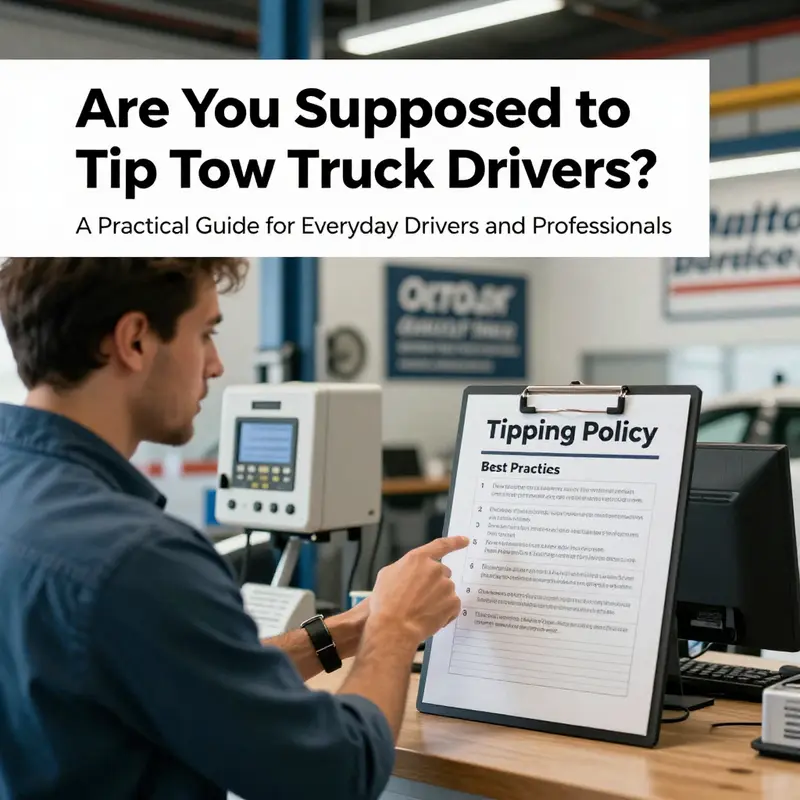
Towing services are priced by the provider and may include base labor, fuel, insurance, and wear on the vehicle. Tipping is discretionary and not universally expected, and some companies prohibit tipping. Before offering cash, verify the policy with the dispatcher or by checking the terms of service. If tipping is allowed, a common range is roughly 10 to 20 percent of the total tow cost for good or exceptional service, with smaller or no tips for routine service. When the driver arrives promptly, communicates clearly, handles the vehicle with care, helps with tasks beyond the basics, or stays to answer questions, a modest tip may reflect appreciation. If the service is straightforward, paying the agreed price may be sufficient. Distinguish any service fee or fuel surcharge from a gratuity, as they are not tips. Carry a small amount of cash for tipping to avoid card processing hurdles and to make tipping straightforward. When in doubt, ask the driver or dispatcher about tipping policy before paying.
Final thoughts
The tipping question for tow truck drivers hinges on a blend of pricing realism, service quality, and local norms. In most cases, the base towing fee covers the driver’s labor and operating costs, so tipping remains optional. Recognize exceptional effort—such as rapid emergency response, safe vehicle handling, or helpful guidance—and a modest tip (for example, $5–$20) can be appropriate if you’re comfortable and the company allows tips. Always prioritize paying the agreed-upon rate for the service itself and confirm any tipping policy with the provider if there’s any doubt. By understanding economic context, etiquette variations, and company guidance, Everyday Drivers, Residents & Commuters, Truck Owners, Auto Repair Shops & Dealerships, and Property Managers can navigate tipping with confidence and fairness.