
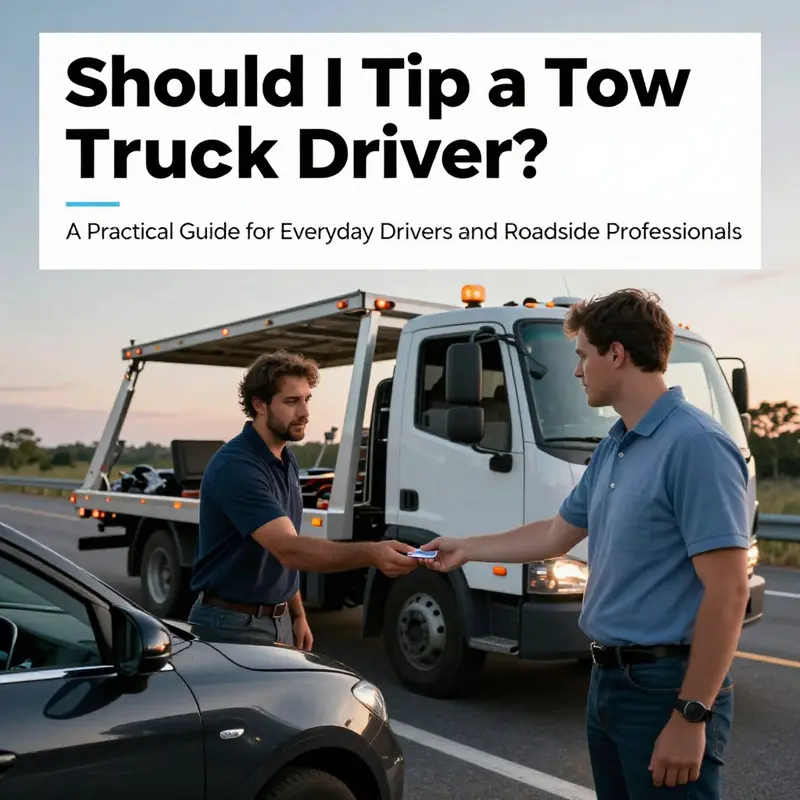
Roadside incidents are an everyday risk for drivers, residents, commuters, and those who manage fleets or large properties. Tow truck drivers step in when you’re stranded, often under pressure, in unpredictable weather, or on tight schedules. Their compensation commonly relies on hourly wages or per-job fees, with gratuities playing a meaningful role in recognizing quality, speed, safety, and care. While tipping is not universally mandated, it remains a widely accepted courtesy that can influence service outcomes and driver morale. This article unpacks tipping norms, economic realities for drivers, and practical guidelines you can apply in real-world scenarios—whether you’re a single driver, a property manager coordinating service calls, a repair shop coordinating pickups, or a truck owner relying on consistent roadside support. The discussion is organized into three focused chapters so you can understand the normative landscape, economic factors behind driver earnings, and concrete tipping strategies you can apply in routine and complex situations. Each chapter ties back to the central question: should i tip a tow truck driver, and how can you do it fairly and effectively?
Tow at the Roadside: Navigating Tipping Norms, Gratitude, and Practical Etiquette for Tow Truck Drivers
Being stranded on the shoulder of a highway or back street is stressful, and the tow arrives and the scene shifts toward a safer path forward. The driver introduces themselves, assesses the vehicle, and begins the safe handoff to a shop or location. In that moment a question often arises: should you tip? Tipping etiquette in roadside assistance is a space between professional fees and personal gratitude, a space that can feel murky if you are not sure what to expect. Understanding tipping norms is not about universal rules like in a restaurant. It’s about acknowledging the work, the conditions drivers face, and the practical ways to show appreciation without creating confusion for the driver or the company.
Across the United States tipping a tow driver is generally not expected in the same way as tipping a waiter. Tow services are priced as professional services with fees set by the provider. The transaction is a business service rather than a personal service where tips are standard. The driver’s wage model may include income that does not rely on gratuities the same way as other service industries. In other words a tip is not a universal part of the payout for tow work, and that shapes how drivers and companies approach the topic.
That said tipping remains a meaningful form of feedback when service stands out. The situations that invite tipping are those where the driver shows exceptional professionalism, extra care, or resilience in tough conditions. A tow with bad weather, a tricky recovery, specialized equipment used with care, or clear calm communication tends to invite appreciation. A tip communicates gratitude and recognition that the driver invested extra effort time or expertise to ensure safety and a smoother process. If the service meets those highs, a tip in the range ten to twenty dollars is a common starting point, with room for more if the job is complex or the level of service warrants. The idea is to reward quality without pressuring anyone or creating an expectation that tipping should be the default every time.
You may see broader guidance from industry sources. The National Association of Automobile Clubs notes there is no universal tipping guideline for tow operators. They suggest showing respect and gratitude in stressful roadside moments, while acknowledging that independent operators or local companies may have their own policies. Some tow operators publish policies about tips, others simply appreciate a kind gesture at the end of a job. In practice your best move is to consider the service you received and, if in doubt, ask the driver or company about their tipping policy. It is a practical and respectful approach that honors the reality that policies can vary by company and region.
If you decide to tip a small amount handed directly to the driver in cash at the end of the service is simple and reliable. Cash is easily received and can be distributed quickly, which matters when the driver has other calls or needs to secure the vehicle before handing off. A tip can be a straightforward token for routine service or a more generous gesture if the driver has gone beyond what was expected. This approach keeps the process personal and immediate, which aligns with roadside assistance where time is often of the essence and the driver’s role is to restore order in a stressful moment.
For a quick practical anchor consider the following framework. If the service is routine and the driver performs the task efficiently with clear communication a tip is not mandatory but might still be appreciated as a small gesture. If the service involves complex handling such as off road recovery long distance tow or adverse weather conditions the same relief and extra effort that made the service successful justify a larger tip. If the driver goes above and beyond helping you navigate a tricky situation offering extra safety tips or coordinating with dispatch to arrange a follow up elevating the tip becomes sensible. If you are unsure whether tipping is expected at all requesting a quick clarification from the company can spare awkward moments and help you decide what feels appropriate.
One practical note is how tipping can be integrated with roadside etiquette. If you deal with a tow company that has a storefront or a dispatch system you might want to ask about tipping policies before a service call begins. Asking in advance helps set expectations for both sides and reduces stress during an already tense situation. In many cases the driver will welcome a straightforward pre service acknowledgement that tips are welcome if warranted, or that a non tipping policy is in place. Clarity in advance can prevent awkwardness when the job ends and the bill is settled. If clarifying ahead of time is not possible the moment when the driver completes the service offers a natural point to assess whether a tip is deserved.
Tow truck drivers often work as independent contractors or are employed by small fleets that may not include gratuity in their pricing. Their daily income can be highly variable, and supplemental gratuities can be an important part of their earnings. In that light tipping becomes less about obligation and more about a respectful acknowledgment of service quality. It is not a universal rule but a meaningful repercussion for recognizing competence care and the capacity to maintain calm in a high-pressure scenario. In the end tipping is a personal choice anchored in the specifics of the service and the context of the moment.
To help you navigate this choice without overthinking consider a few reflective prompts as you assess the service you’ve received. Did the driver arrive promptly and communicate clearly about the plan and the timeline? Was the vehicle handled with care and did the driver make safety a visible priority? Did the driver go out of their way to minimize further inconvenience for you, perhaps by coordinating with a shop or arranging a secure drop off? Was the service delivered with courtesy, professionalism, and a willingness to answer questions without rushing you? If the answer leans toward yes then a tip would be a natural and deserved expression of appreciation. If responses were mixed you can still acknowledge the effort with a modest tip or simply with a kind word depending on what feels most appropriate. There is no one size fits all answer, but a clear through line remains: tipping should reflect service quality, not a mandatory rule.
The social etiquette around tipping a tow truck driver benefits from a compassionate frame. Roadside breakdowns are stressful, and the driver’s focus is on safety, efficiency, and a clear plan to get you back on the road. A tip is less about the money and more about signaling that you recognize the driver’s role in restoring order in a chaotic moment. It is a gesture of respect for the skill and judgment the driver brings to a precarious situation. It mirrors the broader principle of honoring skilled labor — recognizing that expertise even in a routine task carries added value when delivered with care and professionalism.
For a quick reference, a concise rule of thumb can be helpful. If you had to share the experience with a friend or family member, would you tell them to consider tipping for exceptional service? If yes, that is a strong indicator that a tip is appropriate. If the service was average and unremarkable, a small courteous acknowledgment—whether in cash or even a brief note of thanks—can still be meaningful. And if you’re confronted with a policy that prohibits tips, accept the rule with grace, knowing that gratitude can also be expressed via positive ratings, favorable reviews, or a direct compliment to the dispatcher—actions that bolster the driver’s and company’s reputation without complicating the transaction.
As you think about the broader landscape of roadside assistance, tipping norms do evolve with culture and region. Some areas may have more established expectations around gratuities for service providers on the road, while others adhere more strictly to a policy driven approach. The key is to stay informed and approach each situation with tact and discernment. The goal is to acknowledge quality without pressuring anyone or creating a sense of obligation beyond what feels appropriate to you. The dynamic nature of roadside assistance means you’re engaging with people who are trained to manage risk and navigate uncertainty, bringing you to a safer endpoint. In that light, a well placed tip is not an afterthought but a concrete form of appreciation that complements the driver’s professional competence.
If you want a straightforward way to frame your decision consider the following thought: tipping is a discretionary practice based on service quality, not a mandatory add on to the bill. In most common scenarios a tip is optional and can be guided by the level of service you experienced. If you choose to tip do so with cash and hand it directly to the driver at the end of the service. If you’re unsure, ask the company about their policy, and if you decide to tip after the fact a polite phone call or a written note to the company can convey your appreciation without creating any awkwardness for the driver. In the end, the choice to tip or not will likely be seen as a reflection of your judgment about the driver’s performance and the value you place on their contribution to your safety and convenience in a challenging moment.
One memorable truth stands out: tipping is not a mandate, but it is a meaningful channel for feedback and gratitude when done thoughtfully. The range of ten to twenty dollars for routine services, or a percentage for more complex jobs, is a familiar compass for many customers. But beyond the numbers the heart of tipping lies in recognizing effort, skill, and the human element that keeps you moving forward when you feel most stuck. If you’re ever in doubt, remember that a brief respectful exchange with the driver or the company can clarify expectations and ensure that your gesture is both appropriate and appreciated. The goal is a smooth dignified resolution to the disruption you faced, with a clear signal that you value the driver’s skill and dedication in the moment.
For readers curious about the broader conversation, additional perspectives and guidelines from reputable sources can be helpful. AAA guidance emphasizes that tipping is not a standard practice for tow operators, though gratitude and courtesy remain important in stressful roadside moments. The takeaway is to approach tipping as a discretionary choice grounded in service quality, with careful attention to the driver’s policy and the situational context. As you move through different chapters of this article you’ll see how tipping norms intersect with customer expectations, corporate policies, and regional practices, creating a nuanced map that helps you respond with both confidence and goodwill in future roadside encounters. If you want to explore a broader discussion about tipping etiquette in automotive services, you can consult industry resources and consumer guidance that address similar questions in related fields. For a broader perspective, see AAA towing tips and truths. Do you tip tow truck drivers? and the ongoing conversations about how gratuities shape service experiences. External resource: https://www.aaa.com/automotive/articles/towing-tips-and-truths
Tow-Tipping in Context: Economic Realities, Courtesy, and Roadside Service
When you find yourself stranded on the shoulder of a highway or parked in a dimly lit lot with hazard lights blinking and a driver’s hands steady at the wheel, the question of tipping can feel as tangled as the situation that put you there. The math of tipping a tow truck driver is not a riddle to be solved by a single rule. It sits at the intersection of economics, customer courtesy, and the lived realities of a profession where workers often operate with narrow margins and variable workloads. The practical answer, in short, is nuanced: tipping is generally optional, but it is a meaningful way to acknowledge service quality, safety, and the stress of difficult roadside work. The broader story is almost always about value—how a driver’s timely arrival, careful handling of a damaged or immobilized vehicle, and calm, professional demeanor reduce your anxiety and risk, even when the underlying price is driven by distance, vehicle type, and the complexity of the tow. In other words, tipping emerges not from a single fixed standard but from attentive observation of service and a fair assessment of the moment’s stakes.
The economic reality for tow truck drivers helps illuminate why tipping is not a guaranteed part of the transaction. In many cases, tow services price their work using a mix of fixed fees and hourly components, with charges that reflect distance to the scene, the type of vehicle being hauled, terrain, and the level of complexity involved in safely securing and transporting the vehicle. The base rates are often laid out in service agreements or posted at the company’s office or yard, and the customer-facing bill may itemize starting fees, mileage charges, winching or recovery fees, and any additional services such as off-road extraction or long-distance towing. In such a framework, the driver’s take-home pay is not inherently tied to every tip; the tipping culture serves more as a supplemental gesture than a revenue stream. This distinction matters because it reframes tipping from a payment method for services rendered to a voluntary acknowledgment of service quality. It also sets expectations about how much weight a tip should carry in the overall compensation equation. The broader industry context supports this view: while there is no universal mandate or official guideline requiring tips, the practice persists because it represents a direct, personal signal of appreciation for the individual who answered a distress call, navigated hazardous conditions, and safeguarded your property as if it were their own.
The variances in the day-to-day work of tow truck drivers often illustrate why a tip can be appropriate or even warranted. Consider a routine tow on a dry afternoon versus a complex extraction in a snowstorm, a recovery on a remote hillside, or a vehicle that requires extra precautions to protect it from further damage during loading. In the straightforward cases, a tip in the range of modest gratitude acknowledges promptness and professional handling without pressuring the customer to overextend financially. In more demanding scenarios—where weather is extreme, lighting is poor, or the vehicle is precariously positioned—drivers may invest additional time, effort, or risk to complete the job. In those moments, a larger tip, or at least a heartening word of thanks, signals recognition of the extra care and risk assumed. This is not charity in the narrow sense; it is an expression of mutual respect between the customer and someone who plays a critical role in restoring safety and mobility during a disruption.
Guidance within the industry has long suggested that tipping is optional and situational, not a compulsory element of the transaction. While many customers gravitate toward a practical range, some households adopt a broader approach, tipping a certain amount for routine service and adjusting upward when the work requires special skill, extra tools, or more time than anticipated. In the absence of a standardized rule, a helpful heuristic emerges: treat tipping as a reflection of service quality and the toll the experience has taken on you, not as a payment essential to the driver’s earnings. The factor of time is particularly relevant. A tow that arrives quickly and demonstrates attentiveness to safety, proper vehicle handling, and clear communication about what will happen next—these are the moments that often justify a small, sincere tip. Conversely, if the service feels rushed, shoddy, or unsafe, a tip would be inappropriate not because tipping is prohibited, but because the service quality does not warrant a gratuity in the eyes of the customer. In such instances, you still have recourse: you can provide feedback to the company, request a written estimate for future services, or seek alternatives that better align with your expectations. The point is not to reward poor performance but to acknowledge excellence when it occurs.
If you want to anchor your decision in real-world norms, think of tipping as a courtesy that complements the service’s intrinsic value. The industry experience of many customers and professionals alike suggests tipping ranges that many find reasonable for routine tows—typically a modest cash tip of around $10 to $20. For more complex jobs that demand greater skill, longer hours, or additional effort—such as off-road recoveries, multi-vehicle scenarios, or long-distance towing—the tip can climb to roughly 15 to 20 percent of the total bill. These figures are not hard-and-fast requirements but rather widely observed patterns that reflect the joint dynamics of service intensity and customer generosity. If you assess the situation and feel that the driver went above and beyond—assessing weather conditions, navigating tight spaces, or handling your vehicle with extra care—a larger tip becomes a fitting acknowledgment of their dedication and risk management. Importantly, there is an element of common sense: if the cost already reflects a fair market rate, and the driver has delivered a reliable, careful service, tipping within the expected range is a sensible expression of gratitude rather than a financial obligation.
The absence of a universal tipping rule creates room for prudent judgment. If you are unsure whether tipping is expected, a direct question to the tow company—before the service begins or once the job concludes—can illuminate the policy and help you decide. In many cases, drivers themselves do not expect a tip as a condition of service. Yet a polite request for guidance, or a courteous inquiry about whether tipping is customary in a given area, often yields a clear answer and eliminates awkwardness. The general principle remains unchanged: most professionals appreciate a gesture of appreciation, even if their compensation structure already accounts for the work performed. A simple thank-you, in addition to a small tip when appropriate, can reinforce a positive interaction and leave you with a sense of closure after a stressful episode. For readers who want a quick, practical reference to etiquette, a concise guide on the etiquette of tipping tow drivers exists and can be consulted as a helpful companion to this discussion tip-tow-truck-driver.
Beyond the numbers, the ethical dimension of tipping deserves attention. The act can signal solidarity with workers who often operate with independent agency or under company policies that limit wage growth. In some regions, the overall cost of tow services may be regulated, with posted rates that provide predictability for customers but still leave room for discretionary recognition of service quality. The tipping question is, in that sense, a civil gesture that complements formal compensation, rather than a lever to extract extra value from a customer in a moment of vulnerability. The ethical considerations also extend to the driver’s perspective: a tip is not a guarantee of future preferential treatment or a substitute for professional standards. A good tow driver should maintain safety, transparency, and courtesy regardless of whether a tip is offered. The relationship between tip and service should ideally be a reinforcing loop: a fair note of appreciation strengthens morale and encourages continued professionalism, which in turn raises the likelihood of positive experiences for future customers. The best tipping practice, then, honors both the practical realities of compensation and the human elements of trust, reliability, and respect.
In discussing these dynamics, it is important to keep in mind the broader ecosystem that governs tow services. Most drivers operate within teams or independent operations that must cover maintenance, fuel, insurance, licensing, and the cost of equipment that enables safe loading and transport. When you consider these overheads, tipping becomes a meaningful signal that your experience reflected quality and care, rather than a mere courtesy thrown into the air. The decision to tip should also consider the overall value delivered: was the service prompt, the vehicle handled with care, were the costs explained clearly and transparently, and did the driver communicate what would happen next in a way that reduced your confusion and anxiety? If the answers are affirmative, a tip reinforces that value. If not, your feedback and future selection of providers can guide others toward more reliable experiences, and the event’s impact on you—financial and emotional—will be reflected more fairly in your tipping choice.
The practical mechanics of tipping deserve a few concrete recommendations. Cash remains the most universally accepted form of gratuity, especially in a roadside setting where the driver might be paid on a per-call basis and cash tips can be delivered discreetly, promptly, and securely. If you pay by card or through an electronic invoice, some companies allow tipping at checkout or via a mobile terminal. In those scenarios, consider confirming whether the option to tip is available and whether any processing fees apply. If the bill already includes a substantial service charge or tolls, you can adjust your tip amount accordingly, ensuring that your gesture remains proportionate to the overall value delivered. In any case, avoid withholding a tip because you expect a lower price or because you suspect the driver’s performance will be inconsistent. Instead, base your choice on the service quality, the circumstances of the day, and your ability to express gratitude without strain. A brief, sincere compliment about the driver’s professionalism can accompany a tip and make the exchange more personal without making the moment awkward or transactional.
The storytelling aspect of tipping also matters. People remember the way they were treated when stressed, and a driver who remained calm, explained every step, and exercised care with the vehicle can leave a lasting impression that transcends the moment. Conversely, an experience marked by poor communication or rough handling can generate lasting frustration, which may be reason enough not to tip, or to provide feedback that helps the company address deficiencies. In this light, tipping becomes part of a broader feedback loop that improves service quality over time. If you want to dig deeper into etiquette and norms, a quick reference guide is available at our resource hub, which provides focused guidance for readers who want a concise snapshot of how tipping tends to work in practice tip-tow-truck-driver.
In closing, tipping a tow truck driver should be understood not as a rigid rule but as a measured act of appreciation for service quality, safety, and the management of a stressful situation. The economics of tow services—where base fees cover the core costs and tips function as optional recognition—address the practical realities of a profession that blends transportation with specialized recovery work. The decision to tip is shaped by several factors: the driver’s timeliness, the complexity of the tow, weather and road conditions, the degree of care afforded to the vehicle, and the overall communication and demeanor. When those elements align, a modest tip can feel entirely appropriate. When they do not, it remains acceptable to withhold a tip while providing constructive feedback to the company. Either way, a respectful, clear, and honest interaction will often encourage better experiences for everyone who relies on roadside assistance in moments of need. The ultimate takeaway is straightforward: tipping is optional but meaningful when earned, and it should reflect a fair balance between the service delivered and the customer’s ability to recognize it. As you navigate future tow scenarios, keep in mind that your gesture can reinforce a standard of service that values safety, competence, and empathy as much as the price charged.
External resource: https://www.aaa.com
Tow Truck Etiquette in Tight Spots: Practical Tipping Guidelines, Amounts, and Scenarios
Being stranded on the side of a road can feel vulnerable and exposed. The glow of a distant streetlight, the echo of passing cars, and the clock ticking in your mind all converge into a single, urgent demand: get me out of here. In that moment, a tow truck driver arrives not just with a winch and a tow rope, but with a careful blend of skill, judgment, and composure that helps restore a sense of safety. Tipping, in this context, is less about tradition or obligation and more about recognizing expertise under pressure. The broader question—do you tip a tow truck driver?—deserves a nuanced answer that respects the realities of roadside work, the variability of local norms, and the distinct value a driver can add when every moment matters. This chapter weaves together practical tipping guidelines, realistic amounts, and scenarios that illuminate when a gesture of appreciation makes a meaningful difference without turning tipping into a rigid rulebook. It is not a sermon on generosity; it is a compact, honest assessment of how to respond with tact and fairness when a professional has navigated your moment of crisis with care and competence.
To begin, it helps to understand the economics and the tempo of tow-truck work. Drivers may operate as independent contractors or be part of a company that bills for service separately from labor, parts, or mileage. In either case, gratuity is not typically built into the fee. The income of a tow driver often hinges on the combination of wages, per-job rates, and the unpredictable cadence of the roadside. Some jobs arrive with a swift, calm efficiency; others unfold in rain, sleet, or glare of sun, across long stretches of highway or over rough terrain. In many cases, a tip functions as a direct acknowledgment of the driver’s specialized skill—the ability to assess a vehicle’s condition under constraint, to secure loads safely, to navigate traffic and terrain with minimal risk, and to communicate clearly about what is happening and what might come next. A tip becomes, in essence, a small but tangible meter of appreciation for competence exercised under pressure.
What makes tipping meaningful in practice varies by the service moment. If a driver arrives promptly during an emergency, that punctuality can itself feel like a first wave of relief. But punctuality is only part of the equation. Clear communication about the plan, transparent explanations of potential issues, and recommendations that help you decide on insurance, repair options, or next steps can turn a routine tow into a constructive, even comforting, experience. A driver who offers practical help beyond the bare mechanics—assisting with belongings, securing a hazardous load, or taking extra safety steps in challenging conditions—adds value that goes beyond the physical act of pulling or transporting. When such elements are present, a tip becomes a visible signal that you noticed the full scope of effort, not just the endpoint of the tow.
There is also a moral economy to consider. Roadside tasks often unfold in high-stress environments. You may be cold, anxious, or hurried, while the driver must balance safety, efficiency, and the proprietary knowledge of their equipment. The space for gratitude, then, is both a personal acknowledgment and a professional courtesy. Gratitude, in this sense, is not solely about dollars. It is about the respectful recognition that a difficult job was done well under tough conditions. When the driver shows patience—whether in explaining the process, clarifying how the vehicle will be moved, or outlining what the next steps might be—it is natural to respond with a gesture that aligns with the situation’s gravity and the service’s quality.
An important practical frame is to consider tipping as discretionary rather than mandatory. There is no universal tariff or rule that applies in every city or county. Local customs vary, as do the policies of individual towing companies. Some places may treat tipping as customary in roadside services, while others rely more on fixed pricing or insurance arrangements. The absence of a universal standard does not devalue tipping; it simply places tipping in the realm of a thoughtful, case-by-case choice. In the same breath, do not assume that a lack of a visible tip means dissatisfaction. A driver may have conducted a flawless job within the quoted terms, and the payer’s context—such as receiving a direct bill through insurance—may limit the practical feasibility of tipping immediately. The key lies in reading the situation and matching your response to the service quality you experienced. If the service was routine and smooth, a modest tip can still be appropriate; if the service spanned a long distance, required extra maneuvering, or included careful handling of a fragile cargo, a larger gesture can be warranted.
The tipping range commonly discussed reflects a practical spectrum rather than a rigid rule. A general guideline often runs from a modest $5 to a more generous $20. In many cases, a routine tow that is prompt and professional might justify a $5 to $10 tip. When the job is more complex—such as a long-distance tow, a vehicle with unusual handling needs, or a recovery from difficult terrain—the amount toward the higher end of the spectrum becomes reasonable, and some customers opt for closer to $20 or even a percentage. The percent approach, commonly cited for longer or more involved tasks, typically hovers around 10 to 15 percent of the total bill in some jurisdictions, but the exact figure should be informed by the total charge, the complexity of the job, and the driver’s demonstrated value. The beauty of this flexible approach is that it honors both small acts of courtesy and larger efforts in challenging circumstances. It allows you to calibrate the tip to the scale of the service, rather than to a preordained amount.
The decision to tip also hinges on how the service interacts with other components of the transaction. If there are hidden fees, administrative charges, or a line item labeled gratuity that you did not anticipate, it is wise to review the invoice before deciding how to tip. A transparent bill that clearly distinguishes labor, mileage, and any added fees can guide your tipping posture in a way that feels fair to both parties. In contrast, if the price is bundled in a way that includes a service fee or gratuity, tipping again may feel redundant or overcompensatory. Your responsibility as a consumer is to look at the value you received in contact with the price paid, then decide accordingly. The aim is to avoid tipping out of habit when the service has fallen short, and to avoid under-tipping when the driver has earned more than the basic expectations. This is why a quick receipt check and a thoughtful assessment of the driver’s performance matter as much as the tip amount itself.
To illuminate how this plays out in real moments, consider several common but distinct scenarios. In an emergency where the driver arrives within minutes and provides a playlist of step-by-step guidance—clear, calm, and precise—your sense of relief is accompanied by a practical recognition of service. A tip in the $10 to $15 range might feel proportional to the rapid arrival and the fact that the driver helped simplify a stressful situation. If the weather is brutal and the driver waited in the storm, perhaps offering $15 to $20 acknowledges the endurance involved. When the driver goes beyond simply towing, by helping you with insurance paperwork questions, explaining how to file a claim, or giving repair recommendations, the value extends into guidance beyond mechanics. In such cases, a tip at the upper end of the range or a percentage that reflects the extra effort is appropriate.
On the flip side, there are moments when tipping is ill-judged. If the service is routine but delayed, if the driver shows little concern for safety or courtesy, or if the invoice includes unclear or excessive charges, tipping may be inappropriate or could even feel exploitative. In these cases, it can be more constructive to address concerns through the company’s customer service channels rather than tipping. The presence of hidden fees, or a lack of communication about the service plan, should prompt a decision not to tip until the issue is resolved. It is worth noting that some drivers may still appreciate a polite gesture even after a less-than-satisfactory encounter, but the prudent course is to reserve tipping for moments when service quality clearly demonstrates diligence and care.
The practical mechanics of tipping deserve careful attention as well. Cash is a traditional and widely accepted method, but many drivers can also accept tips via card or digital payment. If you are tipping in person, a discreet, respectful approach goes a long way. Place the tip in your hand rather than leaving it in the open console or on a bill, and offer a short word of thanks that acknowledges the driver’s effort. If you are dealing with a card transaction, ask about tipping options before finalizing the payment to avoid miscommunications or awkward moments at the point of completion. A simple, courteous expression—“Thank you for getting me out of a tough spot. I appreciate your help”—coupled with the tip, reinforces the sense that the gesture is a recognition of professional service rather than a token you are obliged to give.
An important but often overlooked detail concerns whether tipping is part of the policy of the towing company. Some firms may include a “customer service fee” or a built-in gratuity on invoices, which can influence how customers perceive the tipping expectation. If you notice a line item that appears to be gratuity, consider whether an additional tip is appropriate based on the driver’s performance. If no such line item exists, your tipping decision rests entirely on the service quality you observed. The bottom line is to weigh the value delivered against the price paid, then decide on a tip that feels fair and proportional. When in doubt, a modest tip accompanied by a sincere note of appreciation can be a meaningful gesture without creating a sense of obligation.
To support readers in making that decision, a quick mental checklist can be useful, even within the urgency of the moment. First, check the invoice for gratuity or service fees. Second, assess the service quality: was the driver courteous, efficient, and safe? Third, consider the context: emergency response, severe weather, or long travel distances can justify a larger tip. Finally, use your discretion to determine an amount that reflects the overall impact of the service. This approach helps ensure that tipping remains a personal and respectful gesture rather than a perfunctory routine.
For readers who want a concise, directed answer while still staying grounded in practical reality, there is a helpful resource that distills these considerations further. Do U Tip A Tow Truck Driver offers a straightforward framework for deciding when and how much to tip. You can explore that guidance here: Do U Tip A Tow Truck Driver. The aim of such a resource is not to prescribe a universal formula but to provide a pragmatic reference that respects both customer circumstances and driver effort. If you seek a quick decision flow, this kind of guidance can be a valuable companion to your own judgment at the curbside.
As you navigate tipping in this context, it is also worth keeping an eye on how tipping culture intersects with broader professional norms. Tow truck work, while highly skilled and essential, sits at the intersection of service-oriented labor and field independence. The driver’s ability to manage risk, adapt to variable terrain, and communicate under pressure deserves recognition. Tipping, when offered, reinforces a shared understanding that good outcomes in roadside emergencies are a collaborative achievement. It is a quiet acknowledgment of competence, reliability, and human decency in moments when fear or frustration could otherwise dominate the scene. The best tips are those that reflect genuine evaluation rather than a reflexive gesture, and they should feel appropriate to the service you received.
Finally, remember that tipping is one part of a broader practice of respectful consumer engagement. If you find yourself repeatedly interacting with a local tow service, you may gradually sense the company’s norms and expectations. In such cases, you might learn whether a handwritten thanks or a brief positive note submitted through a customer service channel sits well with the drivers and the company alike. In the end, the goal is to honor a difficult job done well, while maintaining your own sense of fairness and autonomy as a customer. The tension and relief of being towed can easily tilt toward stress, but a well-placed tip can close that moment with a sense of closure and gratitude that benefits everyone involved.
For readers who want to explore related practical considerations beyond tipping, you may wish to explore related topics in the broader article series. The linked resource above provides a concise framework for tipping decisions, while other chapters consider how to evaluate tow pricing, understand mileage charges, and navigate insurance questions that often accompany roadside incidents. The aim is to equip you with a balanced sense of how to respond with both courtesy and discernment, preserving safety and dignity for all involved.
External resource: National Association of Automobile Clubs – Towing Tips & Guidelines (https://www.naacc.com/towing-tips)
Final thoughts
Tipping a tow truck driver is a practical, widely accepted gesture that supports reliable roadside service and fair compensation. Norms vary by region, job complexity, weather, and the level of care demonstrated during a recovery. Routine towing often earns a modest tip, while complex recoveries or exceptional service deserve proportionally larger recognition. Economic realities—where wages and per-job fees may not fully reflect the effort, risk, and skill required—mean tips can meaningfully supplement a driver’s income and incentivize safe, careful handling of vehicles. When in doubt, consider local practices, the level of assistance provided, and your own financial comfort. If possible, opt for cash on the scene for immediacy or discuss digital tipping options if offered by the company. Above all, communicate appreciation clearly and respectfully, which reinforces good service and supports drivers who manage challenging roadside situations. A thoughtful tip, aligned with the circumstances, communicates value for professional, reliable help when it matters most.