
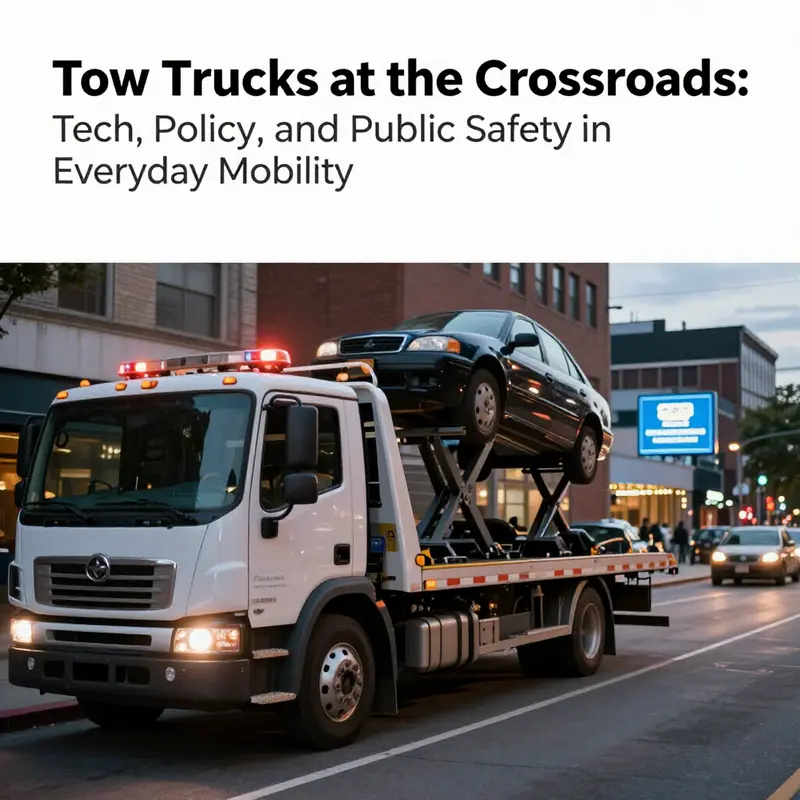
Tow trucks are more than roadside helpers; they are mobile technology hubs that connect drivers to repairs, fleets to compliance, and communities to safer streets. From the visible metal and hydraulics to the sensors and digital networks working behind the scenes, every tow is a choreography of engineering, economics, and public interest. For everyday drivers, the tow truck is a promise of reliability when a car stalls on a busy road; for residents and commuters, it represents orderly traffic management and safety; for truck owners and repair shops, it defines uptime, service quality, and business resilience; for dealerships, it maps part supply and warranty logistics; for property managers, it means access clearances and on-site safety coordination. All these roles hinge on a single, versatile vehicle family that has grown far beyond a simple winch and flatbed.
This article unpacks tow trucks through three interlocking lenses to illuminate how a seemingly straightforward service sits at the intersection of technology, markets, policy, and people. Chapter 1 surveys technological advances that turn tow trucks into data-enabled recovery platforms: hydraulic lifts that operate with precision, remote winches that reach into tight spaces, telematics that monitor usage, and GPS routing that minimizes exposure to risk. The result is faster, safer, and more predictable service for drivers and fleets alike, with tangible benefits for auto repair shops that depend on reliable vehicle handoffs and dealerships that rely on efficient logistics.
Chapter 2 examines the economic, regulatory, and geopolitical dimensions shaping the industry. Costs, insurance, and labor shortages influence how tow operations price and schedule work. Regulations govern safety standards, environmental footprints, and storage practices. Geopolitical dynamics affect the supply chain for critical components, spare parts, and specialized equipment. For property managers and commercial fleets, understanding these forces helps with budgeting, compliance, and long-term planning, ensuring that tow services remain dependable even when markets shift.
Chapter 3 explores the societal impact and public safety initiatives connected to tow operations. Effective towing reduces secondary crashes, clears emergency corridors, and supports first responders during incidents. It also builds community trust through transparent practices, worker safety training, and collaborative campaigns with police, fire, and EMS. By weaving technology, economics, and safety into a coherent picture, readers can appreciate how a tow truck contributes to everyday resilience on roads, in neighborhoods, and across commercial districts.
Together, these chapters reveal a holistic view of a tow truck as a technologically evolving, economically embedded, and socially consequential asset in everyday life.
From Hydraulics to Hyperconnectivity: The Smart Evolution of Tow Trucks
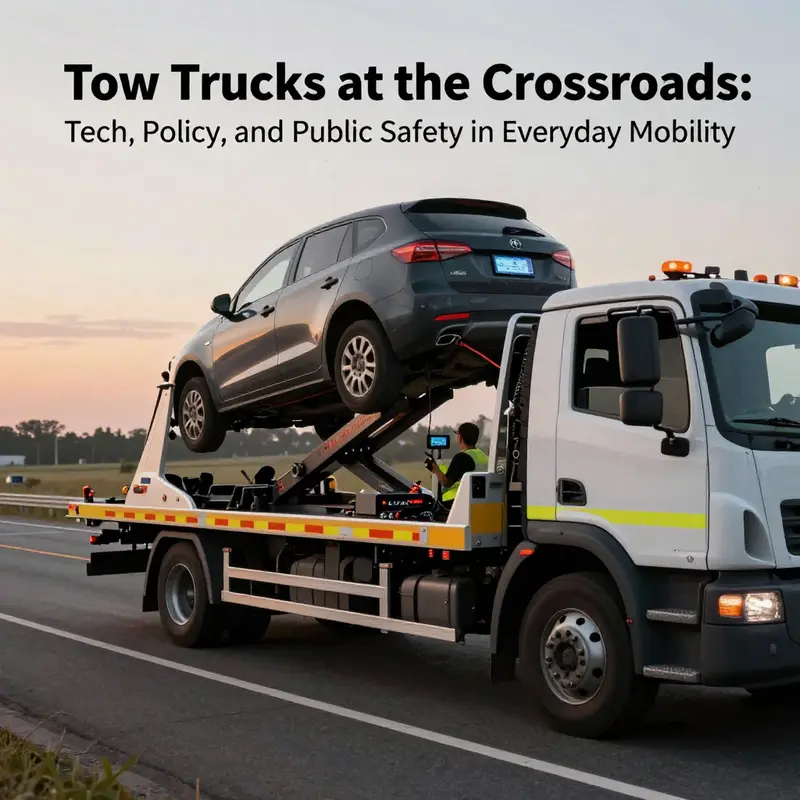
A tow truck does more than haul a broken car. It sits at the interface of roadside safety, crisis management, and mechanical engineering, quietly evolving from a simple mechanical pulling device into a highly integrated, data-driven recovery asset. The arc of its development mirrors a broader shift in vehicle technology: the shift from brute force to precision, from manual wrestling with weight to orchestrated control backed by sensors, hydraulics, and connectivity. In the modern street scene, a tow truck is as much a mobile command center as a recovery vehicle, capable of assessing a scene, selecting the right loading approach, and communicating its status to a dispatch network in real time. The result is not only faster and safer recoveries but a stream of operational data that reshapes how fleets, responders, and shop networks think about vehicle downtime and road safety. The evolution is not a single leap but a layered progression, where each improvement builds on the last, widening the wheelhouse of what tow trucks can do and how they do it.
Hydraulic lifts and flatbed technology sit at the heart of this progression. Early tow devices relied on crude levers and gravity to move a vehicle, but hydraulic systems brought a precision that biological limbs could only envy. A hydraulically actuated bed can tilt, roll, and slide with a level of control that reduces ground contact, minimizes damage to a towed vehicle, and enables loading in constrained spaces. Flatbeds—whether rollback or slide systems—offer a full-vehicle platform that supports the entire payload with balance and restraint. The operator no longer lifts with back and muscle alone; instead, they command a sequence of hydraulically powered motions that place the vehicle on the bed with minimal scrapes, scruffs, or surprises. The bed’s articulation, the bed angle, and the integrated wheel stoppers become parts of a choreography, a careful sequence that guards vulnerable bumpers and undercarriages while preserving tire and wheel integrity. The result is not merely a safer load but a faster one; a modern operator can position a damaged or high-value vehicle with fewer adjustments, fewer repositionings, and less time on a roadside shoulder where danger never sleeps.
A critical decision in the field is choosing between wheel-lift systems and flatbeds. Wheel-lift setups lift one or more wheels off the ground, allowing for compact operations in tight spaces and for mid-weight vehicles where full-bed loading would be unnecessary or inefficient. They excel in situations where rapid mobilization matters more than the conservation of the entire vehicle’s contact with a platform. Flatbeds, by contrast, distribute weight more evenly and provide full-vehicle transport without putting pressure on unnecessarily delicate components. They are typically favored for high-value or low-clearance vehicles, where the risk of damage upon loading is a constant worry or where immobilizing a vehicle in place would otherwise invite further hazards. The practical takeaway for operators and fleets is simple: the choice of configuration should align with the typical recovery profile, the weight distribution of the expected payload, and the terrain most often encountered. Yet even this dichotomy is evolving as hybrid approaches appear and as the line between platform technologies blurs, propelled by smarter controls, better sensors, and more capable hydraulics.
Stability and safety remain indispensable in the modern toolkit. Outriggers and stabilizers anchor a recovering vehicle so that the dynamic loads of winching, winch line tension, and uneven ground do not twist a chassis or tip the unit itself. Load-sensing systems monitor how weight distributes across axles and tires, guiding operators toward safer, more controlled recoveries. Advances in hydraulics—variable-displacement pumps, high-flow circuits, and fail-safe valves—offer smoother operation and shorter cycle times, translating to quicker, more reliable outcomes on busy highways or chaotic accident sites. Ergonomics also matter greatly; cab controls have become more intuitive, with ergonomically organized layouts that reduce operator strain and improve precision. In practice, this means the operator can engage a winch, set a bed angle, and stabilize the vehicle with a few well-placed commands, while still maintaining a clear, focused awareness of the scene. All these features converge to strengthen a single objective: reducing risk for the crew, the vehicle, and the traveling public.
The story grows richer with the addition of GPS, telematics, and fleet optimization. Real-time location data enables dispatch centers to triage efficiently, allocating the nearest available unit to the scene and providing more accurate ETAs to callers. Beyond mere location, telematics bring a pulse to the fleet: fuel usage, engine health, hydraulic pressures, and battery status render a digital portrait of each asset. Predictive maintenance becomes a practical reality rather than a theoretical ideal, as wear patterns in winches, tethers, and hydraulic lines are monitored and flagged before a breakdown interrupts service. The operational implications are profound: with better visibility into vehicle health and dynamic routing capabilities, fleets can reduce downtime, improve response times, and extend the life of heavy-duty equipment. The road becomes a networked environment where every recovery contributes data that improves the next response, a feedback loop that rewards proactive maintenance and smarter dispatch decisions.
Remote winching adds another layer of safety and precision. Operators can control winch inputs from a distance, or from vantage points that keep them out of the line of potential danger. Cameras, sensors, and interlocks provide a layered safety net: line tension indicators prevent sudden snaps, proximity sensing avoids entanglement with obstacles, and interlocks ensure that approaching personnel are out of the danger zone before operations continue. Remote operation is not about replacing human judgment but about extending it—giving responders more control in complex recoveries, such as uneven terrain, steep grades, or delicate impound situations. The ability to adjust tension, speed, and anchor points with calculated restraint reduces the risk of secondary injuries and material damage while maintaining a decisive tempo. In such moments, the tow truck transforms from a single-purpose machine into a controlled instrument of recovery, capable of navigating the gray zones of on-scene risk with more precision than ever before.
The integration of tow trucks with broader vehicle systems and services marks a decisive shift toward a connected ecosystem. Telematics feeds into dispatch workflows, allowing for more accurate triage and faster resource allocation. Digital logs capture winch settings, loading criteria, and recovery steps that support safety audits and accountability. Asset management systems monitor wear across components, triggering maintenance workflows that precede failures. This digital infrastructure does not replace the craft and expertise of the operator; it augments it, providing data-driven guidance that helps crews optimize every recovery, document best practices, and demonstrate compliance with evolving safety standards. As fleets become more connected, the role of the tow operator expands as well. The driver becomes not only a skilled mechanic but also a data-informed decision-maker who can read sensor readouts, interpret telemetry dashboards, and translate that information into safer, more efficient on-scene actions.
The currents of industry trends push toward IoT integration and, with time, a greater embrace of automation and intelligent assistive tools. Sensors proliferate across hydraulics, tethers, wheels, and chassis, feeding a cloud-based analytic layer that supports predictive maintenance, safety compliance, and performance benchmarking. The aim is not to displace skilled operators but to elevate their capabilities, offering real-time guidance that reduces guesswork in the field. Safety-centric design becomes a non-negotiable standard, reflecting the understanding that roadside recoveries are among the most hazardous tasks on public roads. Interlocks, automatic brake checks, and enhanced visibility features reduce exposure to traffic and other hazards. The same motifs—sensor networks, diagnostics, and system interoperability—mirror developments in adjacent heavy equipment sectors, from cranes to industrial vehicles, creating a convergence that accelerates learning and best-practice diffusion across industries.
Practically, these advances reshape the economics and logistics of towing operations. Investment decisions no longer hinge solely on purchase price but on total cost of ownership, including maintenance, downtime, and the value of faster, safer recoveries. Fleets weigh the marginal benefits of remote operations, more robust wheel-lift or flatbed configurations, and smarter bed controls against the upfront capital outlay and ongoing training needs. Training becomes continuous rather than episodic, because new software interfaces, diagnostic tools, and remote-control protocols require ongoing education. The human factor remains central: technicians must interpret data, troubleshoot sensors, and adapt to evolving workflows while preserving the core craft of vehicle recovery. When viewed through this lens, the tow truck emerges as a hybrid of old-school mechanical prowess and modern digital stewardship—a vehicle that carries both a chassis-level competence and a data-driven mindset.
For readers curious about the market and investment dynamics surrounding tow-truck capabilities, consider how much the equipment itself factors into what a fleet can responsibly promise customers. The question of price encapsulates a broader truth: the best investments are those that translate into safer scenes, faster response times, and longer vehicle life. If you want a practical starting point for these considerations, you can explore contemporary discussions about tow-truck pricing and related costs, which illuminate how technology choices interact with financing, maintenance, and risk governance. How much is a tow truck? This line of inquiry points to a broader narrative about the value of modernized recovery capability in a world where every second and every centimeter of safety counts.
The chapter concludes not with a hard stop but with an invitation to see the tow truck as a moving intersection where hydraulics, sensors, and human judgment meet. The vehicle’s evolution—from the predictable snap of a rope to the measured precision of a remote-controlled winching system—reflects a broader commitment to safer roadways, faster incident clearance, and more reliable, data-informed service delivery. The road remains unpredictable, and emergencies will continue to demand rapid, careful action. Yet the tools around the tow truck are creating a steadier baseline of safety and efficiency, turning what used to be improvised recovery into a disciplined, repeatable process. As technology continues to advance, the tow truck will keep pushing the boundary of what is possible in roadside assistance, not by replacing the human touch but by enhancing it, and not by erasing risk but by managing it with greater foresight and control.
External resource: For broader context on public-facing safety and response dynamics in emergency vehicle operations, see the BBC report on emergency responses and road safety practices. BBC coverage on emergency response and safety
Tow at the Crossroads: Economic Pressures, Regulatory Reform, and Global Currents Shaping Roadside Recovery
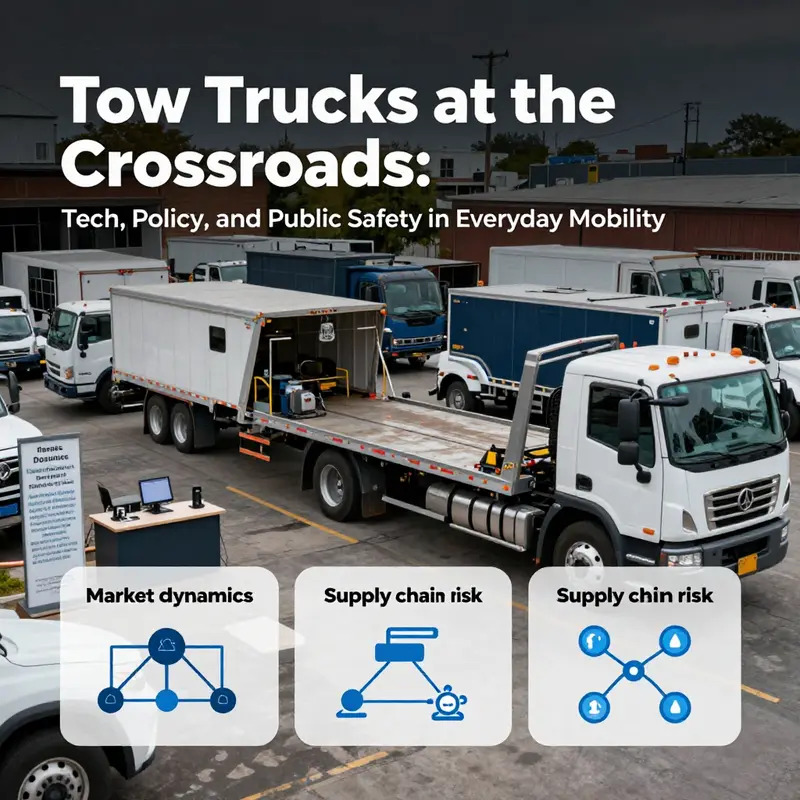
The tow truck, a vehicle whose purpose is quiet and utilitarian, sits at a curious junction where money, law, and global events intersect with the everyday drama of the road. Its work is far more than the mechanical act of pulling a car onto a flatbed or wrapping a hook around a damaged bumper. It is an enterprise built on expensive equipment, evolving safety standards, regulatory oversight, and the volatile rhythms of global markets. In the United States, the industry operates within a dense ecosystem of costs, incentives, and mandates that together determine which operators survive, which strategies flourish, and how quickly fleets can be modernized to meet public expectations about safety and reliability. To understand the present and to anticipate where roadside recovery will head, one must trace how economic forces, regulatory design, and geopolitical undercurrents push and pull the industry in sometimes parallel, sometimes competing directions.
Economically, towing is a capital-intensive line of work that demands substantial upfront investment and ongoing expenditure. Fleet owners contend with the twin pressures of rising operating costs and constrained pricing power. Fuel costs, insurance premiums, depreciation, maintenance, and the cost of specialized equipment all compete for a slice of a relatively predictable, if not ballooning, expense ledger. For smaller and mid-sized operators, these financial pressures are especially acute. They lack the same scale advantages enjoyed by larger players, making procurement decisions a high-stakes exercise. When every run may involve roping in a single truck that can tow, lift, or haul a disabled vehicle, the economics of asset utilization become a central question: how to balance availability, response time, and maintenance with the need to keep debt service and monthly costs manageable. The market rewards reliability, but reliability costs money, and that tension is visible in every fleet choice from the age of the trucks to the size of the crew and the hours of operation.
This economic tension is mitigated, in part, by demand patterns tied to road safety and accident response. In dense urban areas, tow operators are especially busy during peak periods and after severe weather events, when incidents accumulate with little warning and the ability to mobilize quickly becomes a public safety matter. In rural zones, demand may be steadier but less frenetic, testing the endurance of smaller fleets that must juggle maintenance cycles with long travel times and the costs of travel to remote incident sites. The industry thus relies on a mix of scheduling discipline, geographic coverage, and fleet resilience. As demand clusters around incident hotspots—where accidents tend to occur and where law enforcement collaborates with private operators to manage traffic flow—the economics of coverage become more complex. Operators must decide whether to deploy a lean, high-turnover model or invest in larger, multi-vehicle units capable of rapid response and heavy-duty lifting. Either path requires careful attention to the cost of equipment that can meet evolving expectations for safety and efficiency.
Of course, technology is not merely a driver of safety; it is a lever for efficiency that can dampen some of the financial pressures by reducing downtime and improving job acceptance rates. Modern tow trucks increasingly come with hydraulic lifts, remote-controlled winches, and telematics that optimize routes, monitor vehicle health, and provide real-time location data to dispatch centers. Telematics can lower maintenance costs by predicting failures before they disrupt service and can sharpen business models through data-driven pricing, insurance discounts, and risk management. Yet the adoption of such technologies is itself a financial decision—one that weighs upfront capex against long-run savings and improved service levels. In the regionally diversified landscape of the United States, where costs and regulations vary by state and municipality, the decision to upgrade fleets is not merely a matter of best practices; it is a strategic calculation with consequences for competitiveness and survivability in lean years.
Regulatory dynamics inject a different kind of pressure into the industry’s economic calculus. A landmark shift occurred on 7 November 2022, when new federal standards began to govern the licensing and technical requirements for tow trucks. The intent behind these updates was multi-fold: to enhance road safety, to reduce environmental impact, and to standardize the equipment used at roadside recoveries so that responders can work with greater predictability across jurisdictions. For operators, the rule change signaled a clear need to modernize fleets. Older vehicles, once adequate for basic towing, now faced more stringent safety features, better braking systems, improved visibility, standardized emergency lighting, and perhaps more sophisticated braking and stabilization mechanisms. The cost of compliance—upgrading or replacing aging fleets—pushed some operators to accelerate capital expenditure, while for others, it intensified the pressure to form partnerships or join larger networks that could spread the burden of compliance costs across a broader base. The SBDC Blog’s discussion of these new regulations provides a practical outline of what operators must embrace to stay licensed and insured in a landscape that increasingly rewards consistency and safety over marginal gains in speed or convenience.
Regulatory reform does not exist in a vacuum. It interacts with a broader policy architecture that shapes how drivers, passengers, and motorists experience roadside assistance. Standardized safety features can reduce the risk of injury to responders and to the public, but standards also influence the speed at which fleets can be refreshed and scaled. In the wake of updated rules, some operators are compelled to redesign maintenance programs, retrain staff, and reconfigure dispatch protocols to align with new safety expectations. The regulatory push also interacts with environmental considerations. As jurisdictions pursue lower emissions and cleaner fleets, compliance becomes a potential source of competitive differentiation. A modern tow truck with efficient engines and advanced braking systems can be not just a safer option but a more economical one over the vehicle’s lifetime due to reduced fuel consumption and longer component life. The regulatory environment, then, becomes a market signal about which technologies deserve prioritization and which business practices deserve support. The result is a cycle: regulation raises the bar, which increases capital needs, which can prompt consolidation or migration toward scalable models, which in turn influences how local governments structure their emergency-response capabilities and how insurers price risk.
Geopolitical factors—globally driven supply chains, trade policies, and energy dynamics—add another layer of complexity. The components that keep tow fleets operational—advanced electronics, steel, tires, hydraulics, and braking systems—are subject to the same global tugs that affect other heavy industries. When tensions rise or production lines stall, procurement delays and price volatility follow. For operators trying to forecast maintenance budgets and fleet renewal timetables, geopolitical developments can be as consequential as domestic wage trends or regional labor markets. Energy policy, too, matters in an indirect but meaningful way. Decisions about energy independence, fuel pricing, and the availability of refined products influence day-to-day operating costs. In scenarios where fuel costs spike, dispatch algorithms and pricing models may need to adjust to preserve margins without undermining service reliability. The interconnectedness of these global currents with the local and regional realities of towing underscores a central theme: the tow industry is both a passenger on and a co-driver of wider economic and political forces.
The interplay of these factors—cost pressures, regulatory upgrades, and geopolitical dynamics—also shapes how operators think about training and workforce development. The push toward safer, more standardized operations requires skilled technicians who understand modern hydraulics, electronics, and vehicle diagnostics. It requires dispatchers who can interpret real-time data, foresee potential bottlenecks, and manage risk in high-stress recovery scenarios. Training frameworks, therefore, become strategic assets. They slow the immediate cost burden but yield longer-term dividends in efficiency, safety, and customer trust. In this sense, the industry’s response to regulation and market pressure is not merely to comply with the letter of the law or to chase lower prices. It is to cultivate a culture of readiness, reliability, and continuous improvement that can absorb shocks—whether a sudden fuel spike, a regulatory tightening, or a supply-chain disruption caused by a geopolitical incident.
In looking ahead, the practical implications for operators hinge on how they balance asset intensity with service intensity. Those who invest in flexible fleets, modular configurations, and interoperable safety features stand a better chance of adapting to shifting regulatory criteria and price environments. They can optimize turnaround times, improve incident capture rates, and reduce downtime between calls. These advantages compound over time, as better data integration informs strategic decisions about fleet size, geographic coverage, and maintenance scheduling. Yet the path to modernization is not evenly shared. The smallest operators, already contending with thin margins, may struggle to finance upgrades without external support or collaborative models that spread risk and cost. Policymakers and industry bodies, recognizing the public benefit of a robust roadside-recovery network, may consider incentives or shared-resource arrangements that enable broader access to modern, compliant equipment. Such arrangements could help mitigate the disparities that currently exist and ensure that essential services—especially during emergencies—are not a function of market heft alone.
Within this evolving mosaic, one practical question remains at the heart of business strategy: how to price services in a way that sustains investment while remaining fair to customers and consistent with the regulatory environment. Pricing is not simply a reflection of labor and parts. It is a negotiation among contract terms, risk, insurance, and the cost of compliance. It is also a forward-looking signal to the market about whether operators will continue to invest in the technology and training that safety and efficiency demand. For readers seeking a direct lens on this dimension, the industry discussions around costs and pricing provide a concrete window into how operators translate macroeconomic and regulatory realities into daily business decisions. See the discussion on tow-truck costs and pricing for a detailed exploration of how these factors play out in practice: tow-truck-costs-pricing.
As this chapter situates itself at the intersection of market forces, policy choices, and global currents, it also nods toward the broader ecosystem in which tow services operate. The relationship with law enforcement, municipal authorities, and highway safety programs matters. Police and traffic agencies frequently rely on tow operators to clear blocked lanes, secure accident scenes, and transport vehicles involved in investigations or impoundment. The timing and manner in which these collaborations occur can influence both workload and risk. In turn, the financial health of towing firms affects their capacity to respond to surge events, such as major accidents or natural disasters, where the demand for fast, safe, and legally compliant recovery becomes critical to public safety and traffic resilience. The chapter’s argument is not that regulation or geopolitics alone determine outcomes, but that their influence is felt through the price of equipment, the speed of fleet renewal, the availability of trained personnel, and the reliability of the service that communities rely on every day.
In sum, the tow truck industry embodies a dynamic equilibrium among cost discipline, safety imperatives, and external shocks. It is a field where capital intensity meets public service, where compliance carries a price but also a promise of safer roads. The economic realities of running a tilt- or wheel-lift-equipped vehicle compete with the regulatory push for higher standards and the geopolitical ripples that shape supply lines and fuel markets. Operators who read these currents well can craft business models that weather cycles, while still maintaining the flexibility to respond quickly when a driver’s car breaks down on a crowded highway or when a scene demands urgent, coordinated action. This synthesis of market, policy, and world affairs forms the backbone of the tow truck industry’s present and sets the trajectory for its future, linking the everyday work of roadside recovery to the broader forces that steer modern transportation and public safety alike.
External reference: https://www.bbc.co.uk/news/uk-england-47385697
Tow Trucks, Public Safety, and the Roadway Commons
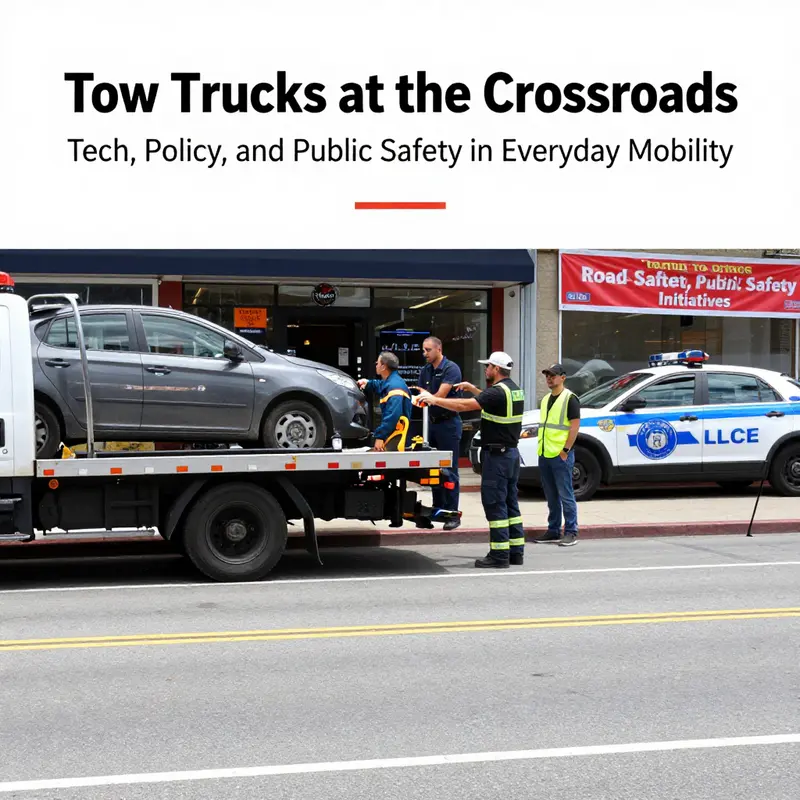
In cities and along highways, tow trucks are visible yet quiet stewards of mobility. They arrive at incidents to restore movement, reduce risk, and support an orderly public space. This chapter explores the role of towing as a public safety function, how transparency in practice—such as dashcams and standardized procedures—builds trust, and why consistent training and regulatory oversight matter for drivers, pedestrians, and responders. By examining the intersection of policy, technology, and field work, we see towing as a civic service that links individual incidents to a broader commitment to safe, accessible transportation. From dispatch to cleanup, every step in the tow operation carries implications for accountability, efficiency, and the public good. The goal is a system where tow operators are seen not only as service providers, but as guardians of public safety and orderly urban life.
Final thoughts
Tow trucks sit at the crossroads of engineering excellence, policy craft, and public service. Technological advances push recovery work toward greater safety and efficiency; economic and regulatory frameworks shape costs, access to parts, and fleet viability; and public safety initiatives embed towing within a broader commitment to road users. For everyday drivers, residents, commuters, truck owners, auto repair shops, dealerships, and property managers, this integrated view offers practical takeaways: expect smarter dispatch and safer recoveries, plan around regulatory cycles and parts supply, and engage with tow partners as allies in safety and uptime. The future points toward increasingly connected fleets, standardized best practices, and closer coordination among law enforcement, municipalities, and private operators. In the end, the tow truck remains a critical enabler of mobility — not a nuisance to be endured, but a trusted partner in keeping traffic moving, repairs progressing, and communities safe.